
Zero Point Energy: Difference between revisions
Created page with " <nowiki>**</nowiki>Zero-point energy** (**ZPE**) is the lowest possible [energy](<nowiki>https://en.wikipedia.org/wiki/Energy</nowiki> "Energy") that a [quantum mechanical](<nowiki>https://en.wikipedia.org/wiki/Quantum_mechanical</nowiki> "Quantum mechanical") system may have. Unlike in [classical mechanics](<nowiki>https://en.wikipedia.org/wiki/Classical_mechanics</nowiki> "Classical mechanics"), quantum systems constantly [fluctuate](<nowiki>https://en.wikipedia.org/..." |
No edit summary |
||
| Line 1: | Line 1: | ||
<nowiki>**</nowiki>Zero-point energy** (**ZPE**) is the lowest possible [energy](<nowiki>https://en.wikipedia.org/wiki/Energy</nowiki> "Energy") that a [quantum mechanical](<nowiki>https://en.wikipedia.org/wiki/Quantum_mechanical</nowiki> "Quantum mechanical") system may have. Unlike in [classical mechanics](<nowiki>https://en.wikipedia.org/wiki/Classical_mechanics</nowiki> "Classical mechanics"), quantum systems constantly [fluctuate](<nowiki>https://en.wikipedia.org/wiki/Quantum_fluctuation</nowiki> "Quantum fluctuation") in their lowest energy state as described by the [Heisenberg uncertainty principle](<nowiki>https://en.wikipedia.org/wiki/Heisenberg_uncertainty_principle</nowiki> "Heisenberg uncertainty principle").<nowiki><sup id="cite_ref-FOOTNOTESciama1991137_1-0"><a href="https://en.wikipedia.org/wiki/Zero-point_energy#cite_note-FOOTNOTESciama1991137-1">[1]</a></nowiki><nowiki></sup></nowiki> Therefore, even at [absolute zero](<nowiki>https://en.wikipedia.org/wiki/Absolute_zero</nowiki> "Absolute zero"), atoms and molecules retain some vibrational motion. Apart from [atoms](<nowiki>https://en.wikipedia.org/wiki/Atom</nowiki> "Atom") and [molecules](<nowiki>https://en.wikipedia.org/wiki/Molecule</nowiki> "Molecule"), the empty space of [the vacuum](<nowiki>https://en.wikipedia.org/wiki/Vacuum_state</nowiki> "Vacuum state") also has these properties. According to [quantum field theory](<nowiki>https://en.wikipedia.org/wiki/Quantum_field_theory</nowiki> "Quantum field theory"), the universe can be thought of not as isolated particles but continuous fluctuating [fields](<nowiki>https://en.wikipedia.org/wiki/Field_(physics)</nowiki> "Field (physics)"): [matter](<nowiki>https://en.wikipedia.org/wiki/Matter</nowiki> "Matter") fields, whose [quanta](<nowiki>https://en.wikipedia.org/wiki/Quantum</nowiki> "Quantum") are [fermions](<nowiki>https://en.wikipedia.org/wiki/Fermions</nowiki> "Fermions") (i.e., [leptons](<nowiki>https://en.wikipedia.org/wiki/Lepton</nowiki> "Lepton") and [quarks](<nowiki>https://en.wikipedia.org/wiki/Quark</nowiki> "Quark")), and [force fields](<nowiki>https://en.wikipedia.org/wiki/Force_field_(physics)</nowiki> "Force field (physics)"), whose quanta are [bosons](<nowiki>https://en.wikipedia.org/wiki/Boson</nowiki> "Boson") (e.g., [photons](<nowiki>https://en.wikipedia.org/wiki/Photon</nowiki> "Photon") and [gluons](<nowiki>https://en.wikipedia.org/wiki/Gluon</nowiki> "Gluon")). All these fields have zero-point energy.<nowiki><sup id="cite_ref-FOOTNOTEMilonni199435_2-0"><a href="https://en.wikipedia.org/wiki/Zero-point_energy#cite_note-FOOTNOTEMilonni199435-2">[2]</a></nowiki><nowiki></sup></nowiki> These fluctuating zero-point fields lead to a kind of reintroduction of an [aether](<nowiki>https://en.wikipedia.org/wiki/Luminiferous_aether</nowiki> "Luminiferous aether") in physics<nowiki><sup id="cite_ref-FOOTNOTESciama1991137_1-1"><a href="https://en.wikipedia.org/wiki/Zero-point_energy#cite_note-FOOTNOTESciama1991137-1">[1]</a></nowiki><nowiki></sup></nowiki><nowiki><sup id="cite_ref-FOOTNOTEDavies2011_3-0"><a href="https://en.wikipedia.org/wiki/Zero-point_energy#cite_note-FOOTNOTEDavies2011-3">[3]</a></nowiki><nowiki></sup></nowiki> since some systems can detect the existence of this energy. However, this aether cannot be thought of as a physical medium if it is to be [Lorentz invariant](<nowiki>https://en.wikipedia.org/wiki/Lorentz_invariant</nowiki> "Lorentz invariant") such that there is no contradiction with [Einstein's](<nowiki>https://en.wikipedia.org/wiki/Albert_Einstein</nowiki> "Albert Einstein") theory of [special relativity](<nowiki>https://en.wikipedia.org/wiki/Special_relativity</nowiki> "Special relativity").<nowiki><sup id="cite_ref-FOOTNOTESciama1991137_1-2"><a href="https://en.wikipedia.org/wiki/Zero-point_energy#cite_note-FOOTNOTESciama1991137-1">[1]</a></nowiki><nowiki></sup></nowiki> | <nowiki>**</nowiki>Zero-point energy** (**[[ZPE]]**) is the lowest possible [energy](<nowiki>https://en.wikipedia.org/wiki/Energy</nowiki> "Energy") that a [quantum mechanical](<nowiki>https://en.wikipedia.org/wiki/Quantum_mechanical</nowiki> "Quantum mechanical") system may have. Unlike in [classical mechanics](<nowiki>https://en.wikipedia.org/wiki/Classical_mechanics</nowiki> "Classical mechanics"), quantum systems constantly [fluctuate](<nowiki>https://en.wikipedia.org/wiki/Quantum_fluctuation</nowiki> "Quantum fluctuation") in their lowest energy state as described by the [Heisenberg uncertainty principle](<nowiki>https://en.wikipedia.org/wiki/Heisenberg_uncertainty_principle</nowiki> "Heisenberg uncertainty principle").<nowiki><sup id="cite_ref-FOOTNOTESciama1991137_1-0"><a href="https://en.wikipedia.org/wiki/Zero-point_energy#cite_note-FOOTNOTESciama1991137-1">[1]</a></nowiki><nowiki></sup></nowiki> Therefore, even at [absolute zero](<nowiki>https://en.wikipedia.org/wiki/Absolute_zero</nowiki> "Absolute zero"), atoms and molecules retain some vibrational motion. Apart from [atoms](<nowiki>https://en.wikipedia.org/wiki/Atom</nowiki> "Atom") and [molecules](<nowiki>https://en.wikipedia.org/wiki/Molecule</nowiki> "Molecule"), the empty space of [the vacuum](<nowiki>https://en.wikipedia.org/wiki/Vacuum_state</nowiki> "Vacuum state") also has these properties. According to [quantum field theory](<nowiki>https://en.wikipedia.org/wiki/Quantum_field_theory</nowiki> "Quantum field theory"), the universe can be thought of not as isolated particles but continuous fluctuating [fields](<nowiki>https://en.wikipedia.org/wiki/Field_(physics)</nowiki> "Field (physics)"): [matter](<nowiki>https://en.wikipedia.org/wiki/Matter</nowiki> "Matter") fields, whose [quanta](<nowiki>https://en.wikipedia.org/wiki/Quantum</nowiki> "Quantum") are [fermions](<nowiki>https://en.wikipedia.org/wiki/Fermions</nowiki> "Fermions") (i.e., [leptons](<nowiki>https://en.wikipedia.org/wiki/Lepton</nowiki> "Lepton") and [quarks](<nowiki>https://en.wikipedia.org/wiki/Quark</nowiki> "Quark")), and [force fields](<nowiki>https://en.wikipedia.org/wiki/Force_field_(physics)</nowiki> "Force field (physics)"), whose quanta are [bosons](<nowiki>https://en.wikipedia.org/wiki/Boson</nowiki> "Boson") (e.g., [photons](<nowiki>https://en.wikipedia.org/wiki/Photon</nowiki> "Photon") and [gluons](<nowiki>https://en.wikipedia.org/wiki/Gluon</nowiki> "Gluon")). All these fields have zero-point energy.<nowiki><sup id="cite_ref-FOOTNOTEMilonni199435_2-0"><a href="https://en.wikipedia.org/wiki/Zero-point_energy#cite_note-FOOTNOTEMilonni199435-2">[2]</a></nowiki><nowiki></sup></nowiki> These fluctuating zero-point fields lead to a kind of reintroduction of an [aether](<nowiki>https://en.wikipedia.org/wiki/Luminiferous_aether</nowiki> "Luminiferous aether") in physics<nowiki><sup id="cite_ref-FOOTNOTESciama1991137_1-1"><a href="https://en.wikipedia.org/wiki/Zero-point_energy#cite_note-FOOTNOTESciama1991137-1">[1]</a></nowiki><nowiki></sup></nowiki><nowiki><sup id="cite_ref-FOOTNOTEDavies2011_3-0"><a href="https://en.wikipedia.org/wiki/Zero-point_energy#cite_note-FOOTNOTEDavies2011-3">[3]</a></nowiki><nowiki></sup></nowiki> since some systems can detect the existence of this energy. However, this aether cannot be thought of as a physical medium if it is to be [Lorentz invariant](<nowiki>https://en.wikipedia.org/wiki/Lorentz_invariant</nowiki> "Lorentz invariant") such that there is no contradiction with [Einstein's](<nowiki>https://en.wikipedia.org/wiki/Albert_Einstein</nowiki> "Albert Einstein") theory of [special relativity](<nowiki>https://en.wikipedia.org/wiki/Special_relativity</nowiki> "Special relativity").<nowiki><sup id="cite_ref-FOOTNOTESciama1991137_1-2"><a href="https://en.wikipedia.org/wiki/Zero-point_energy#cite_note-FOOTNOTESciama1991137-1">[1]</a></nowiki><nowiki></sup></nowiki> | ||
The notion of a zero-point energy is also important for [cosmology](<nowiki>https://en.wikipedia.org/wiki/Cosmology</nowiki> "Cosmology"), and physics currently lacks a full theoretical model for understanding zero-point energy in this context; in particular, the discrepancy between theorized and observed vacuum energy in the universe is a source of major contention.<nowiki><sup id="cite_ref-4"><a href="https://en.wikipedia.org/wiki/Zero-point_energy#cite_note-4">[4]</a></nowiki><nowiki></sup></nowiki> Physicists [Richard Feynman](<nowiki>https://en.wikipedia.org/wiki/Richard_Feynman</nowiki> "Richard Feynman") and [John Wheeler](<nowiki>https://en.wikipedia.org/wiki/John_Archibald_Wheeler</nowiki> "John Archibald Wheeler") calculated the zero-point radiation of the vacuum to be an order of magnitude greater than [nuclear energy](<nowiki>https://en.wikipedia.org/wiki/Atomic_energy</nowiki> "Atomic energy"), with a single light bulb containing enough energy to boil all the world's oceans.<nowiki><sup id="cite_ref-FOOTNOTEPilkington2003_5-0"><a href="https://en.wikipedia.org/wiki/Zero-point_energy#cite_note-FOOTNOTEPilkington2003-5">[5]</a></nowiki><nowiki></sup></nowiki> Yet according to Einstein's theory of [general relativity](<nowiki>https://en.wikipedia.org/wiki/General_relativity</nowiki> "General relativity"), any such energy would gravitate, and the experimental evidence from the [expansion of the universe](<nowiki>https://en.wikipedia.org/wiki/Expansion_of_the_universe</nowiki> "Expansion of the universe"), [dark energy](<nowiki>https://en.wikipedia.org/wiki/Dark_energy</nowiki> "Dark energy") and the [Casimir effect](<nowiki>https://en.wikipedia.org/wiki/Casimir_effect</nowiki> "Casimir effect") shows any such energy to be exceptionally weak. A popular proposal that attempts to address this issue is to say that the [fermion field](<nowiki>https://en.wikipedia.org/wiki/Fermion_field</nowiki> "Fermion field") has a negative zero-point energy, while the [boson field](<nowiki>https://en.wikipedia.org/wiki/Boson_field</nowiki> "Boson field") has positive zero-point energy and thus these energies somehow cancel each other out.<nowiki><sup id="cite_ref-FOOTNOTEWeinberg2015376_6-0"><a href="https://en.wikipedia.org/wiki/Zero-point_energy#cite_note-FOOTNOTEWeinberg2015376-6">[6]</a></nowiki><nowiki></sup></nowiki><nowiki><sup id="cite_ref-FOOTNOTESciama1991138_7-0"><a href="https://en.wikipedia.org/wiki/Zero-point_energy#cite_note-FOOTNOTESciama1991138-7">[7]</a></nowiki><nowiki></sup></nowiki> This idea would be true if [supersymmetry](<nowiki>https://en.wikipedia.org/wiki/Supersymmetry</nowiki> "Supersymmetry") were an exact [symmetry of nature](<nowiki>https://en.wikipedia.org/wiki/Symmetry_(physics)</nowiki> "Symmetry (physics)"); however, the [LHC](<nowiki>https://en.wikipedia.org/wiki/LHC</nowiki> "LHC") at [CERN](<nowiki>https://en.wikipedia.org/wiki/CERN</nowiki> "CERN") has so far found no evidence to support it. Moreover, it is known that if supersymmetry is valid at all, it is at most a [broken symmetry](<nowiki>https://en.wikipedia.org/wiki/Symmetry_breaking</nowiki> "Symmetry breaking"), only true at very high energies, and no one has been able to show a theory where zero-point cancellations occur in the low-energy universe we observe today.<nowiki><sup id="cite_ref-FOOTNOTESciama1991138_7-1"><a href="https://en.wikipedia.org/wiki/Zero-point_energy#cite_note-FOOTNOTESciama1991138-7">[7]</a></nowiki><nowiki></sup></nowiki> This discrepancy is known as the [cosmological constant problem](<nowiki>https://en.wikipedia.org/wiki/Cosmological_constant_problem</nowiki> "Cosmological constant problem") and it is one of the greatest [unsolved mysteries in physics](<nowiki>https://en.wikipedia.org/wiki/List_of_unsolved_problems_in_physics</nowiki> "List of unsolved problems in physics"). Many physicists believe that "the vacuum holds the key to a full understanding of nature".<nowiki><sup id="cite_ref-FOOTNOTEDavies1985104_8-0"><a href="https://en.wikipedia.org/wiki/Zero-point_energy#cite_note-FOOTNOTEDavies1985104-8">[8]</a></nowiki><nowiki></sup></nowiki> | The notion of a zero-point energy is also important for [cosmology](<nowiki>https://en.wikipedia.org/wiki/Cosmology</nowiki> "Cosmology"), and physics currently lacks a full theoretical model for understanding zero-point energy in this context; in particular, the discrepancy between theorized and observed vacuum energy in the universe is a source of major contention.<nowiki><sup id="cite_ref-4"><a href="https://en.wikipedia.org/wiki/Zero-point_energy#cite_note-4">[4]</a></nowiki><nowiki></sup></nowiki> Physicists [Richard Feynman](<nowiki>https://en.wikipedia.org/wiki/Richard_Feynman</nowiki> "Richard Feynman") and [John Wheeler](<nowiki>https://en.wikipedia.org/wiki/John_Archibald_Wheeler</nowiki> "John Archibald Wheeler") calculated the zero-point radiation of the vacuum to be an order of magnitude greater than [nuclear energy](<nowiki>https://en.wikipedia.org/wiki/Atomic_energy</nowiki> "Atomic energy"), with a single light bulb containing enough energy to boil all the world's oceans.<nowiki><sup id="cite_ref-FOOTNOTEPilkington2003_5-0"><a href="https://en.wikipedia.org/wiki/Zero-point_energy#cite_note-FOOTNOTEPilkington2003-5">[5]</a></nowiki><nowiki></sup></nowiki> Yet according to Einstein's theory of [general relativity](<nowiki>https://en.wikipedia.org/wiki/General_relativity</nowiki> "General relativity"), any such energy would gravitate, and the experimental evidence from the [expansion of the universe](<nowiki>https://en.wikipedia.org/wiki/Expansion_of_the_universe</nowiki> "Expansion of the universe"), [dark energy](<nowiki>https://en.wikipedia.org/wiki/Dark_energy</nowiki> "Dark energy") and the [Casimir effect](<nowiki>https://en.wikipedia.org/wiki/Casimir_effect</nowiki> "Casimir effect") shows any such energy to be exceptionally weak. A popular proposal that attempts to address this issue is to say that the [fermion field](<nowiki>https://en.wikipedia.org/wiki/Fermion_field</nowiki> "Fermion field") has a negative zero-point energy, while the [boson field](<nowiki>https://en.wikipedia.org/wiki/Boson_field</nowiki> "Boson field") has positive zero-point energy and thus these energies somehow cancel each other out.<nowiki><sup id="cite_ref-FOOTNOTEWeinberg2015376_6-0"><a href="https://en.wikipedia.org/wiki/Zero-point_energy#cite_note-FOOTNOTEWeinberg2015376-6">[6]</a></nowiki><nowiki></sup></nowiki><nowiki><sup id="cite_ref-FOOTNOTESciama1991138_7-0"><a href="https://en.wikipedia.org/wiki/Zero-point_energy#cite_note-FOOTNOTESciama1991138-7">[7]</a></nowiki><nowiki></sup></nowiki> This idea would be true if [supersymmetry](<nowiki>https://en.wikipedia.org/wiki/Supersymmetry</nowiki> "Supersymmetry") were an exact [symmetry of nature](<nowiki>https://en.wikipedia.org/wiki/Symmetry_(physics)</nowiki> "Symmetry (physics)"); however, the [LHC](<nowiki>https://en.wikipedia.org/wiki/LHC</nowiki> "LHC") at [CERN](<nowiki>https://en.wikipedia.org/wiki/CERN</nowiki> "CERN") has so far found no evidence to support it. Moreover, it is known that if supersymmetry is valid at all, it is at most a [broken symmetry](<nowiki>https://en.wikipedia.org/wiki/Symmetry_breaking</nowiki> "Symmetry breaking"), only true at very high energies, and no one has been able to show a theory where zero-point cancellations occur in the low-energy universe we observe today.<nowiki><sup id="cite_ref-FOOTNOTESciama1991138_7-1"><a href="https://en.wikipedia.org/wiki/Zero-point_energy#cite_note-FOOTNOTESciama1991138-7">[7]</a></nowiki><nowiki></sup></nowiki> This discrepancy is known as the [cosmological constant problem](<nowiki>https://en.wikipedia.org/wiki/Cosmological_constant_problem</nowiki> "Cosmological constant problem") and it is one of the greatest [unsolved mysteries in physics](<nowiki>https://en.wikipedia.org/wiki/List_of_unsolved_problems_in_physics</nowiki> "List of unsolved problems in physics"). Many physicists believe that "the vacuum holds the key to a full understanding of nature".<nowiki><sup id="cite_ref-FOOTNOTEDavies1985104_8-0"><a href="https://en.wikipedia.org/wiki/Zero-point_energy#cite_note-FOOTNOTEDavies1985104-8">[8]</a></nowiki><nowiki></sup></nowiki> | ||
Latest revision as of 20:44, 25 December 2022
**Zero-point energy** (**ZPE**) is the lowest possible [energy](https://en.wikipedia.org/wiki/Energy "Energy") that a [quantum mechanical](https://en.wikipedia.org/wiki/Quantum_mechanical "Quantum mechanical") system may have. Unlike in [classical mechanics](https://en.wikipedia.org/wiki/Classical_mechanics "Classical mechanics"), quantum systems constantly [fluctuate](https://en.wikipedia.org/wiki/Quantum_fluctuation "Quantum fluctuation") in their lowest energy state as described by the [Heisenberg uncertainty principle](https://en.wikipedia.org/wiki/Heisenberg_uncertainty_principle "Heisenberg uncertainty principle").<sup id="cite_ref-FOOTNOTESciama1991137_1-0"><a href="https://en.wikipedia.org/wiki/Zero-point_energy#cite_note-FOOTNOTESciama1991137-1">[1]</a></sup> Therefore, even at [absolute zero](https://en.wikipedia.org/wiki/Absolute_zero "Absolute zero"), atoms and molecules retain some vibrational motion. Apart from [atoms](https://en.wikipedia.org/wiki/Atom "Atom") and [molecules](https://en.wikipedia.org/wiki/Molecule "Molecule"), the empty space of [the vacuum](https://en.wikipedia.org/wiki/Vacuum_state "Vacuum state") also has these properties. According to [quantum field theory](https://en.wikipedia.org/wiki/Quantum_field_theory "Quantum field theory"), the universe can be thought of not as isolated particles but continuous fluctuating [fields](https://en.wikipedia.org/wiki/Field_(physics) "Field (physics)"): [matter](https://en.wikipedia.org/wiki/Matter "Matter") fields, whose [quanta](https://en.wikipedia.org/wiki/Quantum "Quantum") are [fermions](https://en.wikipedia.org/wiki/Fermions "Fermions") (i.e., [leptons](https://en.wikipedia.org/wiki/Lepton "Lepton") and [quarks](https://en.wikipedia.org/wiki/Quark "Quark")), and [force fields](https://en.wikipedia.org/wiki/Force_field_(physics) "Force field (physics)"), whose quanta are [bosons](https://en.wikipedia.org/wiki/Boson "Boson") (e.g., [photons](https://en.wikipedia.org/wiki/Photon "Photon") and [gluons](https://en.wikipedia.org/wiki/Gluon "Gluon")). All these fields have zero-point energy.<sup id="cite_ref-FOOTNOTEMilonni199435_2-0"><a href="https://en.wikipedia.org/wiki/Zero-point_energy#cite_note-FOOTNOTEMilonni199435-2">[2]</a></sup> These fluctuating zero-point fields lead to a kind of reintroduction of an [aether](https://en.wikipedia.org/wiki/Luminiferous_aether "Luminiferous aether") in physics<sup id="cite_ref-FOOTNOTESciama1991137_1-1"><a href="https://en.wikipedia.org/wiki/Zero-point_energy#cite_note-FOOTNOTESciama1991137-1">[1]</a></sup><sup id="cite_ref-FOOTNOTEDavies2011_3-0"><a href="https://en.wikipedia.org/wiki/Zero-point_energy#cite_note-FOOTNOTEDavies2011-3">[3]</a></sup> since some systems can detect the existence of this energy. However, this aether cannot be thought of as a physical medium if it is to be [Lorentz invariant](https://en.wikipedia.org/wiki/Lorentz_invariant "Lorentz invariant") such that there is no contradiction with [Einstein's](https://en.wikipedia.org/wiki/Albert_Einstein "Albert Einstein") theory of [special relativity](https://en.wikipedia.org/wiki/Special_relativity "Special relativity").<sup id="cite_ref-FOOTNOTESciama1991137_1-2"><a href="https://en.wikipedia.org/wiki/Zero-point_energy#cite_note-FOOTNOTESciama1991137-1">[1]</a></sup>
The notion of a zero-point energy is also important for [cosmology](https://en.wikipedia.org/wiki/Cosmology "Cosmology"), and physics currently lacks a full theoretical model for understanding zero-point energy in this context; in particular, the discrepancy between theorized and observed vacuum energy in the universe is a source of major contention.<sup id="cite_ref-4"><a href="https://en.wikipedia.org/wiki/Zero-point_energy#cite_note-4">[4]</a></sup> Physicists [Richard Feynman](https://en.wikipedia.org/wiki/Richard_Feynman "Richard Feynman") and [John Wheeler](https://en.wikipedia.org/wiki/John_Archibald_Wheeler "John Archibald Wheeler") calculated the zero-point radiation of the vacuum to be an order of magnitude greater than [nuclear energy](https://en.wikipedia.org/wiki/Atomic_energy "Atomic energy"), with a single light bulb containing enough energy to boil all the world's oceans.<sup id="cite_ref-FOOTNOTEPilkington2003_5-0"><a href="https://en.wikipedia.org/wiki/Zero-point_energy#cite_note-FOOTNOTEPilkington2003-5">[5]</a></sup> Yet according to Einstein's theory of [general relativity](https://en.wikipedia.org/wiki/General_relativity "General relativity"), any such energy would gravitate, and the experimental evidence from the [expansion of the universe](https://en.wikipedia.org/wiki/Expansion_of_the_universe "Expansion of the universe"), [dark energy](https://en.wikipedia.org/wiki/Dark_energy "Dark energy") and the [Casimir effect](https://en.wikipedia.org/wiki/Casimir_effect "Casimir effect") shows any such energy to be exceptionally weak. A popular proposal that attempts to address this issue is to say that the [fermion field](https://en.wikipedia.org/wiki/Fermion_field "Fermion field") has a negative zero-point energy, while the [boson field](https://en.wikipedia.org/wiki/Boson_field "Boson field") has positive zero-point energy and thus these energies somehow cancel each other out.<sup id="cite_ref-FOOTNOTEWeinberg2015376_6-0"><a href="https://en.wikipedia.org/wiki/Zero-point_energy#cite_note-FOOTNOTEWeinberg2015376-6">[6]</a></sup><sup id="cite_ref-FOOTNOTESciama1991138_7-0"><a href="https://en.wikipedia.org/wiki/Zero-point_energy#cite_note-FOOTNOTESciama1991138-7">[7]</a></sup> This idea would be true if [supersymmetry](https://en.wikipedia.org/wiki/Supersymmetry "Supersymmetry") were an exact [symmetry of nature](https://en.wikipedia.org/wiki/Symmetry_(physics) "Symmetry (physics)"); however, the [LHC](https://en.wikipedia.org/wiki/LHC "LHC") at [CERN](https://en.wikipedia.org/wiki/CERN "CERN") has so far found no evidence to support it. Moreover, it is known that if supersymmetry is valid at all, it is at most a [broken symmetry](https://en.wikipedia.org/wiki/Symmetry_breaking "Symmetry breaking"), only true at very high energies, and no one has been able to show a theory where zero-point cancellations occur in the low-energy universe we observe today.<sup id="cite_ref-FOOTNOTESciama1991138_7-1"><a href="https://en.wikipedia.org/wiki/Zero-point_energy#cite_note-FOOTNOTESciama1991138-7">[7]</a></sup> This discrepancy is known as the [cosmological constant problem](https://en.wikipedia.org/wiki/Cosmological_constant_problem "Cosmological constant problem") and it is one of the greatest [unsolved mysteries in physics](https://en.wikipedia.org/wiki/List_of_unsolved_problems_in_physics "List of unsolved problems in physics"). Many physicists believe that "the vacuum holds the key to a full understanding of nature".<sup id="cite_ref-FOOTNOTEDavies1985104_8-0"><a href="https://en.wikipedia.org/wiki/Zero-point_energy#cite_note-FOOTNOTEDavies1985104-8">[8]</a></sup>
## Etymology and terminology\[[edit](https://en.wikipedia.org/w/index.php?title=Zero-point_energy&action=edit§ion=1 "Edit section: Etymology and terminology")\]
The term **zero-point energy (ZPE)** [is a translation](https://en.wikipedia.org/wiki/Calque "Calque") from the German **Nullpunktsenergie.**<sup id="cite_ref-FOOTNOTEEinstein1995270–285_9-0"><a href="https://en.wikipedia.org/wiki/Zero-point_energy#cite_note-FOOTNOTEEinstein1995270%E2%80%93285-9">[9]</a></sup> Sometimes used interchangeably with it are the terms **zero-point radiation** and **ground state energy**. The term **zero-point field** (**ZPF**) can be used when referring to a specific vacuum field, for instance the [QED vacuum](https://en.wikipedia.org/wiki/QED_vacuum "QED vacuum") which specifically deals with [quantum electrodynamics](https://en.wikipedia.org/wiki/Quantum_electrodynamics "Quantum electrodynamics") (e.g., electromagnetic interactions between photons, electrons and the vacuum) or the [QCD vacuum](https://en.wikipedia.org/wiki/QCD_vacuum "QCD vacuum") which deals with [quantum chromodynamics](https://en.wikipedia.org/wiki/Quantum_chromodynamics "Quantum chromodynamics") (e.g., [color charge](https://en.wikipedia.org/wiki/Color_charge "Color charge") interactions between quarks, gluons and the vacuum). A vacuum can be viewed not as empty space but as the combination of all zero-point fields. In [quantum field theory](https://en.wikipedia.org/wiki/Quantum_field_theory "Quantum field theory") this combination of fields is called the [vacuum state](https://en.wikipedia.org/wiki/Vacuum_state "Vacuum state"), its associated zero-point energy is called the [vacuum energy](https://en.wikipedia.org/wiki/Vacuum_energy "Vacuum energy") and the average energy value is called the [vacuum expectation value](https://en.wikipedia.org/wiki/Vacuum_expectation_value "Vacuum expectation value") (VEV) also called its **condensate**.
## Overview\[[edit](https://en.wikipedia.org/w/index.php?title=Zero-point_energy&action=edit§ion=2 "Edit section: Overview")\]
[](https://en.wikipedia.org/wiki/File:Zero-point_energy_v.s._motion.jpg)
Kinetic energy vs temperature
In [classical mechanics](https://en.wikipedia.org/wiki/Classical_mechanics "Classical mechanics") all [particles](https://en.wikipedia.org/wiki/Particle "Particle") can be thought of as having some [energy](https://en.wikipedia.org/wiki/Energy "Energy") made up of their [potential energy](https://en.wikipedia.org/wiki/Potential_energy "Potential energy") and [kinetic energy](https://en.wikipedia.org/wiki/Kinetic_energy "Kinetic energy"). [Temperature](https://en.wikipedia.org/wiki/Temperature "Temperature"), for example, arises from the intensity of random particle motion caused by kinetic energy (known as [Brownian motion](https://en.wikipedia.org/wiki/Brownian_motion "Brownian motion")). As temperature is reduced to [absolute zero](https://en.wikipedia.org/wiki/Absolute_zero "Absolute zero"), it might be thought that all motion ceases and particles come completely to rest. In fact, however, kinetic energy is retained by particles even at the lowest possible temperature. The random motion corresponding to this zero-point energy never vanishes; it is a consequence of the [uncertainty principle](https://en.wikipedia.org/wiki/Uncertainty_principle "Uncertainty principle") of [quantum mechanics](https://en.wikipedia.org/wiki/Quantum_mechanics "Quantum mechanics").
[](https://en.wikipedia.org/wiki/File:Zero-point_energy_of_harmonic_oscillator.svg)
Zero-point radiation continually imparts random impulses on an [electron](https://en.wikipedia.org/wiki/Electron "Electron"), so that it never comes to a complete stop. Zero-point radiation gives the [oscillator](https://en.wikipedia.org/wiki/Harmonic_oscillator "Harmonic oscillator") an average energy equal to the frequency of oscillation multiplied by one-half of [Planck's constant](https://en.wikipedia.org/wiki/Planck_constant "Planck constant").
The uncertainty principle states that no object can ever have precise values of position and velocity simultaneously. The total energy of a quantum mechanical object (potential and kinetic) is described by its [Hamiltonian](https://en.wikipedia.org/wiki/Hamiltonian_(quantum_mechanics) "Hamiltonian (quantum mechanics)") which also describes the system as a harmonic oscillator, or [wave function](https://en.wikipedia.org/wiki/Wave_function "Wave function"), that fluctuates between various energy states (see [wave-particle duality](https://en.wikipedia.org/wiki/Wave-particle_duality "Wave-particle duality")). All quantum mechanical systems undergo fluctuations even in their ground state, a consequence of their [wave](https://en.wikipedia.org/wiki/Wave "Wave")\-like nature. The uncertainty principle requires every quantum mechanical system to have a fluctuating zero-point energy greater than the minimum of its classical [potential well](https://en.wikipedia.org/wiki/Potential_well "Potential well"). This results in motion even at [absolute zero](https://en.wikipedia.org/wiki/Absolute_zero "Absolute zero"). For example, [liquid helium](https://en.wikipedia.org/wiki/Liquid_helium "Liquid helium") does not freeze under atmospheric pressure regardless of temperature due to its zero-point energy.
Given the equivalence of mass and energy expressed by [Albert Einstein](https://en.wikipedia.org/wiki/Albert_Einstein "Albert Einstein")'s [_E_ = _mc_<sup>2</sup>](https://en.wikipedia.org/wiki/E_%3D_mc2 "E = mc2"), any point in [space](https://en.wikipedia.org/wiki/Spacetime "Spacetime") that contains energy can be thought of as having mass to create particles. [Virtual particles](https://en.wikipedia.org/wiki/Virtual_particles "Virtual particles") spontaneously flash into existence at every point in space due to the energy of [quantum fluctuations](https://en.wikipedia.org/wiki/Quantum_fluctuations "Quantum fluctuations") caused by the uncertainty principle. Modern physics has developed [quantum field theory](https://en.wikipedia.org/wiki/Quantum_field_theory "Quantum field theory") (QFT) to understand the fundamental interactions between matter and forces, it treats every single point of space as a [quantum harmonic oscillator](https://en.wikipedia.org/wiki/Harmonic_oscillator_(quantum) "Harmonic oscillator (quantum)"). According to QFT the universe is made up of matter fields, whose [quanta](https://en.wikipedia.org/wiki/Quantum "Quantum") are [fermions](https://en.wikipedia.org/wiki/Fermions "Fermions") (i.e. [leptons](https://en.wikipedia.org/wiki/Lepton "Lepton") and [quarks](https://en.wikipedia.org/wiki/Quark "Quark")), and force fields, whose quanta are [bosons](https://en.wikipedia.org/wiki/Boson "Boson") (e.g. [photons](https://en.wikipedia.org/wiki/Photon "Photon") and [gluons](https://en.wikipedia.org/wiki/Gluon "Gluon")). All these fields have zero-point energy.<sup id="cite_ref-FOOTNOTEMilonni199435_2-1"><a href="https://en.wikipedia.org/wiki/Zero-point_energy#cite_note-FOOTNOTEMilonni199435-2">[2]</a></sup> Recent experiments advocate the idea that particles themselves can be thought of as excited states of the underlying [quantum vacuum](https://en.wikipedia.org/wiki/Quantum_vacuum "Quantum vacuum"), and that all properties of matter are merely vacuum fluctuations arising from interactions of the zero-point field.<sup id="cite_ref-FOOTNOTEBattersby2008_10-0"><a href="https://en.wikipedia.org/wiki/Zero-point_energy#cite_note-FOOTNOTEBattersby2008-10">[10]</a></sup>
The idea that "empty" space can have an intrinsic energy associated to it, and that there is no such thing as a "true vacuum" is seemingly unintuitive. It is often argued that the entire universe is completely bathed in the zero-point radiation, and as such it can add only some constant amount to calculations. Physical measurements will therefore reveal only deviations from this value.<sup id="cite_ref-FOOTNOTEItzyksonZuber1980111_11-0"><a href="https://en.wikipedia.org/wiki/Zero-point_energy#cite_note-FOOTNOTEItzyksonZuber1980111-11">[11]</a></sup> For many practical calculations zero-point energy is dismissed by fiat in the mathematical model as a term that has no physical effect. Such treatment causes problems however, as in Einstein's theory of [general relativity](https://en.wikipedia.org/wiki/General_relativity "General relativity") the absolute energy value of space is not an arbitrary constant and gives rise to the [cosmological constant](https://en.wikipedia.org/wiki/Cosmological_constant "Cosmological constant"). For decades most physicists assumed that there was some undiscovered fundamental principle that will remove the infinite zero-point energy and make it completely vanish. If the vacuum has no intrinsic, absolute value of energy it will not gravitate. It was believed that as the universe expands from the aftermath of the [Big Bang](https://en.wikipedia.org/wiki/Big_Bang "Big Bang"), the energy contained in any unit of empty space will decrease as the total energy spreads out to fill the volume of the universe; [galaxies](https://en.wikipedia.org/wiki/Galaxies "Galaxies") and all matter in the universe should begin to decelerate. This possibility was ruled out in 1998 by the discovery that the expansion of the universe is not slowing down but is in fact accelerating, meaning empty space does indeed have some intrinsic energy. The discovery of [dark energy](https://en.wikipedia.org/wiki/Dark_energy "Dark energy") is best explained by zero-point energy, though it still remains a mystery as to why the value appears to be so small compared to the huge value obtained through theory - the [cosmological constant problem](https://en.wikipedia.org/wiki/Cosmological_constant_problem "Cosmological constant problem").<sup id="cite_ref-FOOTNOTEWeinberg2015376_6-1"><a href="https://en.wikipedia.org/wiki/Zero-point_energy#cite_note-FOOTNOTEWeinberg2015376-6">[6]</a></sup>
Many physical effects attributed to zero-point energy have been experimentally verified, such as [spontaneous emission](https://en.wikipedia.org/wiki/Spontaneous_emission "Spontaneous emission"), [Casimir force](https://en.wikipedia.org/wiki/Casimir_force "Casimir force"), [Lamb shift](https://en.wikipedia.org/wiki/Lamb_shift "Lamb shift"), [magnetic moment of the electron](https://en.wikipedia.org/wiki/Electron_magnetic_moment "Electron magnetic moment") and [Delbrück scattering](https://en.wikipedia.org/wiki/Delbr%C3%BCck_scattering "Delbrück scattering").<sup id="cite_ref-FOOTNOTEMilonni1994111_12-0"><a href="https://en.wikipedia.org/wiki/Zero-point_energy#cite_note-FOOTNOTEMilonni1994111-12">[12]</a></sup><sup id="cite_ref-FOOTNOTEGreinerMüllerRafelski201212_13-0"><a href="https://en.wikipedia.org/wiki/Zero-point_energy#cite_note-FOOTNOTEGreinerM%C3%BCllerRafelski201212-13">[13]</a></sup> These effects are usually called "radiative corrections".<sup id="cite_ref-FOOTNOTEBordag_et_al.20094_14-0"><a href="https://en.wikipedia.org/wiki/Zero-point_energy#cite_note-FOOTNOTEBordag_et_al.20094-14">[14]</a></sup> In more complex nonlinear theories (e.g. QCD) zero-point energy can give rise to a variety of complex phenomena such as [multiple stable states](https://en.wikipedia.org/wiki/Bistability "Bistability"), [symmetry breaking](https://en.wikipedia.org/wiki/Spontaneous_symmetry_breaking "Spontaneous symmetry breaking"), [chaos](https://en.wikipedia.org/wiki/Chaos_theory "Chaos theory") and [emergence](https://en.wikipedia.org/wiki/Emergence "Emergence"). Many physicists believe that "the vacuum holds the key to a full understanding of nature"<sup id="cite_ref-FOOTNOTEDavies1985104_8-1"><a href="https://en.wikipedia.org/wiki/Zero-point_energy#cite_note-FOOTNOTEDavies1985104-8">[8]</a></sup> and that studying it is critical in the search for the [theory of everything](https://en.wikipedia.org/wiki/Theory_of_everything "Theory of everything"). Active areas of research include the effects of virtual particles,<sup id="cite_ref-FOOTNOTECho2015_15-0"><a href="https://en.wikipedia.org/wiki/Zero-point_energy#cite_note-FOOTNOTECho2015-15">[15]</a></sup> [quantum entanglement](https://en.wikipedia.org/wiki/Quantum_entanglement "Quantum entanglement"),<sup id="cite_ref-FOOTNOTEChoi2013_16-0"><a href="https://en.wikipedia.org/wiki/Zero-point_energy#cite_note-FOOTNOTEChoi2013-16">[16]</a></sup> the difference (if any) between [inertial and gravitational mass](https://en.wikipedia.org/wiki/Mass#Inertial_mass "Mass"),<sup id="cite_ref-Haisch_et_al._1994_17-0"><a href="https://en.wikipedia.org/wiki/Zero-point_energy#cite_note-Haisch_et_al._1994-17">[17]</a></sup> variation in the [speed of light](https://en.wikipedia.org/wiki/Speed_of_light "Speed of light"),<sup id="cite_ref-18"><a href="https://en.wikipedia.org/wiki/Zero-point_energy#cite_note-18">[18]</a></sup> a reason for the observed value of the [cosmological constant](https://en.wikipedia.org/wiki/Cosmological_constant "Cosmological constant")<sup id="cite_ref-FOOTNOTERughZinkernagel2002_19-0"><a href="https://en.wikipedia.org/wiki/Zero-point_energy#cite_note-FOOTNOTERughZinkernagel2002-19">[19]</a></sup> and the nature of [dark energy](https://en.wikipedia.org/wiki/Dark_energy "Dark energy").<sup id="cite_ref-Dark_Energy_May_Be_Vacuum_20-0"><a href="https://en.wikipedia.org/wiki/Zero-point_energy#cite_note-Dark_Energy_May_Be_Vacuum-20">[20]</a></sup><sup id="cite_ref-FOOTNOTEWall2014_21-0"><a href="https://en.wikipedia.org/wiki/Zero-point_energy#cite_note-FOOTNOTEWall2014-21">[21]</a></sup>
## History\[[edit](https://en.wikipedia.org/w/index.php?title=Zero-point_energy&action=edit§ion=3 "Edit section: History")\]
### Early aether theories\[[edit](https://en.wikipedia.org/w/index.php?title=Zero-point_energy&action=edit§ion=4 "Edit section: Early aether theories")\]
[](https://en.wikipedia.org/wiki/File:James_Clerk_Maxwell.png)
Zero-point energy evolved from historical ideas about the [vacuum](https://en.wikipedia.org/wiki/Vacuum "Vacuum"). To [Aristotle](https://en.wikipedia.org/wiki/Aristotle "Aristotle") the vacuum was τὸ κενόν, "the empty"; i.e., space independent of body. He believed this concept violated basic physical principles and asserted that [the elements](https://en.wikipedia.org/wiki/Classical_element#Greece "Classical element") of fire, air, earth, and water were not made of atoms, but were continuous. To the [atomists](https://en.wikipedia.org/wiki/Atomists "Atomists") the concept of emptiness had absolute character: it was the distinction between existence and nonexistence.<sup id="cite_ref-FOOTNOTESaundersBrown19911_22-0"><a href="https://en.wikipedia.org/wiki/Zero-point_energy#cite_note-FOOTNOTESaundersBrown19911-22">[22]</a></sup> Debate about the characteristics of the vacuum were largely confined to the realm of [philosophy](https://en.wikipedia.org/wiki/Philosophy "Philosophy"), it was not until much later on with the beginning of [the renaissance](https://en.wikipedia.org/wiki/Renaissance "Renaissance"), that [Otto von Guericke](https://en.wikipedia.org/wiki/Otto_von_Guericke "Otto von Guericke") invented the first vacuum pump and the first testable scientific ideas began to emerge. It was thought that a totally empty volume of space could be created by simply removing all gases. This was the first generally accepted concept of the vacuum.<sup id="cite_ref-FOOTNOTEConlon2011225_23-0"><a href="https://en.wikipedia.org/wiki/Zero-point_energy#cite_note-FOOTNOTEConlon2011225-23">[23]</a></sup>
Late in the 19th century, however, it became apparent that the evacuated region still contained [thermal radiation](https://en.wikipedia.org/wiki/Thermal_radiation "Thermal radiation"). The existence of the [aether](https://en.wikipedia.org/wiki/Luminiferous_aether "Luminiferous aether") as a substitute for a true void was the most prevalent theory of the time. According to the successful [electromagnetic](https://en.wikipedia.org/wiki/Electromagnetism "Electromagnetism") aether theory based upon [Maxwell's](https://en.wikipedia.org/wiki/James_Clerk_Maxwell "James Clerk Maxwell") [electrodynamics](https://en.wikipedia.org/wiki/Electrodynamics "Electrodynamics"), this all-encompassing aether was endowed with energy and hence very different from nothingness. The fact that electromagnetic and gravitational phenomena were easily transmitted in empty space indicated that their associated aethers were part of the fabric of space itself. Maxwell himself noted that:
> To those who maintained the existence of a plenum as a philosophical principle, nature's abhorrence of a vacuum was a sufficient reason for imagining an all-surrounding aether... Aethers were invented for the planets to swim in, to constitute electric atmospheres and magnetic effluvia, to convey sensations from one part of our bodies to another, and so on, till a space had been filled three or four times with aethers.<sup id="cite_ref-FOOTNOTEKraghOverduin20147_24-0"><a href="https://en.wikipedia.org/wiki/Zero-point_energy#cite_note-FOOTNOTEKraghOverduin20147-24">[24]</a></sup>
However, the results of the [Michelson–Morley experiment](https://en.wikipedia.org/wiki/Michelson%E2%80%93Morley_experiment "Michelson–Morley experiment") in 1887 were the first strong evidence that the then-prevalent aether theories were seriously flawed, and initiated a line of research that eventually led to [special relativity](https://en.wikipedia.org/wiki/Special_relativity "Special relativity"), which ruled out the idea of a stationary aether altogether. To scientists of the period, it seemed that a true vacuum in space might be created by cooling and thus eliminating all radiation or energy. From this idea evolved the second concept of achieving a real vacuum: cool a region of space down to [absolute zero](https://en.wikipedia.org/wiki/Absolute_zero "Absolute zero") temperature after evacuation. Absolute zero was technically impossible to achieve in the 19th century, so the debate remained unsolved.
### Second quantum theory\[[edit](https://en.wikipedia.org/w/index.php?title=Zero-point_energy&action=edit§ion=5 "Edit section: Second quantum theory")\]
[](https://en.wikipedia.org/wiki/File:Max_Planck_(Nobel_1918).jpg)
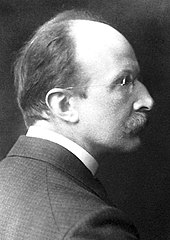
In 1900, [Max Planck](https://en.wikipedia.org/wiki/Max_Planck "Max Planck") derived the average energy ε of a single _energy radiator_, e.g., a vibrating atomic unit, as a function of absolute temperature:<sup id="cite_ref-FOOTNOTEPlanck1900_25-0"><a href="https://en.wikipedia.org/wiki/Zero-point_energy#cite_note-FOOTNOTEPlanck1900-25">[25]</a></sup>
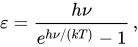
where h is [Planck's constant](https://en.wikipedia.org/wiki/Planck%27s_constant "Planck's constant"), ν is the [frequency](https://en.wikipedia.org/wiki/Frequency "Frequency"), k is the [Boltzmann constant](https://en.wikipedia.org/wiki/Boltzmann_constant "Boltzmann constant"), and T is the absolute [temperature](https://en.wikipedia.org/wiki/Temperature "Temperature"). The zero-point energy makes no contribution to Planck's original law, as its existence was unknown to Planck in 1900.<sup id="cite_ref-FOOTNOTELoudon20009_26-0"><a href="https://en.wikipedia.org/wiki/Zero-point_energy#cite_note-FOOTNOTELoudon20009-26">[26]</a></sup>
The concept of zero-point energy was developed by [Max Planck](https://en.wikipedia.org/wiki/Max_Planck "Max Planck") in Germany in 1911 as a corrective term added to a zero-grounded formula developed in his original quantum theory in 1900.<sup id="cite_ref-FOOTNOTEKragh20127_27-0"><a href="https://en.wikipedia.org/wiki/Zero-point_energy#cite_note-FOOTNOTEKragh20127-27">[27]</a></sup>
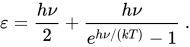
In 1912, Max Planck published the first journal article to describe the discontinuous emission of radiation, based on the discrete quanta of energy.<sup id="cite_ref-FOOTNOTEPlanck1912a_28-0"><a href="https://en.wikipedia.org/wiki/Zero-point_energy#cite_note-FOOTNOTEPlanck1912a-28">[28]</a></sup> In Planck's "second quantum theory" resonators absorbed energy continuously, but emitted energy in discrete energy quanta only when they reached the boundaries of finite cells in phase space, where their energies became integer multiples of _hν_. This theory led Planck to his new radiation law, but in this version energy resonators possessed a zero-point energy, the smallest average energy a resonator could take on. Planck's radiation equation contained a residual energy factor, one _hν_/2, as an additional term dependent on the frequency ν, which was greater than zero (where h is Planck's constant). It is therefore widely agreed that "Planck's equation marked the birth of the concept of zero-point energy."<sup id="cite_ref-FOOTNOTEMilonni199410_29-0"><a href="https://en.wikipedia.org/wiki/Zero-point_energy#cite_note-FOOTNOTEMilonni199410-29">[29]</a></sup> In a series of papers from 1911 to 1913,<sup id="cite_ref-30"><a href="https://en.wikipedia.org/wiki/Zero-point_energy#cite_note-30">[30]</a></sup> Planck found the average energy of an oscillator to be:<sup id="cite_ref-FOOTNOTEKragh20127_27-1"><a href="https://en.wikipedia.org/wiki/Zero-point_energy#cite_note-FOOTNOTEKragh20127-27">[27]</a></sup><sup id="cite_ref-FOOTNOTEKuhn1978235_31-0"><a href="https://en.wikipedia.org/wiki/Zero-point_energy#cite_note-FOOTNOTEKuhn1978235-31">[31]</a></sup>
[](https://en.wikipedia.org/wiki/File:Albert_Einstein_(Nobel).png)
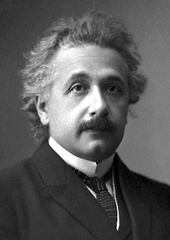
Einstein's official 1921 portrait after receiving the Nobel Prize in Physics
Soon, the idea of zero-point energy attracted the attention of [Albert Einstein](https://en.wikipedia.org/wiki/Albert_Einstein "Albert Einstein") and his assistant [Otto Stern](https://en.wikipedia.org/wiki/Otto_Stern "Otto Stern").<sup id="cite_ref-32"><a href="https://en.wikipedia.org/wiki/Zero-point_energy#cite_note-32">[32]</a></sup> In 1913 they published a paper that attempted to prove the existence of zero-point energy by calculating the specific heat of hydrogen gas and compared it with the experimental data. However, after assuming they had succeeded, they retracted support for the idea shortly after publication because they found Planck's second theory may not apply to their example. In a letter to [Paul Ehrenfest](https://en.wikipedia.org/wiki/Paul_Ehrenfest "Paul Ehrenfest") of the same year Einstein declared zero-point energy "dead as a doornail"<sup id="cite_ref-FOOTNOTEEinstein1993563–565_33-0"><a href="https://en.wikipedia.org/wiki/Zero-point_energy#cite_note-FOOTNOTEEinstein1993563%E2%80%93565-33">[33]</a></sup> Zero-point energy was also invoked by [Peter Debye](https://en.wikipedia.org/wiki/Peter_Debye "Peter Debye"),<sup id="cite_ref-34"><a href="https://en.wikipedia.org/wiki/Zero-point_energy#cite_note-34">[34]</a></sup> who noted that zero-point energy of the atoms of a [crystal lattice](https://en.wikipedia.org/wiki/Crystal_lattice "Crystal lattice") would cause a reduction in the intensity of the diffracted radiation in [X-ray diffraction](https://en.wikipedia.org/wiki/X-ray_diffraction "X-ray diffraction") even as the temperature approached absolute zero. In 1916 [Walther Nernst](https://en.wikipedia.org/wiki/Walther_Nernst "Walther Nernst") proposed that empty space was filled with zero-point [electromagnetic radiation](https://en.wikipedia.org/wiki/Electromagnetic_radiation "Electromagnetic radiation").<sup id="cite_ref-35"><a href="https://en.wikipedia.org/wiki/Zero-point_energy#cite_note-35">[35]</a></sup> With the development of [general relativity](https://en.wikipedia.org/wiki/General_relativity "General relativity") Einstein found the energy density of the vacuum to contribute towards a [cosmological constant](https://en.wikipedia.org/wiki/Cosmological_constant "Cosmological constant") in order to obtain static solutions to his field equations; the idea that empty space, or the vacuum, could have some intrinsic energy associated to it had returned, with Einstein stating in 1920:
> There is a weighty argument to be adduced in favour of the aether hypothesis. To deny the aether is ultimately to assume that empty space has no physical qualities whatever. The fundamental facts of mechanics do not harmonize with this view... according to the general theory of relativity space is endowed with physical qualities; in this sense, therefore, there exists an aether. According to the general theory of relativity space without aether is unthinkable; for in such space there not only would be no propagation of light, but also no possibility of existence for standards of space and time (measuring-rods and clocks), nor therefore any space-time intervals in the physical sense. But this aether may not be thought of as endowed with the quality characteristic of ponderable media, as consisting of parts which may be tracked through time. The idea of motion may not be applied to it.<sup id="cite_ref-36"><a href="https://en.wikipedia.org/wiki/Zero-point_energy#cite_note-36">[36]</a></sup><sup id="cite_ref-37"><a href="https://en.wikipedia.org/wiki/Zero-point_energy#cite_note-37">[37]</a></sup>
[](https://en.wikipedia.org/wiki/File:Heisenberg,Werner_1924_G%C3%B6ttingen_-_adjusted.jpeg)
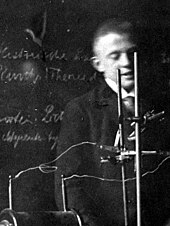
[Kurt Bennewitz](https://de.wikipedia.org/wiki/Kurt_Bennewitz_(chemist) "de:Kurt Bennewitz (chemist)") and [Francis Simon](https://en.wikipedia.org/wiki/Francis_Simon "Francis Simon") (1923)<sup id="cite_ref-38"><a href="https://en.wikipedia.org/wiki/Zero-point_energy#cite_note-38">[38]</a></sup> who worked at [Walther Nernst](https://en.wikipedia.org/wiki/Walther_Nernst "Walther Nernst")'s laboratory in Berlin, studied the melting process of chemicals at low temperatures. Their calculations of the melting points of [hydrogen](https://en.wikipedia.org/wiki/Hydrogen "Hydrogen"), [argon](https://en.wikipedia.org/wiki/Argon "Argon") and [mercury](https://en.wikipedia.org/wiki/Mercury_(element) "Mercury (element)") led them to conclude that the results provided evidence for a zero-point energy. Moreover, they suggested correctly, as was later verified by Simon (1934),<sup id="cite_ref-39"><a href="https://en.wikipedia.org/wiki/Zero-point_energy#cite_note-39">[39]</a></sup><sup id="cite_ref-40"><a href="https://en.wikipedia.org/wiki/Zero-point_energy#cite_note-40">[40]</a></sup> that this quantity was responsible for the difficulty in solidifying helium even at absolute zero. In 1924 [Robert Mulliken](https://en.wikipedia.org/wiki/Robert_S._Mulliken "Robert S. Mulliken")<sup id="cite_ref-41"><a href="https://en.wikipedia.org/wiki/Zero-point_energy#cite_note-41">[41]</a></sup> provided direct evidence for the zero-point energy of molecular vibrations by comparing the band spectrum of <sup>10</sup>BO and <sup>11</sup>BO: the isotopic difference in the transition frequencies between the ground vibrational states of two different electronic levels would vanish if there were no zero-point energy, in contrast to the observed spectra. Then just a year later in 1925,<sup id="cite_ref-42"><a href="https://en.wikipedia.org/wiki/Zero-point_energy#cite_note-42">[42]</a></sup> with the development of [matrix mechanics](https://en.wikipedia.org/wiki/Matrix_mechanics "Matrix mechanics") in [Werner Heisenberg](https://en.wikipedia.org/wiki/Werner_Heisenberg "Werner Heisenberg")'s famous article "[Quantum theoretical re-interpretation of kinematic and mechanical relations](https://en.wikipedia.org/wiki/Quantum_theoretical_re-interpretation_of_kinematic_and_mechanical_relations "Quantum theoretical re-interpretation of kinematic and mechanical relations")" the zero-point energy was derived from quantum mechanics.<sup id="cite_ref-FOOTNOTEKragh2002162_43-0"><a href="https://en.wikipedia.org/wiki/Zero-point_energy#cite_note-FOOTNOTEKragh2002162-43">[43]</a></sup>
In 1913 [Niels Bohr](https://en.wikipedia.org/wiki/Niels_Bohr "Niels Bohr") had proposed what is now called the [Bohr model](https://en.wikipedia.org/wiki/Bohr_model "Bohr model") of the atom,<sup id="cite_ref-44"><a href="https://en.wikipedia.org/wiki/Zero-point_energy#cite_note-44">[44]</a></sup><sup id="cite_ref-45"><a href="https://en.wikipedia.org/wiki/Zero-point_energy#cite_note-45">[45]</a></sup><sup id="cite_ref-46"><a href="https://en.wikipedia.org/wiki/Zero-point_energy#cite_note-46">[46]</a></sup> but despite this it remained a mystery as to why electrons do not fall into their nuclei. According to classical ideas, the fact that an accelerating charge loses energy by radiating implied that an electron should spiral into the nucleus and that atoms should not be stable. This problem of classical mechanics was nicely summarized by [James Hopwood Jeans](https://en.wikipedia.org/wiki/James_Hopwood_Jeans "James Hopwood Jeans") in 1915: "There would be a very real difficulty in supposing that the (force) law 1/_r_<sup>2</sup> held down to the zero values of r. For the forces between two charges at zero distance would be infinite; we should have charges of opposite sign continually rushing together and, when once together, no force would tend to shrink into nothing or to diminish indefinitely in size."<sup id="cite_ref-47"><a href="https://en.wikipedia.org/wiki/Zero-point_energy#cite_note-47">[47]</a></sup> The resolution to this puzzle came in 1926 with [Schrödinger's](https://en.wikipedia.org/wiki/Erwin_Schr%C3%B6dinger "Erwin Schrödinger") [famous equation](https://en.wikipedia.org/wiki/Schr%C3%B6dinger_equation "Schrödinger equation").<sup id="cite_ref-48"><a href="https://en.wikipedia.org/wiki/Zero-point_energy#cite_note-48">[48]</a></sup> This equation explained the new, non-classical fact that an electron confined to be close to a nucleus would necessarily have a large kinetic energy so that the minimum total energy (kinetic plus potential) actually occurs at some positive separation rather than at zero separation; in other words, zero-point energy is essential for atomic stability.<sup id="cite_ref-49"><a href="https://en.wikipedia.org/wiki/Zero-point_energy#cite_note-49">[49]</a></sup>
### Quantum field theory and beyond\[[edit](https://en.wikipedia.org/w/index.php?title=Zero-point_energy&action=edit§ion=6 "Edit section: Quantum field theory and beyond")\]
In 1926 [Pascual Jordan](https://en.wikipedia.org/wiki/Pascual_Jordan "Pascual Jordan")<sup id="cite_ref-50"><a href="https://en.wikipedia.org/wiki/Zero-point_energy#cite_note-50">[50]</a></sup> published the first attempt to quantize the electromagnetic field. In a joint paper with [Max Born](https://en.wikipedia.org/wiki/Max_Born "Max Born") and [Werner Heisenberg](https://en.wikipedia.org/wiki/Werner_Heisenberg "Werner Heisenberg") he considered the field inside a cavity as a superposition of quantum harmonic oscillators. In his calculation he found that in addition to the "thermal energy" of the oscillators there also had to exist an infinite zero-point energy term. He was able to obtain the same fluctuation formula that Einstein had obtained in 1909.<sup id="cite_ref-51"><a href="https://en.wikipedia.org/wiki/Zero-point_energy#cite_note-51">[51]</a></sup> However, Jordan did not think that his infinite zero-point energy term was "real", writing to Einstein that "it is just a quantity of the calculation having no direct physical meaning".<sup id="cite_ref-52"><a href="https://en.wikipedia.org/wiki/Zero-point_energy#cite_note-52">[52]</a></sup> Jordan found a way to get rid of the infinite term, publishing a joint work with Pauli in 1928,<sup id="cite_ref-53"><a href="https://en.wikipedia.org/wiki/Zero-point_energy#cite_note-53">[53]</a></sup> performing what has been called "the first infinite subtraction, or renormalisation, in quantum field theory".<sup id="cite_ref-54"><a href="https://en.wikipedia.org/wiki/Zero-point_energy#cite_note-54">[54]</a></sup>
[](https://en.wikipedia.org/wiki/File:Paul_Dirac,_1933.jpg)
Building on the work of Heisenberg and others [Paul Dirac](https://en.wikipedia.org/wiki/Paul_Dirac "Paul Dirac")'s theory of emission and absorption (1927)<sup id="cite_ref-FOOTNOTEDirac1927_55-0"><a href="https://en.wikipedia.org/wiki/Zero-point_energy#cite_note-FOOTNOTEDirac1927-55">[55]</a></sup> was the first application of the quantum theory of radiation. Dirac's work was seen as crucially important to the emerging field of quantum mechanics; it dealt directly with the process in which "particles" are actually created: [spontaneous emission](https://en.wikipedia.org/wiki/Spontaneous_emission "Spontaneous emission").<sup id="cite_ref-56"><a href="https://en.wikipedia.org/wiki/Zero-point_energy#cite_note-56">[56]</a></sup> Dirac described the quantization of the [electromagnetic field](https://en.wikipedia.org/wiki/Electromagnetic_field "Electromagnetic field") as an ensemble of [harmonic oscillators](https://en.wikipedia.org/wiki/Quantum_harmonic_oscillator "Quantum harmonic oscillator") with the introduction of the concept of [creation and annihilation operators](https://en.wikipedia.org/wiki/Creation_and_annihilation_operators "Creation and annihilation operators") of particles. The theory showed that spontaneous emission depends upon the zero-point energy fluctuations of the electromagnetic field in order to get started.<sup id="cite_ref-Yokoyama,_57-0"><a href="https://en.wikipedia.org/wiki/Zero-point_energy#cite_note-Yokoyama,-57">[57]</a></sup><sup id="cite_ref-FOOTNOTEScullyZubairy1997[httpsbooksgooglecombooksid20ISsQCKKmQCpgPA22_§1.5.2_pp._22–23]_58-0"><a href="https://en.wikipedia.org/wiki/Zero-point_energy#cite_note-FOOTNOTEScullyZubairy1997[httpsbooksgooglecombooksid20ISsQCKKmQCpgPA22_%C2%A71.5.2_pp._22%E2%80%9323]-58">[58]</a></sup> In a process in which a photon is annihilated (absorbed), the photon can be thought of as making a transition into the vacuum state. Similarly, when a photon is created (emitted), it is occasionally useful to imagine that the photon has made a transition out of the vacuum state. In the words of Dirac:<sup id="cite_ref-FOOTNOTEDirac1927_55-1"><a href="https://en.wikipedia.org/wiki/Zero-point_energy#cite_note-FOOTNOTEDirac1927-55">[55]</a></sup>
> The light-quantum has the peculiarity that it apparently ceases to exist when it is in one of its stationary states, namely, the zero state, in which its momentum and therefore also its energy, are zero. When a light-quantum is absorbed it can be considered to jump into this zero state, and when one is emitted it can be considered to jump from the zero state to one in which it is physically in evidence, so that it appears to have been created. Since there is no limit to the number of light-quanta that may be created in this way, we must suppose that there are an infinite number of light quanta in the zero state...
Contemporary physicists, when asked to give a physical explanation for spontaneous emission, generally invoke the zero-point energy of the electromagnetic field. This view was popularized by [Victor Weisskopf](https://en.wikipedia.org/wiki/Victor_Weisskopf "Victor Weisskopf") who in 1935 wrote:<sup id="cite_ref-59"><a href="https://en.wikipedia.org/wiki/Zero-point_energy#cite_note-59">[59]</a></sup>
> From quantum theory there follows the existence of so called zero-point oscillations; for example each oscillator in its lowest is not completely at rest but always is moving about its equilibrium position. Therefore electromagnetic oscillations also can never cease completely. Thus the quantum nature of the electromagnetic field has as its consequence zero point oscillations of the field strength in the lowest energy state, in which there are no light quanta in space... The zero point oscillations act on an electron in the same way as ordinary electrical oscillations do. They can change the eigenstate of the electron, but only in a transition to a state with the lowest energy, since empty space can only take away energy, and not give it up. In this way spontaneous radiation arises as a consequence of the existence of these unique field strengths corresponding to zero point oscillations. Thus spontaneous radiation is induced radiation of light quanta produced by zero point oscillations of empty space
This view was also later supported by [Theodore Welton](https://de.wikipedia.org/wiki/Theodore_Welton "de:Theodore Welton") (1948),<sup id="cite_ref-60"><a href="https://en.wikipedia.org/wiki/Zero-point_energy#cite_note-60">[60]</a></sup> who argued that spontaneous emission "can be thought of as forced emission taking place under the action of the fluctuating field." This new theory, which Dirac coined [quantum electrodynamics](https://en.wikipedia.org/wiki/Quantum_electrodynamics "Quantum electrodynamics") (QED) predicted a fluctuating zero-point or "vacuum" field existing even in the absence of sources.
Throughout the 1940s improvements in [microwave](https://en.wikipedia.org/wiki/Microwave "Microwave") technology made it possible to take more precise measurements of the shift of the levels of a [hydrogen atom](https://en.wikipedia.org/wiki/Hydrogen_atom "Hydrogen atom"), now known as the [Lamb shift](https://en.wikipedia.org/wiki/Lamb_shift "Lamb shift"),<sup id="cite_ref-lamb_61-0"><a href="https://en.wikipedia.org/wiki/Zero-point_energy#cite_note-lamb-61">[61]</a></sup> and measurement of the [magnetic moment](https://en.wikipedia.org/wiki/Magnetic_moment "Magnetic moment") of the electron.<sup id="cite_ref-foley_62-0"><a href="https://en.wikipedia.org/wiki/Zero-point_energy#cite_note-foley-62">[62]</a></sup> Discrepancies between these experiments and Dirac's theory led to the idea of incorporating [renormalisation](https://en.wikipedia.org/wiki/Renormalisation "Renormalisation") into QED to deal with zero-point infinities. Renormalization was originally developed by [Hans Kramers](https://en.wikipedia.org/wiki/Hans_Kramers "Hans Kramers")<sup id="cite_ref-63"><a href="https://en.wikipedia.org/wiki/Zero-point_energy#cite_note-63">[63]</a></sup> and also [Victor Weisskopf](https://en.wikipedia.org/wiki/Victor_Weisskopf "Victor Weisskopf") (1936),<sup id="cite_ref-FOOTNOTEWeisskopf19366_64-0"><a href="https://en.wikipedia.org/wiki/Zero-point_energy#cite_note-FOOTNOTEWeisskopf19366-64">[64]</a></sup> and first successfully applied to calculate a finite value for the Lamb shift by [Hans Bethe](https://en.wikipedia.org/wiki/Hans_Bethe "Hans Bethe") (1947).<sup id="cite_ref-65"><a href="https://en.wikipedia.org/wiki/Zero-point_energy#cite_note-65">[65]</a></sup> As per spontaneous emission, these effects can in part be understood with interactions with the zero-point field.<sup id="cite_ref-FOOTNOTEPower196435_66-0"><a href="https://en.wikipedia.org/wiki/Zero-point_energy#cite_note-FOOTNOTEPower196435-66">[66]</a></sup><sup id="cite_ref-FOOTNOTEMilonni1994111_12-1"><a href="https://en.wikipedia.org/wiki/Zero-point_energy#cite_note-FOOTNOTEMilonni1994111-12">[12]</a></sup> But in light of renormalisation being able to remove some zero-point infinities from calculations, not all physicists were comfortable attributing zero-point energy any physical meaning, viewing it instead as a mathematical artifact that might one day be fully eliminated. In [Wolfgang Pauli](https://en.wikipedia.org/wiki/Wolfgang_Pauli "Wolfgang Pauli")'s 1945 [Nobel lecture](https://en.wikipedia.org/wiki/Nobel_lecture "Nobel lecture")<sup id="cite_ref-67"><a href="https://en.wikipedia.org/wiki/Zero-point_energy#cite_note-67">[67]</a></sup> he made clear his opposition to the idea of zero-point energy stating "It is clear that this zero-point energy has no physical reality".
[](https://en.wikipedia.org/wiki/File:Hendrik_Casimir_(1958).jpg)
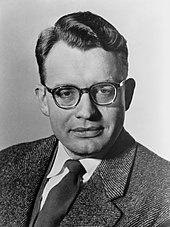
In 1948 [Hendrik Casimir](https://en.wikipedia.org/wiki/Hendrik_Casimir "Hendrik Casimir")<sup id="cite_ref-68"><a href="https://en.wikipedia.org/wiki/Zero-point_energy#cite_note-68">[68]</a></sup><sup id="cite_ref-69"><a href="https://en.wikipedia.org/wiki/Zero-point_energy#cite_note-69">[69]</a></sup> showed that one consequence of the zero-point field is an attractive force between two uncharged, perfectly conducting parallel plates, the so-called [Casimir effect](https://en.wikipedia.org/wiki/Casimir_effect "Casimir effect"). At the time, Casimir was studying the properties of "colloidal solutions". These are viscous materials, such as paint and mayonnaise, that contain micron-sized particles in a liquid matrix. The properties of such solutions are determined by [Van der Waals forces](https://en.wikipedia.org/wiki/Van_der_Waals_forces "Van der Waals forces") – short-range, attractive forces that exist between neutral atoms and molecules. One of Casimir's colleagues, Theo Overbeek, realized that the theory that was used at the time to explain Van der Waals forces, which had been developed by [Fritz London](https://en.wikipedia.org/wiki/Fritz_London "Fritz London") in 1930,<sup id="cite_ref-70"><a href="https://en.wikipedia.org/wiki/Zero-point_energy#cite_note-70">[70]</a></sup><sup id="cite_ref-71"><a href="https://en.wikipedia.org/wiki/Zero-point_energy#cite_note-71">[71]</a></sup> did not properly explain the experimental measurements on colloids. Overbeek therefore asked Casimir to investigate the problem. Working with [Dirk Polder](https://en.wikipedia.org/wiki/Dirk_Polder "Dirk Polder"), Casimir discovered that the interaction between two neutral molecules could be correctly described only if the fact that light travels at a finite speed was taken into account.<sup id="cite_ref-72"><a href="https://en.wikipedia.org/wiki/Zero-point_energy#cite_note-72">[72]</a></sup> Soon afterwards after a conversation with [Bohr](https://en.wikipedia.org/wiki/Niels_Bohr "Niels Bohr") about zero-point energy, Casimir noticed that this result could be interpreted in terms of vacuum fluctuations. He then asked himself what would happen if there were two mirrors – rather than two molecules – facing each other in a vacuum. It was this work that led to his famous prediction of an attractive force between reflecting plates. The work by Casimir and Polder opened up the way to a unified theory of Van der Waals and Casimir forces and a smooth continuum between the two phenomena. This was done by Lifshitz (1956)<sup id="cite_ref-73"><a href="https://en.wikipedia.org/wiki/Zero-point_energy#cite_note-73">[73]</a></sup><sup id="cite_ref-74"><a href="https://en.wikipedia.org/wiki/Zero-point_energy#cite_note-74">[74]</a></sup><sup id="cite_ref-75"><a href="https://en.wikipedia.org/wiki/Zero-point_energy#cite_note-75">[75]</a></sup> in the case of plane parallel [dielectric plates](https://en.wikipedia.org/wiki/Dielectric "Dielectric"). The generic name for both Van der Waals and Casimir forces is dispersion forces, because both of them are caused by dispersions of the operator of the dipole moment.<sup id="cite_ref-76"><a href="https://en.wikipedia.org/wiki/Zero-point_energy#cite_note-76">[76]</a></sup> The role of relativistic forces becomes dominant at orders of a hundred nanometers.
In 1951 [Herbert Callen](https://en.wikipedia.org/wiki/Herbert_Callen "Herbert Callen") and Theodore Welton<sup id="cite_ref-ReferenceB_77-0"><a href="https://en.wikipedia.org/wiki/Zero-point_energy#cite_note-ReferenceB-77">[77]</a></sup> proved the quantum [fluctuation-dissipation theorem](https://en.wikipedia.org/wiki/Fluctuation-dissipation_theorem "Fluctuation-dissipation theorem") (FDT) which was originally formulated in classical form by [Nyquist](https://en.wikipedia.org/wiki/Harry_Nyquist "Harry Nyquist") (1928)<sup id="cite_ref-ReferenceC_78-0"><a href="https://en.wikipedia.org/wiki/Zero-point_energy#cite_note-ReferenceC-78">[78]</a></sup> as an explanation for observed [Johnson noise](https://en.wikipedia.org/wiki/Johnson_noise "Johnson noise") in electric circuits.<sup id="cite_ref-ReferenceD_79-0"><a href="https://en.wikipedia.org/wiki/Zero-point_energy#cite_note-ReferenceD-79">[79]</a></sup> The fluctuation-dissipation theorem showed that when something dissipates energy, in an effectively irreversible way, a connected heat bath must also fluctuate. The fluctuations and the dissipation go hand in hand; it is impossible to have one without the other. The implication of FDT being that the vacuum could be treated as a heat bath coupled to a dissipative force and as such energy could, in part, be extracted from the vacuum for potentially useful work.<sup id="cite_ref-FOOTNOTEMilonni199454_80-0"><a href="https://en.wikipedia.org/wiki/Zero-point_energy#cite_note-FOOTNOTEMilonni199454-80">[80]</a></sup> FDT has been shown to be true experimentally under certain quantum, non-classical, conditions.<sup id="cite_ref-cloudfront.escholarship.org_81-0"><a href="https://en.wikipedia.org/wiki/Zero-point_energy#cite_note-cloudfront.escholarship.org-81">[81]</a></sup><sup id="cite_ref-Allahverdyan-2000_82-0"><a href="https://en.wikipedia.org/wiki/Zero-point_energy#cite_note-Allahverdyan-2000-82">[82]</a></sup><sup id="cite_ref-FOOTNOTEScully_et_al.2003_83-0"><a href="https://en.wikipedia.org/wiki/Zero-point_energy#cite_note-FOOTNOTEScully_et_al.2003-83">[83]</a></sup>
In 1963 the [Jaynes–Cummings model](https://en.wikipedia.org/wiki/Jaynes%E2%80%93Cummings_model "Jaynes–Cummings model")<sup id="cite_ref-84"><a href="https://en.wikipedia.org/wiki/Zero-point_energy#cite_note-84">[84]</a></sup> was developed describing the system of a [two-level atom](https://en.wikipedia.org/wiki/Two-level_system "Two-level system") interacting with a quantized field mode (i.e. the vacuum) within an optical cavity. It gave nonintuitive predictions such as that an atom's spontaneous emission could be driven by field of effectively constant frequency ([Rabi frequency](https://en.wikipedia.org/wiki/Rabi_frequency "Rabi frequency")). In the 1970s experiments were being performed to test aspects of quantum optics and showed that the rate of spontaneous emission of an atom could be controlled using reflecting surfaces.<sup id="cite_ref-FOOTNOTEDrexhage1970_85-0"><a href="https://en.wikipedia.org/wiki/Zero-point_energy#cite_note-FOOTNOTEDrexhage1970-85">[85]</a></sup><sup id="cite_ref-FOOTNOTEDrexhage1974[[Category:Wikipedia_articles_needing_page_number_citations_from_May_2020]]<sup_class="noprint_Inline-Template_"_style="white-space:nowrap;">[<i>[[Wikipedia:Citing_sources|<span_title="This_citation_requires_a_reference_to_the_specific_page_or_range_of_pages_in_which_the_material_appears.&#32;(May_2020)">page&nbsp;needed</span>]]</i>]</sup>_86-0"><a href="https://en.wikipedia.org/wiki/Zero-point_energy#cite_note-FOOTNOTEDrexhage1974[[Category:Wikipedia_articles_needing_page_number_citations_from_May_2020]]%3Csup_class=%22noprint_Inline-Template_%22_style=%22white-space:nowrap;%22%3E&#91;%3Ci%3E[[Wikipedia:Citing_sources|%3Cspan_title=%22This_citation_requires_a_reference_to_the_specific_page_or_range_of_pages_in_which_the_material_appears.&#32;(May_2020)%22%3Epage&nbsp;needed%3C/span%3E]]%3C/i%3E&#93;%3C/sup%3E-86">[86]</a></sup> These results were at first regarded with suspicion in some quarters: it was argued that no modification of a spontaneous emission rate would be possible, after all, how can the emission of a photon be affected by an atom's environment when the atom can only "see" its environment by emitting a photon in the first place? These experiments gave rise to [cavity quantum electrodynamics](https://en.wikipedia.org/wiki/Cavity_quantum_electrodynamics "Cavity quantum electrodynamics") (CQED), the study of effects of mirrors and cavities on radiative corrections. Spontaneous emission can be suppressed (or "inhibited")<sup id="cite_ref-87"><a href="https://en.wikipedia.org/wiki/Zero-point_energy#cite_note-87">[87]</a></sup><sup id="cite_ref-88"><a href="https://en.wikipedia.org/wiki/Zero-point_energy#cite_note-88">[88]</a></sup> or amplified. Amplification was first predicted by Purcell in 1946<sup id="cite_ref-89"><a href="https://en.wikipedia.org/wiki/Zero-point_energy#cite_note-89">[89]</a></sup> (the [Purcell effect](https://en.wikipedia.org/wiki/Purcell_effect "Purcell effect")) and has been experimentally verified.<sup id="cite_ref-FOOTNOTEGoy_et_al.1983_90-0"><a href="https://en.wikipedia.org/wiki/Zero-point_energy#cite_note-FOOTNOTEGoy_et_al.1983-90">[90]</a></sup> This phenomenon can be understood, partly, in terms of the action of the vacuum field on the atom.<sup id="cite_ref-FOOTNOTEMilonni1983_91-0"><a href="https://en.wikipedia.org/wiki/Zero-point_energy#cite_note-FOOTNOTEMilonni1983-91">[91]</a></sup>
## The uncertainty principle\[[edit](https://en.wikipedia.org/w/index.php?title=Zero-point_energy&action=edit§ion=7 "Edit section: The uncertainty principle")\]
Zero-point energy is fundamentally related to the Heisenberg [uncertainty principle](https://en.wikipedia.org/wiki/Uncertainty_principle "Uncertainty principle").<sup id="cite_ref-Heisenberg_1927_92-0"><a href="https://en.wikipedia.org/wiki/Zero-point_energy#cite_note-Heisenberg_1927-92">[92]</a></sup> Roughly speaking, the uncertainty principle states that complementary variables (such as a particle's position and momentum, or a field's value and derivative at a point in space) cannot simultaneously be specified precisely by any given quantum state. In particular, there cannot exist a state in which the system simply sits motionless at the bottom of its potential well, for then its position and momentum would both be completely determined to arbitrarily great precision. Therefore, the lowest-energy state (the ground state) of the system must have a distribution in position and momentum that satisfies the uncertainty principle, which implies its energy must be greater than the minimum of the potential well.
Near the bottom of a [potential well](https://en.wikipedia.org/wiki/Potential_well "Potential well"), the [Hamiltonian](https://en.wikipedia.org/wiki/Hamiltonian_(quantum_mechanics) "Hamiltonian (quantum mechanics)") of a general system (the quantum-mechanical [operator](https://en.wikipedia.org/wiki/Operator_(physics) "Operator (physics)") giving its energy) can be approximated as a [quantum harmonic oscillator](https://en.wikipedia.org/wiki/Quantum_harmonic_oscillator "Quantum harmonic oscillator"),

where _V_<sub>0</sub> is the minimum of the classical potential well.
The uncertainty principle tells us that
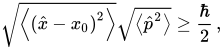
making the [expectation values](https://en.wikipedia.org/wiki/Expectation_value_(quantum_mechanics) "Expectation value (quantum mechanics)") of the [kinetic](https://en.wikipedia.org/wiki/Kinetic_energy "Kinetic energy") and [potential](https://en.wikipedia.org/wiki/Potential_energy "Potential energy") terms above satisfy

The expectation value of the energy must therefore be at least

where _ω_ = √_k_/_m_ is the [angular frequency](https://en.wikipedia.org/wiki/Angular_frequency "Angular frequency") at which the system oscillates.
A more thorough treatment, showing that the energy of the ground state actually saturates this bound and is exactly _E_<sub>0</sub> = _V_<sub>0</sub> + _ħω_/2, requires solving for the ground state of the system.
## Atomic physics\[[edit](https://en.wikipedia.org/w/index.php?title=Zero-point_energy&action=edit§ion=8 "Edit section: Atomic physics")\]
[](https://en.wikipedia.org/wiki/File:QHO-groundstate-animation-color.gif)
The zero-point energy _E_ = _ħω_/2 causes the ground-state of a harmonic oscillator to advance its phase (color). This has measurable effects when several eigenstates are superimposed.
The idea of a [quantum harmonic oscillator](https://en.wikipedia.org/wiki/Quantum_harmonic_oscillator "Quantum harmonic oscillator") and its associated energy can apply to either an atom or a subatomic particle. In ordinary atomic physics, the zero-point energy is the energy associated with the [ground state](https://en.wikipedia.org/wiki/Ground_state "Ground state") of the system. The professional physics literature tends to measure frequency, as denoted by ν above, using [angular frequency](https://en.wikipedia.org/wiki/Angular_frequency "Angular frequency"), denoted with ω and defined by _ω_ = 2_πν_. This leads to a convention of writing Planck's constant h with a bar through its top (ħ) to denote the quantity _h_/2π. In these terms, the most famous such example of zero-point energy is the above _E_ = _ħω_/2 associated with the ground state of the [quantum harmonic oscillator](https://en.wikipedia.org/wiki/Quantum_harmonic_oscillator "Quantum harmonic oscillator"). In quantum mechanical terms, the zero-point energy is the [expectation value](https://en.wikipedia.org/wiki/Expectation_value "Expectation value") of the [Hamiltonian](https://en.wikipedia.org/wiki/Hamiltonian_(quantum_mechanics) "Hamiltonian (quantum mechanics)") of the system in the ground state.
If more than one ground state exists, they are said to be [degenerate](https://en.wikipedia.org/wiki/Degenerate_energy_level "Degenerate energy level"). Many systems have degenerate ground states. Degeneracy occurs whenever there exists a [unitary operator](https://en.wikipedia.org/wiki/Unitary_operator "Unitary operator") which acts non-trivially on a ground state and [commutes](https://en.wikipedia.org/wiki/Commutator "Commutator") with the [Hamiltonian](https://en.wikipedia.org/wiki/Hamiltonian_(quantum_mechanics) "Hamiltonian (quantum mechanics)") of the system.
According to the [third law of thermodynamics](https://en.wikipedia.org/wiki/Third_law_of_thermodynamics "Third law of thermodynamics"), a system at [absolute zero](https://en.wikipedia.org/wiki/Absolute_zero "Absolute zero") [temperature](https://en.wikipedia.org/wiki/Temperature "Temperature") exists in its ground state; thus, its [entropy](https://en.wikipedia.org/wiki/Entropy "Entropy") is determined by the degeneracy of the ground state. Many systems, such as a perfect [crystal lattice](https://en.wikipedia.org/wiki/Crystal_lattice "Crystal lattice"), have a unique ground state and therefore have zero entropy at absolute zero. It is also possible for the highest excited state to have [absolute zero](https://en.wikipedia.org/wiki/Absolute_zero "Absolute zero") [temperature](https://en.wikipedia.org/wiki/Temperature "Temperature") for systems that exhibit [negative temperature](https://en.wikipedia.org/wiki/Negative_temperature "Negative temperature").
The [wave function](https://en.wikipedia.org/wiki/Wave_function "Wave function") of the ground state of a [particle in a one-dimensional well](https://en.wikipedia.org/wiki/Particle_in_a_box "Particle in a box") is a half-period [sine wave](https://en.wikipedia.org/wiki/Sine_wave "Sine wave") which goes to zero at the two edges of the well. The energy of the particle is given by:

where h is the [Planck constant](https://en.wikipedia.org/wiki/Planck_constant "Planck constant"), m is the mass of the particle, n is the energy state (_n_ = 1 corresponds to the ground-state energy), and L is the width of the well.
## Quantum field theory\[[edit](https://en.wikipedia.org/w/index.php?title=Zero-point_energy&action=edit§ion=9 "Edit section: Quantum field theory")\]
In [quantum field theory](https://en.wikipedia.org/wiki/Quantum_field_theory "Quantum field theory") (QFT), the fabric of "empty" space is visualized as consisting of [fields](https://en.wikipedia.org/wiki/Field_(physics) "Field (physics)"), with the field at every point in space and time being a [quantum harmonic oscillator](https://en.wikipedia.org/wiki/Quantum_harmonic_oscillator "Quantum harmonic oscillator"), with neighboring oscillators interacting with each other. According to QFT the universe is made up of matter fields whose [quanta](https://en.wikipedia.org/wiki/Quantum "Quantum") are [fermions](https://en.wikipedia.org/wiki/Fermions "Fermions") (e.g. [electrons](https://en.wikipedia.org/wiki/Electron "Electron") and [quarks](https://en.wikipedia.org/wiki/Quark "Quark")), force fields whose quanta are [bosons](https://en.wikipedia.org/wiki/Boson "Boson") (i.e. [photons](https://en.wikipedia.org/wiki/Photon "Photon") and [gluons](https://en.wikipedia.org/wiki/Gluon "Gluon")) and a Higgs field whose quantum is the [Higgs boson](https://en.wikipedia.org/wiki/Higgs_boson "Higgs boson"). The matter and force fields have zero-point energy.<sup id="cite_ref-FOOTNOTEMilonni199435_2-2"><a href="https://en.wikipedia.org/wiki/Zero-point_energy#cite_note-FOOTNOTEMilonni199435-2">[2]</a></sup> A related term is _zero-point field_ (ZPF), which is the lowest energy state of a particular field.<sup id="cite_ref-93"><a href="https://en.wikipedia.org/wiki/Zero-point_energy#cite_note-93">[93]</a></sup> The vacuum can be viewed not as empty space, but as the combination of all zero-point fields.
In QFT the zero-point energy of the [vacuum state](https://en.wikipedia.org/wiki/Vacuum_state "Vacuum state") is called the [vacuum energy](https://en.wikipedia.org/wiki/Vacuum_energy "Vacuum energy") and the average expectation value of the Hamiltonian is called the [vacuum expectation value](https://en.wikipedia.org/wiki/Vacuum_expectation_value "Vacuum expectation value") (also called condensate or simply VEV). The [QED vacuum](https://en.wikipedia.org/wiki/QED_vacuum "QED vacuum") is a part of the vacuum state which specifically deals with [quantum electrodynamics](https://en.wikipedia.org/wiki/Quantum_electrodynamics "Quantum electrodynamics") (e.g. electromagnetic interactions between photons, electrons and the vacuum) and the [QCD vacuum](https://en.wikipedia.org/wiki/QCD_vacuum "QCD vacuum") deals with [quantum chromodynamics](https://en.wikipedia.org/wiki/Quantum_chromodynamics "Quantum chromodynamics") (e.g. [color charge](https://en.wikipedia.org/wiki/Color_charge "Color charge") interactions between quarks, gluons and the vacuum). Recent experiments advocate the idea that particles themselves can be thought of as excited states of the underlying [quantum vacuum](https://en.wikipedia.org/wiki/Quantum_vacuum "Quantum vacuum"), and that all properties of matter are merely vacuum fluctuations arising from interactions with the zero-point field.<sup id="cite_ref-FOOTNOTEBattersby2008_10-1"><a href="https://en.wikipedia.org/wiki/Zero-point_energy#cite_note-FOOTNOTEBattersby2008-10">[10]</a></sup>
Each point in space makes a contribution of _E_ = _ħω_/2, resulting in a calculation of infinite zero-point energy in any finite volume; this is one reason [renormalization](https://en.wikipedia.org/wiki/Renormalization "Renormalization") is needed to make sense of quantum field theories. In [cosmology](https://en.wikipedia.org/wiki/Physical_cosmology "Physical cosmology"), the vacuum energy is one possible explanation for the [cosmological constant](https://en.wikipedia.org/wiki/Cosmological_constant "Cosmological constant")<sup id="cite_ref-FOOTNOTERughZinkernagel2002_19-1"><a href="https://en.wikipedia.org/wiki/Zero-point_energy#cite_note-FOOTNOTERughZinkernagel2002-19">[19]</a></sup> and the source of [dark energy](https://en.wikipedia.org/wiki/Dark_energy "Dark energy").<sup id="cite_ref-Dark_Energy_May_Be_Vacuum_20-1"><a href="https://en.wikipedia.org/wiki/Zero-point_energy#cite_note-Dark_Energy_May_Be_Vacuum-20">[20]</a></sup><sup id="cite_ref-FOOTNOTEWall2014_21-1"><a href="https://en.wikipedia.org/wiki/Zero-point_energy#cite_note-FOOTNOTEWall2014-21">[21]</a></sup>
Scientists are not in agreement about how much energy is contained in the vacuum. [Quantum mechanics](https://en.wikipedia.org/wiki/Quantum_mechanics "Quantum mechanics") requires the energy to be large as [Paul Dirac](https://en.wikipedia.org/wiki/Paul_Dirac "Paul Dirac") claimed it is, like a [sea of energy](https://en.wikipedia.org/wiki/Dirac_sea "Dirac sea"). Other scientists specializing in [General Relativity](https://en.wikipedia.org/wiki/General_Relativity "General Relativity") require the energy to be small enough for [curvature of space](https://en.wikipedia.org/wiki/Curvature_of_space "Curvature of space") to agree with observed [astronomy](https://en.wikipedia.org/wiki/Astronomy "Astronomy"). The [Heisenberg](https://en.wikipedia.org/wiki/Werner_Heisenberg "Werner Heisenberg") [uncertainty principle](https://en.wikipedia.org/wiki/Uncertainty_principle "Uncertainty principle") allows the energy to be as large as needed to promote quantum actions for a brief moment of time, even if the average energy is small enough to satisfy relativity and flat space. To cope with disagreements, the vacuum energy is described as a [virtual energy](https://en.wikipedia.org/wiki/Virtual_energy "Virtual energy") [potential](https://en.wikipedia.org/wiki/Potential "Potential") of positive and negative energy.<sup id="cite_ref-FOOTNOTEPeskinSchroeder1995786–791_94-0"><a href="https://en.wikipedia.org/wiki/Zero-point_energy#cite_note-FOOTNOTEPeskinSchroeder1995786%E2%80%93791-94">[94]</a></sup>
In quantum [perturbation theory](https://en.wikipedia.org/wiki/Perturbation_theory "Perturbation theory"), it is sometimes said that the contribution of [one-loop](https://en.wikipedia.org/wiki/One-loop "One-loop") and multi-loop [Feynman diagrams](https://en.wikipedia.org/wiki/Feynman_diagram "Feynman diagram") to [elementary particle](https://en.wikipedia.org/wiki/Elementary_particle "Elementary particle") [propagators](https://en.wikipedia.org/wiki/Propagator "Propagator") are the contribution of [vacuum fluctuations](https://en.wikipedia.org/wiki/Quantum_fluctuation "Quantum fluctuation"), or the zero-point energy to the particle [masses](https://en.wikipedia.org/wiki/Mass "Mass").
### The quantum electrodynamic vacuum\[[edit](https://en.wikipedia.org/w/index.php?title=Zero-point_energy&action=edit§ion=10 "Edit section: The quantum electrodynamic vacuum")\]
The oldest and best known quantized force field is the [electromagnetic field](https://en.wikipedia.org/wiki/Electromagnetic_field "Electromagnetic field"). [Maxwell's equations](https://en.wikipedia.org/wiki/Maxwell%27s_equations "Maxwell's equations") have been superseded by [quantum electrodynamics](https://en.wikipedia.org/wiki/Quantum_electrodynamics "Quantum electrodynamics") (QED). By considering the zero-point energy that arises from QED it is possible to gain a characteristic understanding of zero-point energy that arises not just through electromagnetic interactions but in all [quantum field theories](https://en.wikipedia.org/wiki/Quantum_field_theories "Quantum field theories").
#### Redefining the zero of energy\[[edit](https://en.wikipedia.org/w/index.php?title=Zero-point_energy&action=edit§ion=11 "Edit section: Redefining the zero of energy")\]
In the quantum theory of the electromagnetic field, classical wave amplitudes α and _α_\* are replaced by operators a and _a_<sup>†</sup> that satisfy:
![{\displaystyle \left[a,a^{\dagger }\right]=1}](https://wikimedia.org/api/rest_v1/media/math/render/svg/46ee0fed155949697be50e34c52791e940ae9ffe)
The classical quantity |_α_|<sup>2</sup> appearing in the classical expression for the energy of a field mode is replaced in quantum theory by the photon number operator _a_<sup>†</sup>_a_. The fact that:
![{\displaystyle \left[a,a^{\dagger }a\right]\neq 1}](https://wikimedia.org/api/rest_v1/media/math/render/svg/cc2c5deab61244bcb50a360f5ddd050fe7f2f7e9)
implies that quantum theory does not allow states of the radiation field for which the photon number and a field amplitude can be precisely defined, i.e., we cannot have simultaneous eigenstates for _a_<sup>†</sup>_a_ and a. The reconciliation of wave and particle attributes of the field is accomplished via the association of a probability amplitude with a classical mode pattern. The calculation of field modes is entirely classical problem, while the quantum properties of the field are carried by the mode "amplitudes" _a_<sup>†</sup> and a associated with these classical modes.
The zero-point energy of the field arises formally from the non-commutativity of a and _a_<sup>†</sup>. This is true for any harmonic oscillator: the zero-point energy _ħω_/2 appears when we write the Hamiltonian:
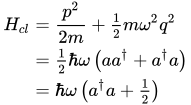
It is often argued that the entire universe is completely bathed in the zero-point electromagnetic field, and as such it can add only some constant amount to expectation values. Physical measurements will therefore reveal only deviations from the vacuum state. Thus the zero-point energy can be dropped from the Hamiltonian by redefining the zero of energy, or by arguing that it is a constant and therefore has no effect on Heisenberg equations of motion. Thus we can choose to declare by fiat that the ground state has zero energy and a field Hamiltonian, for example, can be replaced by:<sup id="cite_ref-FOOTNOTEItzyksonZuber1980111_11-1"><a href="https://en.wikipedia.org/wiki/Zero-point_energy#cite_note-FOOTNOTEItzyksonZuber1980111-11">[11]</a></sup>
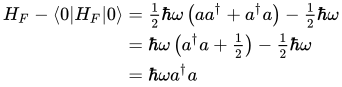
without affecting any physical predictions of the theory. The new Hamiltonian is said to be [normally ordered](https://en.wikipedia.org/wiki/Normal_order "Normal order") (or Wick ordered) and is denoted by a double-dot symbol. The normally ordered Hamiltonian is denoted :_H<sub>F</sub>_, i.e.:

In other words, within the normal ordering symbol we can commute a and _a_<sup>†</sup>. Since zero-point energy is intimately connected to the non-commutativity of a and _a_<sup>†</sup>, the normal ordering procedure eliminates any contribution from the zero-point field. This is especially reasonable in the case of the field Hamiltonian, since the zero-point term merely adds a constant energy which can be eliminated by a simple redefinition for the zero of energy. Moreover, this constant energy in the Hamiltonian obviously commutes with a and _a_<sup>†</sup> and so cannot have any effect on the quantum dynamics described by the Heisenberg equations of motion.
However, things are not quite that simple. The zero-point energy cannot be eliminated by dropping its energy from the Hamiltonian: When we do this and solve the Heisenberg equation for a field operator, we must include the vacuum field, which is the homogeneous part of the solution for the field operator. In fact we can show that the vacuum field is essential for the preservation of the commutators and the formal consistency of [QED](https://en.wikipedia.org/wiki/Quantum_electrodynamics "Quantum electrodynamics"). When we calculate the field energy we obtain not only a contribution from particles and forces that may be present but also a contribution from the vacuum field itself i.e. the zero-point field energy. In other words, the zero-point energy reappears even though we may have deleted it from the Hamiltonian.<sup id="cite_ref-FOOTNOTEMilonni199473–74_95-0"><a href="https://en.wikipedia.org/wiki/Zero-point_energy#cite_note-FOOTNOTEMilonni199473%E2%80%9374-95">[95]</a></sup>
#### The electromagnetic field in free space\[[edit](https://en.wikipedia.org/w/index.php?title=Zero-point_energy&action=edit§ion=12 "Edit section: The electromagnetic field in free space")\]
From Maxwell's equations, the electromagnetic energy of a "free" field i.e. one with no sources, is described by:

We introduce the "mode function" **A**<sub>0</sub>(**r**) that satisfies the [Helmholtz equation](https://en.wikipedia.org/wiki/Helmholtz_equation "Helmholtz equation"):

where _k_ = _ω_/_c_ and assume it is normalized such that:
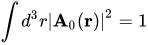
We wish to "quantize" the electromagnetic energy of free space for a multimode field. The field intensity of free space should be independent of position such that |**A**<sub>0</sub>(**r**)|<sup>2</sup> should be independent of **r** for each mode of the field. The mode function satisfying these conditions is:
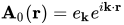
where **k** · **e**<sub><b>k</b></sub> = 0 in order to have the transversality condition **∇** · **A**(**r**,_t_) satisfied for the Coulomb gauge<sup>[<i><a href="https://en.wikipedia.org/wiki/Wikipedia:Accuracy_dispute#Disputed_statement" title="Wikipedia:Accuracy dispute"><span title="The material near this tag is possibly inaccurate or nonfactual. (May 2018)">dubious</span></a> <span>– <a href="https://en.wikipedia.org/wiki/Talk:Zero-point_energy#Dubious" title="Talk:Zero-point energy">discuss</a></span></i>]</sup> in which we are working.
To achieve the desired normalization we pretend space is divided into cubes of volume _V_ = _L_<sup>3</sup> and impose on the field the periodic boundary condition:

or equivalently

where n can assume any integer value. This allows us to consider the field in any one of the imaginary cubes and to define the mode function:
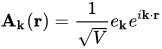
which satisfies the Helmholtz equation, transversality, and the "box normalization":
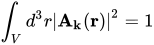
where _e_<sub><b>k</b></sub> is chosen to be a unit vector which specifies the polarization of the field mode. The condition **k** · _e_<sub><b>k</b></sub> = 0 means that there are two independent choices of _e_<sub><b>k</b></sub>, which we call _e_<sub><b>k</b>1</sub> and _e_<sub><b>k</b>2</sub> where _e_<sub><b>k</b>1</sub> · _e_<sub><b>k</b>2</sub> = 0 and _e_<sup>2</sup>
<sub><b>k</b>1</sub> = _e_<sup>2</sup>
<sub><b>k</b>2</sub> = 1. Thus we define the mode functions:

in terms of which the vector potential becomes<sup>[<i><a href="https://en.wikipedia.org/wiki/Wikipedia:Please_clarify" title="Wikipedia:Please clarify"><span title="The text near this tag may need clarification or removal of jargon. (May 2018)">clarification needed</span></a></i>]</sup>:
![{\displaystyle \mathbf {A} _{\mathbf {k} \lambda }(\mathbf {r} ,t)={\sqrt {\frac {2\pi \hbar c^{2}}{\omega _{k}V}}}\left[a_{\mathbf {k} \lambda }(0)e^{i\mathbf {k} \cdot \mathbf {r} }+a_{\mathbf {k} \lambda }^{\dagger }(0)e^{-i\mathbf {k} \cdot \mathbf {r} }\right]e_{\mathbf {k} \lambda }}](https://wikimedia.org/api/rest_v1/media/math/render/svg/573b8c00f49f4ca23bf2d0fe7f5b278d6a2bdb5b)
or:
![{\displaystyle \mathbf {A} _{\mathbf {k} \lambda }(\mathbf {r} ,t)={\sqrt {\frac {2\pi \hbar c^{2}}{\omega _{k}V}}}\left[a_{\mathbf {k} \lambda }(0)e^{-i(\omega _{k}t-\mathbf {k} \cdot \mathbf {r} )}+a_{\mathbf {k} \lambda }^{\dagger }(0)e^{i(\omega _{k}t-\mathbf {k} \cdot \mathbf {r} )}\right]}](https://wikimedia.org/api/rest_v1/media/math/render/svg/2ce4a97e85d91c4bd95ae6bff61a0a2798f7f2ca)
where _ω<sub>k</sub>_ = _kc_ and _a_<sub><b>k</b><i>λ</i></sub>, _a_<sup>†</sup>
<sub><b>k</b><i>λ</i></sub> are photon annihilation and creation operators for the mode with wave vector k and polarization λ. This gives the vector potential for a plane wave mode of the field. The condition for (_k<sub>x</sub>_, _k<sub>y</sub>_, _k<sub>z</sub>_) shows that there are infinitely many such modes. The linearity of Maxwell's equations allows us to write:
![{\displaystyle \mathbf {A} (\mathbf {r} t)=\sum _{\mathbf {k} \lambda }{\sqrt {\frac {2\pi \hbar c^{2}}{\omega _{k}V}}}\left[a_{\mathbf {k} \lambda }(0)e^{i\mathbf {k} \cdot \mathbf {r} }+a_{\mathbf {k} \lambda }^{\dagger }(0)e^{-i\mathbf {k} \cdot \mathbf {r} }\right]e_{\mathbf {k} \lambda }}](https://wikimedia.org/api/rest_v1/media/math/render/svg/21a3afc55e7ef3b7bff249c17912b0a9a4e0c455)
for the total vector potential in free space. Using the fact that:

we find the field Hamiltonian is:

This is the Hamiltonian for an infinite number of uncoupled harmonic oscillators. Thus different modes of the field are independent and satisfy the commutation relations:
![{\displaystyle {\begin{aligned}\left[a_{\mathbf {k} \lambda }(t),a_{\mathbf {k} '\lambda '}^{\dagger }(t)\right]&=\delta _{\mathbf {k} ,\mathbf {k} '}^{3}\delta _{\lambda ,\lambda '}\\[10px]\left[a_{\mathbf {k} \lambda }(t),a_{\mathbf {k} '\lambda '}(t)\right]&=\left[a_{\mathbf {k} \lambda }^{\dagger }(t),a_{\mathbf {k} '\lambda '}^{\dagger }(t)\right]=0\end{aligned}}}](https://wikimedia.org/api/rest_v1/media/math/render/svg/292b79226ac8d94b9e696f41aea21a95dbcae74e)
Clearly the least eigenvalue for _H<sub>F</sub>_ is:

This state describes the zero-point energy of the vacuum. It appears that this sum is divergent – in fact highly divergent, as putting in the density factor

shows. The summation becomes approximately the integral:
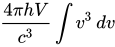
for high values of v. It diverges proportional to _v_<sup>4</sup> for large v.
There are two separate questions to consider. First, is the divergence a real one such that the zero-point energy really is infinite? If we consider the volume V is contained by perfectly conducting walls, very high frequencies can only be contained by taking more and more perfect conduction. No actual method of containing the high frequencies is possible. Such modes will not be stationary in our box and thus not countable in the stationary energy content. So from this physical point of view the above sum should only extend to those frequencies which are countable; a cut-off energy is thus eminently reasonable. However, on the scale of a "universe" questions of general relativity must be included. Suppose even the boxes could be reproduced, fit together and closed nicely by curving spacetime. Then exact conditions for running waves may be possible. However the very high frequency quanta will still not be contained. As per John Wheeler's "geons"<sup id="cite_ref-96"><a href="https://en.wikipedia.org/wiki/Zero-point_energy#cite_note-96">[96]</a></sup> these will leak out of the system. So again a cut-off is permissible, almost necessary. The question here becomes one of consistency since the very high energy quanta will act as a mass source and start curving the geometry.
This leads to the second question. Divergent or not, finite or infinite, is the zero-point energy of any physical significance? The ignoring of the whole zero-point energy is often encouraged for all practical calculations. The reason for this is that energies are not typically defined by an arbitrary data point, but rather changes in data points, so adding or subtracting a constant (even if infinite) should be allowed. However this is not the whole story, in reality energy is not so arbitrarily defined: in general relativity the seat of the curvature of spacetime is the energy content and there the absolute amount of energy has real physical meaning. There is no such thing as an arbitrary additive constant with density of field energy. Energy density curves space, and an increase in energy density produces an increase of curvature. Furthermore, the zero-point energy density has other physical consequences e.g. the Casimir effect, contribution to the Lamb shift, or anomalous magnetic moment of the electron, it is clear it is not just a mathematical constant or artifact that can be cancelled out.<sup id="cite_ref-FOOTNOTEPower196431–33_97-0"><a href="https://en.wikipedia.org/wiki/Zero-point_energy#cite_note-FOOTNOTEPower196431%E2%80%9333-97">[97]</a></sup>
#### Necessity of the vacuum field in QED\[[edit](https://en.wikipedia.org/w/index.php?title=Zero-point_energy&action=edit§ion=13 "Edit section: Necessity of the vacuum field in QED")\]
The vacuum state of the "free" electromagnetic field (that with no sources) is defined as the ground state in which _n_<sub><b>k</b><i>λ</i></sub> = 0 for all modes (**k**, _λ_). The vacuum state, like all stationary states of the field, is an eigenstate of the Hamiltonian but not the electric and magnetic field operators. In the vacuum state, therefore, the electric and magnetic fields do not have definite values. We can imagine them to be fluctuating about their mean value of zero.
In a process in which a photon is annihilated (absorbed), we can think of the photon as making a transition into the vacuum state. Similarly, when a photon is created (emitted), it is occasionally useful to imagine that the photon has made a transition out of the vacuum state.<sup id="cite_ref-FOOTNOTEDirac1927_55-2"><a href="https://en.wikipedia.org/wiki/Zero-point_energy#cite_note-FOOTNOTEDirac1927-55">[55]</a></sup> An atom, for instance, can be considered to be "dressed" by emission and reabsorption of "virtual photons" from the vacuum. The vacuum state energy described by Σ<sub><b>k</b><i>λ</i></sub> _ħω<sub>k</sub>_/2 is infinite. We can make the replacement:

the zero-point energy density is:
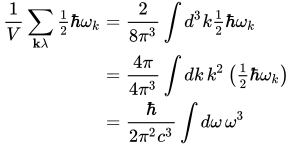
or in other words the spectral energy density of the vacuum field:
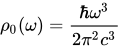
The zero-point energy density in the frequency range from _ω_<sub>1</sub> to _ω_<sub>2</sub> is therefore:

This can be large even in relatively narrow "low frequency" regions of the spectrum. In the optical region from 400 to 700 nm, for instance, the above equation yields around 220 [erg](https://en.wikipedia.org/wiki/Erg "Erg")/cm<sup>3</sup>.
We showed in the above section that the zero-point energy can be eliminated from the Hamiltonian by the normal ordering prescription. However, this elimination does not mean that the vacuum field has been rendered unimportant or without physical consequences. To illustrate this point we consider a linear dipole oscillator in the vacuum. The Hamiltonian for the oscillator plus the field with which it interacts is:

This has the same form as the corresponding classical Hamiltonian and the Heisenberg equations of motion for the oscillator and the field are formally the same as their classical counterparts. For instance the Heisenberg equations for the coordinate **x** and the canonical momentum **p** = _m_**ẋ** +_e_**A**/_c_ of the oscillator are:
![{\displaystyle {\begin{aligned}\mathbf {\dot {x}} &=(i\hbar )^{-1}[\mathbf {x} .H]={\frac {1}{m}}\left(\mathbf {p} -{\frac {e}{c}}\mathbf {A} \right)\\\mathbf {\dot {p}} &=(i\hbar )^{-1}[\mathbf {p} .H]{\begin{aligned}&={\tfrac {1}{2}}\nabla \left(\mathbf {p} -{\frac {e}{c}}\mathbf {A} \right)^{2}-m\omega _{0}^{2}\mathbf {\dot {x}} \\&=-{\frac {1}{m}}\left[\left(\mathbf {p} -{\frac {e}{c}}\mathbf {A} \right)\cdot \nabla \right]\left[-{\frac {e}{c}}\mathbf {A} \right]-{\frac {1}{m}}\left(\mathbf {p} -{\frac {e}{c}}\mathbf {A} \right)\times \nabla \times \left[-{\frac {e}{c}}\mathbf {A} \right]-m\omega _{0}^{2}\mathbf {\dot {x}} \\&={\frac {e}{c}}(\mathbf {\dot {x}} \cdot \nabla )\mathbf {A} +{\frac {e}{c}}\mathbf {\dot {x}} \times \mathbf {B} -m\omega _{0}^{2}\mathbf {\dot {x}} \end{aligned}}\end{aligned}}}](https://wikimedia.org/api/rest_v1/media/math/render/svg/2fc7bd73dc1f0fc5519f1427d30efec3b7806a54)
or:
![{\displaystyle {\begin{aligned}m\mathbf {\ddot {x}} &=\mathbf {\dot {p}} -{\frac {e}{c}}\mathbf {\dot {A}} \\&=-{\frac {e}{c}}\left[\mathbf {\dot {A}} -\left(\mathbf {\dot {x}} \cdot \nabla \right)\mathbf {A} \right]+{\frac {e}{c}}\mathbf {\dot {x}} \times \mathbf {B} -m\omega _{0}^{2}\mathbf {x} \\&=e\mathbf {E} +{\frac {e}{c}}\mathbf {\dot {x}} \times \mathbf {B} -m\omega _{0}^{2}\mathbf {x} \end{aligned}}}](https://wikimedia.org/api/rest_v1/media/math/render/svg/b33f34c188c9b38ac5935b2e8777dedbc487dfbd)
since the rate of change of the vector potential in the frame of the moving charge is given by the convective derivative
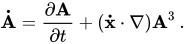
For nonrelativistic motion we may neglect the magnetic force and replace the expression for _m_**ẍ** by:
![{\displaystyle {\begin{aligned}\mathbf {\ddot {x}} +\omega _{0}^{2}\mathbf {x} &\approx {\frac {e}{m}}\mathbf {E} \\&\approx \sum _{\mathbf {k} \lambda }{\sqrt {\frac {2\pi \hbar \omega _{k}}{V}}}\left[a_{\mathbf {k} \lambda }(t)+a_{\mathbf {k} \lambda }^{\dagger }(t)\right]e_{\mathbf {k} \lambda }\end{aligned}}}](https://wikimedia.org/api/rest_v1/media/math/render/svg/7d599af4e0a15961249f4381fd95ca0b826637f4)
Above we have made the electric dipole approximation in which the spatial dependence of the field is neglected. The Heisenberg equation for _a_<sub><b>k</b><i>λ</i></sub> is found similarly from the Hamiltonian to be:
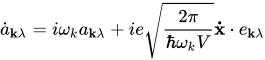
In the electric dipole approximation.
In deriving these equations for **x**, **p**, and _a_<sub><b>k</b><i>λ</i></sub> we have used the fact that equal-time particle and field operators commute. This follows from the assumption that particle and field operators commute at some time (say, _t_ = 0) when the matter-field interpretation is presumed to begin, together with the fact that a Heisenberg-picture operator _A_(_t_) evolves in time as _A_(_t_) = _U_<sup>†</sup>(_t_)_A_(0)_U_(_t_), where _U_(_t_) is the time evolution operator satisfying

Alternatively, we can argue that these operators must commute if we are to obtain the correct equations of motion from the Hamiltonian, just as the corresponding Poisson brackets in classical theory must vanish in order to generate the correct Hamilton equations. The formal solution of the field equation is:

and therefore the equation for _ȧ_<sub><b>k</b><i>λ</i></sub> may be written:

where:
![{\displaystyle \mathbf {E} _{0}(t)=i\sum _{\mathbf {k} \lambda }{\sqrt {\frac {2\pi \hbar \omega _{k}}{V}}}\left[a_{\mathbf {k} \lambda }(0)e^{-i\omega _{k}t}-a_{\mathbf {k} \lambda }^{\dagger }(0)e^{i\omega _{k}t}\right]e_{\mathbf {k} \lambda }}](https://wikimedia.org/api/rest_v1/media/math/render/svg/79c7762e3d4255c5c4f4d6d0407e36584e3ed596)
and:
![{\displaystyle \mathbf {E} _{RR}(t)=-{\frac {4\pi e}{V}}\sum _{\mathbf {k} \lambda }\int _{0}^{t}dt'\left[e_{\mathbf {k} \lambda }\cdot \mathbf {\dot {x}} \left(t'\right)\right]\cos \omega _{k}\left(t'-t\right)}](https://wikimedia.org/api/rest_v1/media/math/render/svg/66305499878dc5dcb445e9e54a8a3508aab1d37e)
It can be shown that in the [radiation reaction](https://en.wikipedia.org/wiki/Abraham%E2%80%93Lorentz_force "Abraham–Lorentz force") field, if the mass m is regarded as the "observed" mass then we can take:
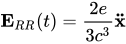
The total field acting on the dipole has two parts, **E**<sub>0</sub>(_t_) and **E**<sub><i>RR</i></sub>(_t_). **E**<sub>0</sub>(_t_) is the free or zero-point field acting on the dipole. It is the homogeneous solution of the Maxwell equation for the field acting on the dipole, i.e., the solution, at the position of the dipole, of the wave equation
![{\displaystyle \left[\nabla ^{2}-{\frac {1}{c^{2}}}{\frac {\partial ^{2}}{\partial t^{2}}}\right]\mathbf {E} =0}](https://wikimedia.org/api/rest_v1/media/math/render/svg/0eb3f09893b6543462f2067d166cefebbecc7811)
satisfied by the field in the (source free) vacuum. For this reason **E**<sub>0</sub>(_t_) is often referred to as the "vacuum field", although it is of course a Heisenberg-picture operator acting on whatever state of the field happens to be appropriate at _t_ = 0. **E**<sub><i>RR</i></sub>(_t_) is the source field, the field generated by the dipole and acting on the dipole.
Using the above equation for **E**<sub><i>RR</i></sub>(_t_) we obtain an equation for the Heisenberg-picture operator  that is formally the same as the classical equation for a linear dipole oscillator:

where _τ_ = 2_e_<sup>2</sup>/3_mc_<sup>3</sup>. in this instance we have considered a dipole in the vacuum, without any "external" field acting on it. the role of the external field in the above equation is played by the vacuum electric field acting on the dipole.
Classically, a dipole in the vacuum is not acted upon by any "external" field: if there are no sources other than the dipole itself, then the only field acting on the dipole is its own radiation reaction field. In quantum theory however there is always an "external" field, namely the source-free or vacuum field **E**<sub>0</sub>(_t_).
According to our earlier equation for _a_<sub><b>k</b><i>λ</i></sub>(_t_) the free field is the only field in existence at _t_ = 0 as the time at which the interaction between the dipole and the field is "switched on". The state vector of the dipole-field system at _t_ = 0 is therefore of the form

where |vac⟩ is the vacuum state of the field and |_ψ<sub>D</sub>_⟩ is the initial state of the dipole oscillator. The expectation value of the free field is therefore at all times equal to zero:

since _a_<sub><b>k</b><i>λ</i></sub>(0)|vac⟩ = 0. however, the energy density associated with the free field is infinite:
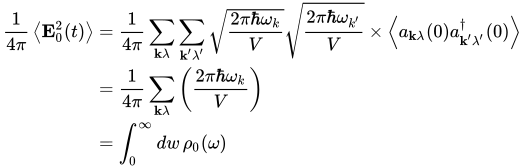
The important point of this is that the zero-point field energy _H<sub>F</sub>_ does not affect the Heisenberg equation for _a_<sub><b>k</b><i>λ</i></sub> since it is a c-number or constant (i.e. an ordinary number rather than an operator) and commutes with _a_<sub><b>k</b><i>λ</i></sub>. We can therefore drop the zero-point field energy from the Hamiltonian, as is usually done. But the zero-point field re-emerges as the homogeneous solution for the field equation. A charged particle in the vacuum will therefore always see a zero-point field of infinite density. This is the origin of one of the infinities of quantum electrodynamics, and it cannot be eliminated by the trivial expedient dropping of the term Σ<sub><b>k</b><i>λ</i></sub> _ħω<sub>k</sub>_/2 in the field Hamiltonian.
The free field is in fact necessary for the formal consistency of the theory. In particular, it is necessary for the preservation of the commutation relations, which is required by the unitary of time evolution in quantum theory:
![{\displaystyle {\begin{aligned}\left[z(t),p_{z}(t)\right]&=\left[U^{\dagger }(t)z(0)U(t),U^{\dagger }(t)p_{z}(0)U(t)\right]\\&=U^{\dagger }(t)\left[z(0),p_{z}(0)\right]U(t)\\&=i\hbar U^{\dagger }(t)U(t)\\&=i\hbar \end{aligned}}}](https://wikimedia.org/api/rest_v1/media/math/render/svg/7bd879d669ee3c5c9fae50a1f314e765c58a3635)
We can calculate \[_z_(_t_),_p<sub>z</sub>_(_t_)\] from the formal solution of the operator equation of motion

Using the fact that
![{\displaystyle \left[a_{\mathbf {k} \lambda }(0),a_{\mathbf {k'} \lambda '}^{\dagger }(0)\right]=\delta _{\mathbf {kk'} }^{3},\delta _{\lambda \lambda '}}](https://wikimedia.org/api/rest_v1/media/math/render/svg/5b319f53134810ccc6a5524bc4cc97a6cd854405)
and that equal-time particle and field operators commute, we obtain:
![{\displaystyle {\begin{aligned}[z(t),p_{z}(t)]&=\left[z(t),m{\dot {z}}(t)\right]+\left[z(t),{\frac {e}{c}}A_{z}(t)\right]\\&=\left[z(t),m{\dot {z}}(t)\right]\\&=\left({\frac {i\hbar e^{2}}{2\pi ^{2}mc^{3}}}\right)\left({\frac {8\pi }{3}}\right)\int _{0}^{\infty }{\frac {d\omega \,\omega ^{4}}{\left(\omega ^{2}-\omega _{0}^{2}\right)^{2}+\tau ^{2}\omega ^{6}}}\end{aligned}}}](https://wikimedia.org/api/rest_v1/media/math/render/svg/41cf948249a6ae51282a1225d60b45d737e07c12)
For the dipole oscillator under consideration it can be assumed that the radiative damping rate is small compared with the natural oscillation frequency, i.e., _τω_<sub>0</sub> ≪ 1. Then the integrand above is sharply peaked at _ω_ = _ω_<sub>0</sub> and:
![{\displaystyle {\begin{aligned}\left[z(t),p_{z}(t)\right]&\approx {\frac {2i\hbar e^{2}}{3\pi mc^{3}}}\omega _{0}^{3}\int _{-\infty }^{\infty }{\frac {dx}{x^{2}+\tau ^{2}\omega _{0}^{6}}}\\&=\left({\frac {2i\hbar e^{2}\omega _{0}^{3}}{3\pi mc^{3}}}\right)\left({\frac {\pi }{\tau \omega _{0}^{3}}}\right)\\&=i\hbar \end{aligned}}}](https://wikimedia.org/api/rest_v1/media/math/render/svg/871074648f797bba79ddb93f1c0a4d7bdafb5378)
the necessity of the vacuum field can also be appreciated by making the small damping approximation in

and

Without the free field **E**<sub>0</sub>(_t_) in this equation the operator **x**(_t_) would be exponentially dampened, and commutators like \[_z_(_t_),_p<sub>z</sub>_(_t_)\] would approach zero for _t_ ≫ 1/_τω_<sup>2</sup>
<sub>0</sub>. With the vacuum field included, however, the commutator is _iħ_ at all times, as required by unitarity, and as we have just shown. A similar result is easily worked out for the case of a free particle instead of a dipole oscillator.<sup id="cite_ref-FOOTNOTEMilonni1981_98-0"><a href="https://en.wikipedia.org/wiki/Zero-point_energy#cite_note-FOOTNOTEMilonni1981-98">[98]</a></sup>
What we have here is an example of a "fluctuation-dissipation elation". Generally speaking if a system is coupled to a bath that can take energy from the system in an effectively irreversible way, then the bath must also cause fluctuations. The fluctuations and the dissipation go hand in hand we cannot have one without the other. In the current example the coupling of a dipole oscillator to the electromagnetic field has a dissipative component, in the form of the zero-point (vacuum) field; given the existence of radiation reaction, the vacuum field must also exist in order to preserve the canonical commutation rule and all it entails.
The spectral density of the vacuum field is fixed by the form of the radiation reaction field, or vice versa: because the radiation reaction field varies with the third derivative of **x**, the spectral energy density of the vacuum field must be proportional to the third power of ω in order for \[_z_(_t_),_p<sub>z</sub>_(_t_)\] to hold. In the case of a dissipative force proportional to **ẋ**, by contrast, the fluctuation force must be proportional to  in order to maintain the canonical commutation relation.<sup id="cite_ref-FOOTNOTEMilonni1981_98-1"><a href="https://en.wikipedia.org/wiki/Zero-point_energy#cite_note-FOOTNOTEMilonni1981-98">[98]</a></sup> This relation between the form of the dissipation and the spectral density of the fluctuation is the essence of the fluctuation-dissipation theorem.<sup id="cite_ref-ReferenceB_77-1"><a href="https://en.wikipedia.org/wiki/Zero-point_energy#cite_note-ReferenceB-77">[77]</a></sup>
The fact that the canonical commutation relation for a harmonic oscillator coupled to the vacuum field is preserved implies that the zero-point energy of the oscillator is preserved. it is easy to show that after a few damping times the zero-point motion of the oscillator is in fact sustained by the driving zero-point field.<sup id="cite_ref-ReferenceG_99-0"><a href="https://en.wikipedia.org/wiki/Zero-point_energy#cite_note-ReferenceG-99">[99]</a></sup>
### The quantum chromodynamic vacuum\[[edit](https://en.wikipedia.org/w/index.php?title=Zero-point_energy&action=edit§ion=14 "Edit section: The quantum chromodynamic vacuum")\]
The QCD vacuum is the [vacuum state](https://en.wikipedia.org/wiki/Vacuum_state "Vacuum state") of [quantum chromodynamics](https://en.wikipedia.org/wiki/Quantum_chromodynamics "Quantum chromodynamics") (QCD). It is an example of a _[non-perturbative](https://en.wikipedia.org/wiki/Non-perturbative "Non-perturbative")_ vacuum state, characterized by a non-vanishing [condensates](https://en.wikipedia.org/wiki/Condensate_(quantum_field_theory) "Condensate (quantum field theory)") such as the [gluon condensate](https://en.wikipedia.org/wiki/Gluon_condensate "Gluon condensate") and the [quark condensate](https://en.wikipedia.org/wiki/Quark_condensate "Quark condensate") in the complete theory which includes quarks. The presence of these condensates characterizes the confined phase of [quark matter](https://en.wikipedia.org/wiki/Quark_matter "Quark matter"). In technical terms, gluons are [vector](https://en.wikipedia.org/wiki/Vector_boson "Vector boson") [gauge bosons](https://en.wikipedia.org/wiki/Gauge_boson "Gauge boson") that mediate [strong interactions](https://en.wikipedia.org/wiki/Strong_interaction "Strong interaction") of [quarks](https://en.wikipedia.org/wiki/Quark "Quark") in [quantum chromodynamics](https://en.wikipedia.org/wiki/Quantum_chromodynamics "Quantum chromodynamics") (QCD). Gluons themselves carry the [color charge](https://en.wikipedia.org/wiki/Color_charge "Color charge") of the strong interaction. This is unlike the [photon](https://en.wikipedia.org/wiki/Photon "Photon"), which mediates the [electromagnetic interaction](https://en.wikipedia.org/wiki/Electromagnetic_force "Electromagnetic force") but lacks an electric charge. Gluons therefore participate in the strong interaction in addition to mediating it, making QCD significantly harder to analyze than QED ([quantum electrodynamics](https://en.wikipedia.org/wiki/Quantum_electrodynamics "Quantum electrodynamics")) as it deals with [nonlinear equations](https://en.wikipedia.org/wiki/Nonlinear_equation "Nonlinear equation") to characterize such interactions.
### The Higgs field\[[edit](https://en.wikipedia.org/w/index.php?title=Zero-point_energy&action=edit§ion=15 "Edit section: The Higgs field")\]
[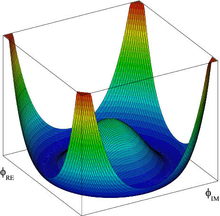](https://en.wikipedia.org/wiki/File:Mecanismo_de_Higgs_PH.png)
The potential for the Higgs field, plotted as function of _ϕ_<sup>0</sup> and _ϕ_<sup>3</sup>. It has a _Mexican-hat_ or _champagne-bottle profile_ at the ground.
The Standard Model hypothesises a field called the Higgs field (symbol: ϕ), which has the unusual property of a non-zero amplitude in its ground state (zero-point) energy after renormalization; i.e., a non-zero vacuum expectation value. It can have this effect because of its unusual "Mexican hat" shaped potential whose lowest "point" is not at its "centre". Below a certain extremely high energy level the existence of this non-zero vacuum expectation [spontaneously breaks](https://en.wikipedia.org/wiki/Spontaneous_symmetry_breaking "Spontaneous symmetry breaking") [electroweak](https://en.wikipedia.org/wiki/Electroweak "Electroweak") [gauge symmetry](https://en.wikipedia.org/wiki/Gauge_symmetry "Gauge symmetry") which in turn gives rise to the Higgs mechanism and triggers the acquisition of mass by those particles interacting with the field. The Higgs mechanism occurs whenever a charged field has a vacuum expectation value. This effect occurs because scalar field components of the Higgs field are "absorbed" by the massive bosons as degrees of freedom, and couple to the fermions via Yukawa coupling, thereby producing the expected mass terms. The expectation value of _ϕ_<sup>0</sup> in the ground state (the [vacuum expectation value](https://en.wikipedia.org/wiki/Vacuum_expectation_value "Vacuum expectation value") or VEV) is then ⟨_ϕ_<sup>0</sup>⟩ = _v_/√2, where _v_ = |_μ_|/√_λ_. The measured value of this parameter is approximately 246 GeV/_c_<sup>2</sup>.<sup id="cite_ref-PDGreview2012_100-0"><a href="https://en.wikipedia.org/wiki/Zero-point_energy#cite_note-PDGreview2012-100">[100]</a></sup> It has units of mass, and is the only free parameter of the Standard Model that is not a dimensionless number.
The Higgs mechanism is a type of [superconductivity](https://en.wikipedia.org/wiki/Superconductivity "Superconductivity") which occurs in the vacuum. It occurs when all of space is filled with a sea of particles which are charged and thus the field has a nonzero vacuum expectation value. Interaction with the vacuum energy filling the space prevents certain forces from propagating over long distances (as it does in a superconducting medium; e.g., in the [Ginzburg–Landau theory](https://en.wikipedia.org/wiki/Ginzburg%E2%80%93Landau_theory "Ginzburg–Landau theory")).
## Experimental observations\[[edit](https://en.wikipedia.org/w/index.php?title=Zero-point_energy&action=edit§ion=16 "Edit section: Experimental observations")\]
Zero-point energy has many observed physical consequences.<sup id="cite_ref-FOOTNOTEMilonni1994111_12-2"><a href="https://en.wikipedia.org/wiki/Zero-point_energy#cite_note-FOOTNOTEMilonni1994111-12">[12]</a></sup> It is important to note that zero-point energy is not merely an artifact of mathematical formalism that can, for instance, be dropped from a Hamiltonian by redefining the zero of energy, or by arguing that it is a constant and therefore has no effect on Heisenberg equations of motion without latter consequence.<sup id="cite_ref-FOOTNOTEMilonni199442–43_101-0"><a href="https://en.wikipedia.org/wiki/Zero-point_energy#cite_note-FOOTNOTEMilonni199442%E2%80%9343-101">[101]</a></sup> Indeed, such treatment could create a problem at a deeper, as of yet undiscovered, theory.<sup id="cite_ref-FOOTNOTEPeskinSchroeder199522_102-0"><a href="https://en.wikipedia.org/wiki/Zero-point_energy#cite_note-FOOTNOTEPeskinSchroeder199522-102">[102]</a></sup> For instance, in general relativity the zero of energy (i.e. the energy density of the vacuum) contributes to a cosmological constant of the type introduced by Einstein in order to obtain static solutions to his field equations.<sup id="cite_ref-FOOTNOTEMilonni2009865_103-0"><a href="https://en.wikipedia.org/wiki/Zero-point_energy#cite_note-FOOTNOTEMilonni2009865-103">[103]</a></sup> The zero-point energy density of the vacuum, due to all quantum fields, is extremely large, even when we cut off the largest allowable frequencies based on plausible physical arguments. It implies a cosmological constant larger than the limits imposed by observation by about 120 orders of magnitude. This "cosmological constant problem" remains one of the greatest unsolved mysteries of physics.<sup id="cite_ref-scientificamerican0588-106_104-0"><a href="https://en.wikipedia.org/wiki/Zero-point_energy#cite_note-scientificamerican0588-106-104">[104]</a></sup>
### Casimir effect\[[edit](https://en.wikipedia.org/w/index.php?title=Zero-point_energy&action=edit§ion=17 "Edit section: Casimir effect")\]
[](https://en.wikipedia.org/wiki/File:Casimir_plates.svg)
Casimir forces on parallel plates
A phenomenon that is commonly presented as evidence for the existence of zero-point energy in vacuum is the [Casimir effect](https://en.wikipedia.org/wiki/Casimir_effect "Casimir effect"), proposed in 1948 by [Dutch](https://en.wikipedia.org/wiki/Netherlands "Netherlands") [physicist](https://en.wikipedia.org/wiki/Physicist "Physicist") [Hendrik Casimir](https://en.wikipedia.org/wiki/Hendrik_Casimir "Hendrik Casimir"), who considered the quantized [electromagnetic field](https://en.wikipedia.org/wiki/Electromagnetic_field "Electromagnetic field") between a pair of grounded, neutral metal plates. The vacuum energy contains contributions from all wavelengths, except those excluded by the spacing between plates. As the plates draw together, more wavelengths are excluded and the vacuum energy decreases. The decrease in energy means there must be a force doing work on the plates as they move.
Early experimental tests from the 1950s onwards gave positive results showing the force was real, but other external factors could not be ruled out as the primary cause, with the range of experimental error sometimes being nearly 100%.<sup id="cite_ref-105"><a href="https://en.wikipedia.org/wiki/Zero-point_energy#cite_note-105">[105]</a></sup><sup id="cite_ref-106"><a href="https://en.wikipedia.org/wiki/Zero-point_energy#cite_note-106">[106]</a></sup><sup id="cite_ref-107"><a href="https://en.wikipedia.org/wiki/Zero-point_energy#cite_note-107">[107]</a></sup><sup id="cite_ref-108"><a href="https://en.wikipedia.org/wiki/Zero-point_energy#cite_note-108">[108]</a></sup><sup id="cite_ref-109"><a href="https://en.wikipedia.org/wiki/Zero-point_energy#cite_note-109">[109]</a></sup> That changed in 1997 with Lamoreaux<sup id="cite_ref-110"><a href="https://en.wikipedia.org/wiki/Zero-point_energy#cite_note-110">[110]</a></sup> conclusively showing that the Casimir force was real. Results have been repeatedly replicated since then.<sup id="cite_ref-111"><a href="https://en.wikipedia.org/wiki/Zero-point_energy#cite_note-111">[111]</a></sup><sup id="cite_ref-FOOTNOTEChan_et_al.2001_112-0"><a href="https://en.wikipedia.org/wiki/Zero-point_energy#cite_note-FOOTNOTEChan_et_al.2001-112">[112]</a></sup><sup id="cite_ref-FOOTNOTEBressi_et_al.2002_113-0"><a href="https://en.wikipedia.org/wiki/Zero-point_energy#cite_note-FOOTNOTEBressi_et_al.2002-113">[113]</a></sup><sup id="cite_ref-FOOTNOTEDecca_et_al.2003_114-0"><a href="https://en.wikipedia.org/wiki/Zero-point_energy#cite_note-FOOTNOTEDecca_et_al.2003-114">[114]</a></sup>
In 2009, Munday et al.<sup id="cite_ref-115"><a href="https://en.wikipedia.org/wiki/Zero-point_energy#cite_note-115">[115]</a></sup> published experimental proof that (as predicted in 1961<sup id="cite_ref-116"><a href="https://en.wikipedia.org/wiki/Zero-point_energy#cite_note-116">[116]</a></sup>) the Casimir force could also be repulsive as well as being attractive. Repulsive Casimir forces could allow quantum levitation of objects in a fluid and lead to a new class of switchable nanoscale devices with ultra-low static friction.<sup id="cite_ref-FOOTNOTECapasso_et_al.2007_117-0"><a href="https://en.wikipedia.org/wiki/Zero-point_energy#cite_note-FOOTNOTECapasso_et_al.2007-117">[117]</a></sup>
An interesting hypothetical side effect of the Casimir effect is the [Scharnhorst effect](https://en.wikipedia.org/wiki/Scharnhorst_effect "Scharnhorst effect"), a hypothetical phenomenon in which light signals travel slightly [faster than c](https://en.wikipedia.org/wiki/Faster-than-light "Faster-than-light") between two closely spaced conducting plates.<sup id="cite_ref-Scharnhorst_1993_118-0"><a href="https://en.wikipedia.org/wiki/Zero-point_energy#cite_note-Scharnhorst_1993-118">[118]</a></sup>
### Lamb shift\[[edit](https://en.wikipedia.org/w/index.php?title=Zero-point_energy&action=edit§ion=18 "Edit section: Lamb shift")\]
[](https://en.wikipedia.org/wiki/File:Hydrogen_fine_structure.svg)
The quantum fluctuations of the electromagnetic field have important physical consequences. In addition to the Casimir effect, they also lead to a splitting between the two [energy levels](https://en.wikipedia.org/wiki/Energy_level "Energy level") <sup>2</sup>_S_<sub><span role="math"><span>1</span><span>/</span><span>2</span></span></sub> and <sup>2</sup>_P_<sub><span role="math"><span>1</span><span>/</span><span>2</span></span></sub> (in [term symbol](https://en.wikipedia.org/wiki/Term_symbol "Term symbol") notation) of the [hydrogen atom](https://en.wikipedia.org/wiki/Hydrogen_atom "Hydrogen atom") which was not predicted by the [Dirac equation](https://en.wikipedia.org/wiki/Dirac_equation "Dirac equation"), according to which these states should have the same energy. Charged particles can interact with the fluctuations of the quantized vacuum field, leading to slight shifts in energy,<sup id="cite_ref-FOOTNOTEItzyksonZuber198080_119-0"><a href="https://en.wikipedia.org/wiki/Zero-point_energy#cite_note-FOOTNOTEItzyksonZuber198080-119">[119]</a></sup> this effect is called the Lamb shift.<sup id="cite_ref-120"><a href="https://en.wikipedia.org/wiki/Zero-point_energy#cite_note-120">[120]</a></sup> The shift of about 4.38×10<sup>−6</sup> eV is roughly 10<sup>−7</sup> of the difference between the energies of the 1s and 2s levels, and amounts to 1,058 MHz in frequency units. A small part of this shift (27 MHz ≈ 3%) arises not from fluctuations of the electromagnetic field, but from fluctuations of the electron–positron field. The creation of (virtual) electron–positron pairs has the effect of screening the Coulomb field and acts as a vacuum dielectric constant. This effect is much more important in muonic atoms.<sup id="cite_ref-FOOTNOTELe_Bellac2006381_121-0"><a href="https://en.wikipedia.org/wiki/Zero-point_energy#cite_note-FOOTNOTELe_Bellac2006381-121">[121]</a></sup>
### Fine-structure constant\[[edit](https://en.wikipedia.org/w/index.php?title=Zero-point_energy&action=edit§ion=19 "Edit section: Fine-structure constant")\]
Taking ħ ([Planck's constant](https://en.wikipedia.org/wiki/Planck%27s_constant "Planck's constant") divided by 2π), c (the [speed of light](https://en.wikipedia.org/wiki/Speed_of_light "Speed of light")), and _e_<sup>2</sup> = _q_<sup>2</sup>
<sub><i>e</i></sub>/4π_ε_<sub>0</sub> (the electromagnetic [coupling constant](https://en.wikipedia.org/wiki/Coupling_constant "Coupling constant") i.e. a measure of the strength of the [electromagnetic force](https://en.wikipedia.org/wiki/Electromagnetic_force "Electromagnetic force") (where _q<sub>e</sub>_ is the absolute value of the [electronic charge](https://en.wikipedia.org/wiki/Electron_charge "Electron charge") and  is the [vacuum permittivity](https://en.wikipedia.org/wiki/Vacuum_permittivity "Vacuum permittivity"))) we can form a dimensionless quantity called the [fine-structure constant](https://en.wikipedia.org/wiki/Fine-structure_constant "Fine-structure constant"):
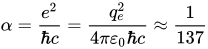
The fine-structure constant is the coupling constant of [quantum electrodynamics](https://en.wikipedia.org/wiki/Quantum_electrodynamics "Quantum electrodynamics") (QED) determining the strength of the interaction between electrons and photons. It turns out that the fine-structure constant is not really a constant at all owing to the zero-point energy fluctuations of the electron-positron field.<sup id="cite_ref-FOOTNOTELe_Bellac200633_122-0"><a href="https://en.wikipedia.org/wiki/Zero-point_energy#cite_note-FOOTNOTELe_Bellac200633-122">[122]</a></sup> The quantum fluctuations caused by zero-point energy have the effect of screening electric charges: owing to (virtual) electron-positron pair production, the charge of the particle measured far from the particle is far smaller than the charge measured when close to it.
The Heisenberg inequality where _ħ_ = _h_/2π, and Δ<sub><i>x</i></sub>, Δ<sub><i>p</i></sub> are the standard deviations of position and momentum states that:
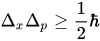
It means that a short distance implies large momentum and therefore high energy i.e. particles of high energy must be used to explore short distances. QED concludes that the fine-structure constant is an increasing function of energy. It has been shown that at energies of the order of the [Z<sup>0</sup> boson](https://en.wikipedia.org/wiki/Z_boson "Z boson") rest energy, _m<sub>z</sub>c_<sup>2</sup> ≈ 90 GeV, that:

rather than the low-energy _α_ ≈ 1/137.<sup id="cite_ref-123"><a href="https://en.wikipedia.org/wiki/Zero-point_energy#cite_note-123">[123]</a></sup><sup id="cite_ref-124"><a href="https://en.wikipedia.org/wiki/Zero-point_energy#cite_note-124">[124]</a></sup> The renormalization procedure of eliminating zero-point energy infinities allows the choice of an arbitrary energy (or distance) scale for defining α. All in all, α depends on the energy scale characteristic of the process under study, and also on details of the renormalization procedure. The energy dependence of α has been observed for several years now in precision experiment in high-energy physics.
### Vacuum birefringence\[[edit](https://en.wikipedia.org/w/index.php?title=Zero-point_energy&action=edit§ion=20 "Edit section: Vacuum birefringence")\]
Light coming from the surface of a strongly magnetic [neutron star](https://en.wikipedia.org/wiki/Neutron_star "Neutron star") (left) becomes linearly polarised as it travels through the vacuum.
In the presence of strong electrostatic fields it is predicted that virtual particles become separated from the vacuum state and form real matter.<sup>[<i><a href="https://en.wikipedia.org/wiki/Wikipedia:Citation_needed" title="Wikipedia:Citation needed"><span title="This claim needs references to reliable sources. (May 2019)">citation needed</span></a></i>]</sup> The fact that electromagnetic radiation can be transformed into matter and vice versa leads to fundamentally new features in [quantum electrodynamics](https://en.wikipedia.org/wiki/Quantum_electrodynamics "Quantum electrodynamics"). One of the most important consequences is that, even in the vacuum, the Maxwell equations have to be exchanged by more complicated formulas. In general, it will be not possible to separate processes in the vacuum from the processes involving matter since electromagnetic fields can create matter if the field fluctuations are strong enough. This leads to highly complex nonlinear interaction - gravity will have an effect on the light at the same time the light has an effect on gravity. These effects were first predicted by [Werner Heisenberg](https://en.wikipedia.org/wiki/Werner_Heisenberg "Werner Heisenberg") and [Hans Heinrich Euler](https://en.wikipedia.org/wiki/Hans_Heinrich_Euler "Hans Heinrich Euler") in 1936<sup id="cite_ref-FOOTNOTEHeisenbergEuler1936_125-0"><a href="https://en.wikipedia.org/wiki/Zero-point_energy#cite_note-FOOTNOTEHeisenbergEuler1936-125">[125]</a></sup> and independently the same year by [Victor Weisskopf](https://en.wikipedia.org/wiki/Victor_Weisskopf "Victor Weisskopf") who stated: "The physical properties of the vacuum originate in the "zero-point energy" of matter, which also depends on absent particles through the external field strengths and therefore contributes an additional term to the purely Maxwellian field energy".<sup id="cite_ref-FOOTNOTEWeisskopf19363_126-0"><a href="https://en.wikipedia.org/wiki/Zero-point_energy#cite_note-FOOTNOTEWeisskopf19363-126">[126]</a></sup><sup id="cite_ref-FOOTNOTEGreinerMüllerRafelski2012278_127-0"><a href="https://en.wikipedia.org/wiki/Zero-point_energy#cite_note-FOOTNOTEGreinerM%C3%BCllerRafelski2012278-127">[127]</a></sup> Thus strong magnetic fields vary the energy contained in the vacuum. The scale above which the electromagnetic field is expected to become nonlinear is known as the [Schwinger limit](https://en.wikipedia.org/wiki/Schwinger_limit "Schwinger limit"). At this point the vacuum has all the properties of a [birefringent medium](https://en.wikipedia.org/wiki/Birefringence "Birefringence"), thus in principle a rotation of the polarization frame (the [Faraday effect](https://en.wikipedia.org/wiki/Faraday_effect "Faraday effect")) can be observed in empty space.<sup id="cite_ref-FOOTNOTEGreinerMüllerRafelski2012291_128-0"><a href="https://en.wikipedia.org/wiki/Zero-point_energy#cite_note-FOOTNOTEGreinerM%C3%BCllerRafelski2012291-128">[128]</a></sup><sup id="cite_ref-129"><a href="https://en.wikipedia.org/wiki/Zero-point_energy#cite_note-129">[129]</a></sup>
[](https://en.wikipedia.org/wiki/File:Wide_field_view_of_the_sky_around_the_very_faint_neutron_star_RX_J1856.5-3754.jpg)
Both Einstein's theory of special and general relativity state that light should pass freely through a vacuum without being altered, a principle known as [Lorentz invariance](https://en.wikipedia.org/wiki/Lorentz_invariance "Lorentz invariance"). Yet, in theory, large nonlinear self-interaction of light due to quantum fluctuations should lead to this principle being measurably violated if the interactions are strong enough. Nearly all theories of [quantum gravity](https://en.wikipedia.org/wiki/Quantum_gravity "Quantum gravity") predict that that Lorentz invariance is not an exact symmetry of nature. It is predicted the speed at which light travels through the vacuum depends on its direction, polarization and the local strength of the magnetic field.<sup id="cite_ref-FOOTNOTEHeylShaviv20001_130-0"><a href="https://en.wikipedia.org/wiki/Zero-point_energy#cite_note-FOOTNOTEHeylShaviv20001-130">[130]</a></sup> There have been a number of inconclusive results which claim to show evidence of a [Lorentz violation](https://en.wikipedia.org/wiki/Modern_searches_for_Lorentz_violation "Modern searches for Lorentz violation") by finding a rotation of the polarization plane of light coming from distant galaxies.<sup id="cite_ref-131"><a href="https://en.wikipedia.org/wiki/Zero-point_energy#cite_note-131">[131]</a></sup> The first concrete evidence for vacuum birefringence was published in 2017 when a team of [astronomers](https://en.wikipedia.org/wiki/Astronomers "Astronomers") looked at the light coming from the star [RX J1856.5-3754](https://en.wikipedia.org/wiki/RX_J1856.5-3754 "RX J1856.5-3754"),<sup id="cite_ref-132"><a href="https://en.wikipedia.org/wiki/Zero-point_energy#cite_note-132">[132]</a></sup> the closest discovered [neutron star](https://en.wikipedia.org/wiki/Neutron_star "Neutron star") to [Earth](https://en.wikipedia.org/wiki/Earth "Earth").<sup id="cite_ref-FOOTNOTERees2012528_133-0"><a href="https://en.wikipedia.org/wiki/Zero-point_energy#cite_note-FOOTNOTERees2012528-133">[133]</a></sup>
Roberto Mignani at the [National Institute for Astrophysics](https://en.wikipedia.org/wiki/National_Institute_for_Astrophysics "National Institute for Astrophysics") in [Milan](https://en.wikipedia.org/wiki/Milan "Milan") who led the team of [astronomers](https://en.wikipedia.org/wiki/Astronomers "Astronomers") has commented that "When Einstein came up with the theory of general relativity 100 years ago, he had no idea that it would be used for navigational systems. The consequences of this discovery probably will also have to be realised on a longer timescale."<sup id="cite_ref-FOOTNOTECrane2016_134-0"><a href="https://en.wikipedia.org/wiki/Zero-point_energy#cite_note-FOOTNOTECrane2016-134">[134]</a></sup> The team found that visible light from the star had undergone linear polarisation<sup>[<i><a href="https://en.wikipedia.org/wiki/Wikipedia:Please_clarify" title="Wikipedia:Please clarify"><span title="The text near this tag may need clarification or removal of jargon. (May 2018)">clarification needed</span></a></i>]</sup> of around 16%. If the birefringence had been caused by light passing through [interstellar gas](https://en.wikipedia.org/wiki/Interstellar_gas "Interstellar gas") or plasma, the effect should have been no more than 1%. Definitive proof would require repeating the observation at other wavelengths and on other neutron stars. At [X-ray](https://en.wikipedia.org/wiki/X-ray "X-ray") wavelengths the polarization from the quantum fluctuations should be near 100%.<sup id="cite_ref-FOOTNOTECho2016_135-0"><a href="https://en.wikipedia.org/wiki/Zero-point_energy#cite_note-FOOTNOTECho2016-135">[135]</a></sup> Although no [telescope](https://en.wikipedia.org/wiki/Telescope "Telescope") currently exists that can make such measurements, there are several proposed X-ray telescopes that may soon be able to verify the result conclusively such as China's [Hard X-ray Modulation Telescope](https://en.wikipedia.org/wiki/Hard_X-ray_Modulation_Telescope "Hard X-ray Modulation Telescope") (HXMT) and NASA's Imaging X-ray Polarimetry Explorer (IXPE).
## Speculated involvement in other phenomena\[[edit](https://en.wikipedia.org/w/index.php?title=Zero-point_energy&action=edit§ion=21 "Edit section: Speculated involvement in other phenomena")\]
### Dark energy\[[edit](https://en.wikipedia.org/w/index.php?title=Zero-point_energy&action=edit§ion=22 "Edit section: Dark energy")\]
In the late 1990s it was discovered that very distant [supernova](https://en.wikipedia.org/wiki/Supernova "Supernova") were dimmer than expected suggesting that the universe's expansion was accelerating rather than slowing down.<sup id="cite_ref-FOOTNOTERiess_et_al.1998_137-0"><a href="https://en.wikipedia.org/wiki/Zero-point_energy#cite_note-FOOTNOTERiess_et_al.1998-137">[137]</a></sup><sup id="cite_ref-FOOTNOTEPerlmutter_et_al.1998_138-0"><a href="https://en.wikipedia.org/wiki/Zero-point_energy#cite_note-FOOTNOTEPerlmutter_et_al.1998-138">[138]</a></sup> This revived discussion that Einstein's [cosmological constant](https://en.wikipedia.org/wiki/Cosmological_constant "Cosmological constant"), long disregarded by physicists as being equal to zero, was in fact some small positive value. This would indicate empty space exerted some form of [negative pressure or energy](https://en.wikipedia.org/wiki/Negative_energy "Negative energy").
There is no natural candidate for what might cause what has been called [dark energy](https://en.wikipedia.org/wiki/Dark_energy "Dark energy") but the current best guess is that it is the zero-point energy of the vacuum.<sup id="cite_ref-139"><a href="https://en.wikipedia.org/wiki/Zero-point_energy#cite_note-139">[139]</a></sup> One difficulty with this assumption is that the zero-point energy of the vacuum is absurdly large compared to the observed cosmological constant. In [general relativity](https://en.wikipedia.org/wiki/General_relativity "General relativity"), [mass](https://en.wikipedia.org/wiki/Mass "Mass") and energy are equivalent; both produce a gravitational field and therefore the theorized vacuum energy of quantum field theory should have led to the universe ripping itself to pieces. This obviously has not happened and this issue, called the [cosmological constant problem](https://en.wikipedia.org/wiki/Cosmological_constant_problem "Cosmological constant problem"), is one of the greatest unsolved mysteries in physics.
The [European Space Agency](https://en.wikipedia.org/wiki/European_Space_Agency "European Space Agency") is building the [Euclid telescope](https://en.wikipedia.org/wiki/Euclid_(spacecraft) "Euclid (spacecraft)"). Due to launch in 2023, it will map galaxies up to 10 billion light years away. By seeing how dark energy influences their arrangement and shape, the mission will allow scientists to see if the strength of dark energy has changed. If dark energy is found to vary throughout time it would indicate it is due to [quintessence](https://en.wikipedia.org/wiki/Quintessence_(physics) "Quintessence (physics)"), where observed acceleration is due to the energy of a [scalar field](https://en.wikipedia.org/wiki/Scalar_field "Scalar field"), rather than the cosmological constant. No evidence of quintessence is yet available, but it has not been ruled out either. It generally predicts a slightly slower acceleration of the expansion of the universe than the cosmological constant. Some scientists think that the best evidence for quintessence would come from violations of Einstein's [equivalence principle](https://en.wikipedia.org/wiki/Equivalence_principle "Equivalence principle") and [variation of the fundamental constants](https://en.wikipedia.org/wiki/Equivalence_principle#Tests_of_the_Einstein_equivalence_principle "Equivalence principle") in space or time.<sup id="cite_ref-Carroll1998_140-0"><a href="https://en.wikipedia.org/wiki/Zero-point_energy#cite_note-Carroll1998-140">[140]</a></sup> [Scalar fields](https://en.wikipedia.org/wiki/Scalar_field "Scalar field") are predicted by the _[Standard Model](https://en.wikipedia.org/wiki/Standard_Model "Standard Model") of particle physics_ and [string theory](https://en.wikipedia.org/wiki/String_theory "String theory"), but an analogous problem to the cosmological constant problem (or the problem of constructing models of [cosmological inflation](https://en.wikipedia.org/wiki/Cosmological_inflation "Cosmological inflation")) occurs: [renormalization](https://en.wikipedia.org/wiki/Renormalization "Renormalization") theory predicts that scalar fields should acquire large masses again due to zero-point energy.
### Cosmic inflation\[[edit](https://en.wikipedia.org/w/index.php?title=Zero-point_energy&action=edit§ion=23 "Edit section: Cosmic inflation")\]
Unsolved problem in physics:
Why does the observable universe have more matter than antimatter?
[Cosmic inflation](https://en.wikipedia.org/wiki/Cosmic_inflation "Cosmic inflation") is a faster-than-light expansion of space just after the [Big Bang](https://en.wikipedia.org/wiki/Big_Bang "Big Bang"). It explains the origin of the [large-scale structure of the cosmos](https://en.wikipedia.org/wiki/Observable_universe#Large-scale_structure "Observable universe"). It is believed [quantum vacuum fluctuations](https://en.wikipedia.org/wiki/Quantum_vacuum_fluctuations "Quantum vacuum fluctuations") caused by zero-point energy arising in the microscopic inflationary period, later became magnified to a cosmic size, becoming the gravitational seeds for galaxies and structure in the Universe (see [galaxy formation and evolution](https://en.wikipedia.org/wiki/Galaxy_formation_and_evolution "Galaxy formation and evolution") and [structure formation](https://en.wikipedia.org/wiki/Structure_formation "Structure formation")).<sup id="cite_ref-141"><a href="https://en.wikipedia.org/wiki/Zero-point_energy#cite_note-141">[141]</a></sup> Many physicists also believe that inflation explains why the Universe appears to be the same in all directions ([isotropic](https://en.wikipedia.org/wiki/Isotropic "Isotropic")), why the [cosmic microwave background](https://en.wikipedia.org/wiki/Cosmic_microwave_background "Cosmic microwave background") radiation is distributed evenly, why the Universe is flat, and why no [magnetic monopoles](https://en.wikipedia.org/wiki/Magnetic_monopole "Magnetic monopole") have been observed.
The mechanism for inflation is unclear, it is similar in effect to dark energy but is a far more energetic and short lived process. As with dark energy the best explanation is some form of vacuum energy arising from quantum fluctuations. It may be that inflation caused [baryogenesis](https://en.wikipedia.org/wiki/Baryogenesis "Baryogenesis"), the hypothetical physical processes that produced an [asymmetry](https://en.wikipedia.org/wiki/Symmetry "Symmetry") (imbalance) between [baryons](https://en.wikipedia.org/wiki/Baryon "Baryon") and antibaryons produced in the [very early universe](https://en.wikipedia.org/wiki/Big_Bang "Big Bang"), but this is far from certain.
## Alternative theories\[[edit](https://en.wikipedia.org/w/index.php?title=Zero-point_energy&action=edit§ion=24 "Edit section: Alternative theories")\]
There has been a long debate<sup id="cite_ref-142"><a href="https://en.wikipedia.org/wiki/Zero-point_energy#cite_note-142">[142]</a></sup> over the question of whether zero-point fluctuations of quantized vacuum fields are "real" i.e. do they have physical effects that cannot be interpreted by an equally valid alternative theory? [Schwinger](https://en.wikipedia.org/wiki/Julian_Schwinger "Julian Schwinger"), in particular, attempted to formulate QED without reference to zero-point fluctuations via his "source theory".<sup id="cite_ref-143"><a href="https://en.wikipedia.org/wiki/Zero-point_energy#cite_note-143">[143]</a></sup> From such an approach it is possible to derive the Casimir Effect without reference to a fluctuating field. Such a derivation was first given by Schwinger (1975)<sup id="cite_ref-144"><a href="https://en.wikipedia.org/wiki/Zero-point_energy#cite_note-144">[144]</a></sup> for a scalar field, and then generalized to the electromagnetic case by Schwinger, DeRaad, and Milton (1978).<sup id="cite_ref-145"><a href="https://en.wikipedia.org/wiki/Zero-point_energy#cite_note-145">[145]</a></sup> in which they state "the vacuum is regarded as truly a state with all physical properties equal to zero". More recently [Jaffe](https://en.wikipedia.org/wiki/Robert_Jaffe "Robert Jaffe") (2005)<sup id="cite_ref-146"><a href="https://en.wikipedia.org/wiki/Zero-point_energy#cite_note-146">[146]</a></sup> has highlighted a similar approach in deriving the Casimir effect stating "the concept of zero-point fluctuations is a heuristic and calculational aid in the description of the Casimir effect, but not a necessity in QED."
Nevertheless, as Jaffe himself notes in his paper, "no one has shown that source theory or another S-matrix based approach can provide a complete description of QED to all orders." Furthermore, [Milonni](https://en.wikipedia.org/wiki/Peter_W._Milonni "Peter W. Milonni") has shown the necessity of the vacuum field for the formal consistency of QED.<sup id="cite_ref-FOOTNOTEMilonni199448_147-0"><a href="https://en.wikipedia.org/wiki/Zero-point_energy#cite_note-FOOTNOTEMilonni199448-147">[147]</a></sup> In [QCD](https://en.wikipedia.org/wiki/QCD "QCD"), [color confinement](https://en.wikipedia.org/wiki/Color_confinement "Color confinement") has led physicists to abandon the source theory or [S-matrix](https://en.wikipedia.org/wiki/S-matrix "S-matrix") based approach for the [strong interactions](https://en.wikipedia.org/wiki/Strong_interactions "Strong interactions"). The [Higgs mechanism](https://en.wikipedia.org/wiki/Higgs_mechanism "Higgs mechanism"), [Hawking Radiation](https://en.wikipedia.org/wiki/Hawking_Radiation "Hawking Radiation") and the [Unruh effect](https://en.wikipedia.org/wiki/Unruh_effect "Unruh effect") are also theorized to be dependent on zero-point vacuum fluctuations, the field contribution being an inseparable parts of these theories. Jaffe continues "Even if one could argue away zero-point contributions to the quantum vacuum energy, the problem of spontaneous symmetry breaking remains: condensates \[ground state vacua\] that carry energy appear at many energy scales in the Standard Model. So there is good reason to be skeptical of attempts to avoid the standard formulation of quantum field theory and the zero-point energies it brings with it." It is difficult to judge the physical reality of infinite zero-point energies that are inherent in field theories, but modern physics does not know any better way to construct gauge-invariant, renormalizable theories than with zero-point energy and they would seem to be a necessity for any attempt at a [unified theory](https://en.wikipedia.org/wiki/Grand_Unified_Theory "Grand Unified Theory").<sup id="cite_ref-FOOTNOTEGreinerMüllerRafelski201220_148-0"><a href="https://en.wikipedia.org/wiki/Zero-point_energy#cite_note-FOOTNOTEGreinerM%C3%BCllerRafelski201220-148">[148]</a></sup>
## Chaotic and emergent phenomena\[[edit](https://en.wikipedia.org/w/index.php?title=Zero-point_energy&action=edit§ion=25 "Edit section: Chaotic and emergent phenomena")\]
The mathematical models used in [classical electromagnetism](https://en.wikipedia.org/wiki/Classical_electromagnetism "Classical electromagnetism"), [quantum electrodynamics](https://en.wikipedia.org/wiki/Quantum_electrodynamics "Quantum electrodynamics") (QED) and the [Standard Model](https://en.wikipedia.org/wiki/Standard_Model "Standard Model") all view the [electromagnetic vacuum](https://en.wikipedia.org/wiki/QED_vacuum "QED vacuum") as a linear system with no overall observable consequence. For example, in the case of the Casimir effect, Lamb shift, and so on these phenomena can be explained by alternative mechanisms other than action of the vacuum by arbitrary changes to the normal ordering of field operators. See the [alternative theories](https://en.wikipedia.org/wiki/Zero-point_energy#Alternative_Theories) section. This is a consequence of viewing electromagnetism as a U(1) gauge theory, which topologically does not allow the complex interaction of a field with and on itself.<sup id="cite_ref-149"><a href="https://en.wikipedia.org/wiki/Zero-point_energy#cite_note-149">[149]</a></sup> In higher symmetry groups and in reality, the vacuum is not a calm, randomly fluctuating, largely immaterial and passive substance, but at times can be viewed as a turbulent virtual [plasma](https://en.wikipedia.org/wiki/Plasma_(physics) "Plasma (physics)") that can have complex vortices (i.e. [solitons](https://en.wikipedia.org/wiki/Soliton "Soliton") vis-à-vis particles), [entangled states](https://en.wikipedia.org/wiki/Entangled_state "Entangled state") and a rich nonlinear structure.<sup id="cite_ref-FOOTNOTEGreinerMüllerRafelski201223_150-0"><a href="https://en.wikipedia.org/wiki/Zero-point_energy#cite_note-FOOTNOTEGreinerM%C3%BCllerRafelski201223-150">[150]</a></sup> There are many observed nonlinear physical electromagnetic phenomena such as [Aharonov–Bohm](https://en.wikipedia.org/wiki/Aharonov%E2%80%93Bohm_effect "Aharonov–Bohm effect") (AB)<sup id="cite_ref-151"><a href="https://en.wikipedia.org/wiki/Zero-point_energy#cite_note-151">[151]</a></sup><sup id="cite_ref-Significance_of_electromagnetic_potentials_in_quantum_theory_152-0"><a href="https://en.wikipedia.org/wiki/Zero-point_energy#cite_note-Significance_of_electromagnetic_potentials_in_quantum_theory-152">[152]</a></sup> and Altshuler–Aronov–Spivak (AAS) effects,<sup id="cite_ref-153"><a href="https://en.wikipedia.org/wiki/Zero-point_energy#cite_note-153">[153]</a></sup> [Berry](https://en.wikipedia.org/wiki/Geometric_phase "Geometric phase"),<sup id="cite_ref-154"><a href="https://en.wikipedia.org/wiki/Zero-point_energy#cite_note-154">[154]</a></sup> Aharonov–Anandan,<sup id="cite_ref-155"><a href="https://en.wikipedia.org/wiki/Zero-point_energy#cite_note-155">[155]</a></sup> Pancharatnam<sup id="cite_ref-156"><a href="https://en.wikipedia.org/wiki/Zero-point_energy#cite_note-156">[156]</a></sup> and Chiao–Wu<sup id="cite_ref-157"><a href="https://en.wikipedia.org/wiki/Zero-point_energy#cite_note-157">[157]</a></sup> phase rotation effects, [Josephson effect](https://en.wikipedia.org/wiki/Josephson_effect "Josephson effect"),<sup id="cite_ref-158"><a href="https://en.wikipedia.org/wiki/Zero-point_energy#cite_note-158">[158]</a></sup><sup id="cite_ref-Joe_159-0"><a href="https://en.wikipedia.org/wiki/Zero-point_energy#cite_note-Joe-159">[159]</a></sup> [Quantum Hall effect](https://en.wikipedia.org/wiki/Quantum_Hall_effect "Quantum Hall effect"),<sup id="cite_ref-vonKlitzing:1980_160-0"><a href="https://en.wikipedia.org/wiki/Zero-point_energy#cite_note-vonKlitzing:1980-160">[160]</a></sup> the [De Haas–Van Alphen effect](https://en.wikipedia.org/wiki/De_Haas%E2%80%93Van_Alphen_effect "De Haas–Van Alphen effect"),<sup id="cite_ref-161"><a href="https://en.wikipedia.org/wiki/Zero-point_energy#cite_note-161">[161]</a></sup> the [Sagnac effect](https://en.wikipedia.org/wiki/Sagnac_effect "Sagnac effect") and many other physically observable phenomena which would indicate that the electromagnetic potential field has real physical meaning rather than being a mathematical artifact<sup id="cite_ref-FOOTNOTEPenrose2004453–454_162-0"><a href="https://en.wikipedia.org/wiki/Zero-point_energy#cite_note-FOOTNOTEPenrose2004453%E2%80%93454-162">[162]</a></sup> and therefore an all encompassing theory would not confine electromagnetism as a local force as is currently done, but as a SU(2) gauge theory or higher geometry. Higher symmetries allow for nonlinear, aperiodic behaviour which manifest as a variety of complex non-equilibrium phenomena that do not arise in the linearised U(1) theory, such as [multiple stable states](https://en.wikipedia.org/wiki/Bistability "Bistability"), [symmetry breaking](https://en.wikipedia.org/wiki/Spontaneous_symmetry_breaking "Spontaneous symmetry breaking"), [chaos](https://en.wikipedia.org/wiki/Chaos_theory "Chaos theory") and [emergence](https://en.wikipedia.org/wiki/Emergence "Emergence").<sup id="cite_ref-163"><a href="https://en.wikipedia.org/wiki/Zero-point_energy#cite_note-163">[163]</a></sup>
What are called Maxwell's equations today, are in fact a simplified version of the original equations reformulated by [Heaviside](https://en.wikipedia.org/wiki/Oliver_Heaviside "Oliver Heaviside"), [FitzGerald](https://en.wikipedia.org/wiki/George_Francis_FitzGerald "George Francis FitzGerald"), [Lodge](https://en.wikipedia.org/wiki/Oliver_Lodge "Oliver Lodge") and [Hertz](https://en.wikipedia.org/wiki/Heinrich_Hertz "Heinrich Hertz"). The original equations used [Hamilton](https://en.wikipedia.org/wiki/William_Rowan_Hamilton "William Rowan Hamilton")'s more expressive [quaternion](https://en.wikipedia.org/wiki/Quaternion "Quaternion") notation,<sup id="cite_ref-164"><a href="https://en.wikipedia.org/wiki/Zero-point_energy#cite_note-164">[164]</a></sup> a kind of [Clifford algebra](https://en.wikipedia.org/wiki/Clifford_algebra "Clifford algebra"), which fully subsumes the standard Maxwell vectorial equations largely used today.<sup id="cite_ref-165"><a href="https://en.wikipedia.org/wiki/Zero-point_energy#cite_note-165">[165]</a></sup> In the late 1880s there was a debate over the relative merits of vector analysis and quaternions. According to Heaviside the electromagnetic potential field was purely metaphysical, an arbitrary mathematical fiction, that needed to be "murdered".<sup id="cite_ref-166"><a href="https://en.wikipedia.org/wiki/Zero-point_energy#cite_note-166">[166]</a></sup> It was concluded that there was no need for the greater physical insights provided by the quaternions if the theory was purely local in nature. Local vector analysis has become the dominant way of using Maxwell's equations ever since. However, this strictly vectorial approach has led to a restrictive topological understanding in some areas of electromagnetism, for example, a full understanding of the energy transfer dynamics in [Tesla's](https://en.wikipedia.org/wiki/Nikola_Tesla "Nikola Tesla") oscillator-shuttle-circuit can only be achieved in quaternionic algebra or higher SU(2) symmetries.<sup id="cite_ref-167"><a href="https://en.wikipedia.org/wiki/Zero-point_energy#cite_note-167">[167]</a></sup> It has often been argued that quaternions are not compatible with special relativity,<sup id="cite_ref-FOOTNOTEPenrose2004201_168-0"><a href="https://en.wikipedia.org/wiki/Zero-point_energy#cite_note-FOOTNOTEPenrose2004201-168">[168]</a></sup> but multiple papers have shown ways of incorporating relativity.<sup id="cite_ref-169"><a href="https://en.wikipedia.org/wiki/Zero-point_energy#cite_note-169">[169]</a></sup><sup id="cite_ref-170"><a href="https://en.wikipedia.org/wiki/Zero-point_energy#cite_note-170">[170]</a></sup><sup id="cite_ref-171"><a href="https://en.wikipedia.org/wiki/Zero-point_energy#cite_note-171">[171]</a></sup><sup id="cite_ref-172"><a href="https://en.wikipedia.org/wiki/Zero-point_energy#cite_note-172">[172]</a></sup>
A good example of nonlinear electromagnetics is in high energy dense plasmas, where [vortical phenomena](https://en.wikipedia.org/wiki/Vortex "Vortex") occur which seemingly violate the [second law of thermodynamics](https://en.wikipedia.org/wiki/Second_law_of_thermodynamics "Second law of thermodynamics") by increasing the energy gradient within the electromagnetic field and violate [Maxwell's laws](https://en.wikipedia.org/wiki/Maxwell%27s_laws "Maxwell's laws") by creating ion currents which capture and concentrate their own and surrounding magnetic fields. In particular [Lorentz force law](https://en.wikipedia.org/wiki/Lorentz_force "Lorentz force"), which elaborates Maxwell's equations is violated by these force free vortices.<sup id="cite_ref-FOOTNOTEBostick_et_al.1966_173-0"><a href="https://en.wikipedia.org/wiki/Zero-point_energy#cite_note-FOOTNOTEBostick_et_al.1966-173">[173]</a></sup><sup id="cite_ref-174"><a href="https://en.wikipedia.org/wiki/Zero-point_energy#cite_note-174">[174]</a></sup><sup id="cite_ref-175"><a href="https://en.wikipedia.org/wiki/Zero-point_energy#cite_note-175">[175]</a></sup> These apparent violations are due to the fact that the traditional conservation laws in classical and quantum electrodynamics (QED) only display linear U(1) symmetry (in particular, by the extended [Noether theorem](https://en.wikipedia.org/wiki/Noether_theorem "Noether theorem"),<sup id="cite_ref-176"><a href="https://en.wikipedia.org/wiki/Zero-point_energy#cite_note-176">[176]</a></sup> [conservation laws](https://en.wikipedia.org/wiki/Conservation_law "Conservation law") such as the [laws of thermodynamics](https://en.wikipedia.org/wiki/Laws_of_thermodynamics "Laws of thermodynamics") need not always apply to [dissipative systems](https://en.wikipedia.org/wiki/Dissipative_systems "Dissipative systems"),<sup id="cite_ref-FOOTNOTEScott2006[httpsbooksgooglecombooksidKC7gZmIEAiwCpgPA163_163]_177-0"><a href="https://en.wikipedia.org/wiki/Zero-point_energy#cite_note-FOOTNOTEScott2006[httpsbooksgooglecombooksidKC7gZmIEAiwCpgPA163_163]-177">[177]</a></sup><sup id="cite_ref-178"><a href="https://en.wikipedia.org/wiki/Zero-point_energy#cite_note-178">[178]</a></sup> which are expressed in gauges of higher symmetry). The second law of thermodynamics states that in a closed linear system entropy flow can only be positive (or exactly zero at the end of a cycle). However, negative entropy (i.e. increased order, structure or self-organisation) can spontaneously appear in an open nonlinear thermodynamic system that is far from equilibrium, so long as this emergent order accelerates the overall flow of entropy in the total system. The 1977 [Nobel Prize in Chemistry](https://en.wikipedia.org/wiki/Nobel_Prize_in_Chemistry "Nobel Prize in Chemistry") was awarded to thermodynamicist [Ilya Prigogine](https://en.wikipedia.org/wiki/Ilya_Prigogine "Ilya Prigogine")<sup id="cite_ref-179"><a href="https://en.wikipedia.org/wiki/Zero-point_energy#cite_note-179">[179]</a></sup> for his theory of dissipative systems that described this notion. Prigogine described the principle as "order through fluctuations"<sup id="cite_ref-180"><a href="https://en.wikipedia.org/wiki/Zero-point_energy#cite_note-180">[180]</a></sup> or "order out of chaos".<sup id="cite_ref-181"><a href="https://en.wikipedia.org/wiki/Zero-point_energy#cite_note-181">[181]</a></sup> It has been argued by some that all emergent order in the universe from galaxies, solar systems, planets, weather, complex chemistry, evolutionary biology to even consciousness, technology and civilizations are themselves examples of thermodynamic dissipative systems; nature having naturally selected these structures to accelerate entropy flow within the universe to an ever-increasing degree.<sup id="cite_ref-182"><a href="https://en.wikipedia.org/wiki/Zero-point_energy#cite_note-182">[182]</a></sup> For example, it has been estimated that human body is 10,000 times more effective at dissipating energy per unit of mass than the sun.<sup id="cite_ref-183"><a href="https://en.wikipedia.org/wiki/Zero-point_energy#cite_note-183">[183]</a></sup>
One may query what this has to do with zero-point energy. Given the complex and adaptive behaviour that arises from nonlinear systems considerable attention in recent years has gone into studying a new class of [phase transitions](https://en.wikipedia.org/wiki/Phase_transition "Phase transition") which occur at absolute zero temperature. These are quantum phase transitions which are driven by EM field fluctuations as a consequence of zero-point energy.<sup id="cite_ref-184"><a href="https://en.wikipedia.org/wiki/Zero-point_energy#cite_note-184">[184]</a></sup> A good example of a spontaneous phase transition that are attributed to zero-point fluctuations can be found in [superconductors](https://en.wikipedia.org/wiki/Superconductor "Superconductor"). Superconductivity is one of the best known empirically quantified macroscopic electromagnetic phenomena whose basis is recognised to be quantum mechanical in origin. The behaviour of the electric and magnetic fields under superconductivity is governed by the [London equations](https://en.wikipedia.org/wiki/London_equations "London equations"). However, it has been questioned in a series of journal articles whether the quantum mechanically canonised London equations can be given a purely classical derivation.<sup id="cite_ref-185"><a href="https://en.wikipedia.org/wiki/Zero-point_energy#cite_note-185">[185]</a></sup> Bostick,<sup id="cite_ref-186"><a href="https://en.wikipedia.org/wiki/Zero-point_energy#cite_note-186">[186]</a></sup><sup id="cite_ref-187"><a href="https://en.wikipedia.org/wiki/Zero-point_energy#cite_note-187">[187]</a></sup> for instance, has claimed to show that the London equations do indeed have a classical origin that applies to superconductors and to some collisionless plasmas as well. In particular it has been asserted that the [Beltrami vortices](https://en.wikipedia.org/wiki/Beltrami_vector_field "Beltrami vector field") in the plasma focus display the same paired [flux-tube](https://en.wikipedia.org/wiki/Flux_tube "Flux tube") morphology as [Type II superconductors](https://en.wikipedia.org/wiki/Type_II_superconductor "Type II superconductor").<sup id="cite_ref-188"><a href="https://en.wikipedia.org/wiki/Zero-point_energy#cite_note-188">[188]</a></sup><sup id="cite_ref-189"><a href="https://en.wikipedia.org/wiki/Zero-point_energy#cite_note-189">[189]</a></sup> Others have also pointed out this connection, Fröhlich<sup id="cite_ref-190"><a href="https://en.wikipedia.org/wiki/Zero-point_energy#cite_note-190">[190]</a></sup> has shown that the hydrodynamic equations of compressible fluids, together with the London equations, lead to a macroscopic parameter ( = electric charge density / mass density), without involving either [quantum phase factors](https://en.wikipedia.org/wiki/Phase_factor "Phase factor") or Planck's constant. In essence, it has been asserted that Beltrami plasma vortex structures are able to at least simulate the morphology of [Type I](https://en.wikipedia.org/wiki/Type-I_superconductor "Type-I superconductor") and [Type II superconductors](https://en.wikipedia.org/wiki/Type-II_superconductor "Type-II superconductor"). This occurs because the "organised" dissipative energy of the vortex configuration comprising the ions and electrons far exceeds the "disorganised" dissipative random thermal energy. The transition from disorganised fluctuations to organised helical structures is a phase transition involving a change in the condensate's energy (i.e. the ground state or zero-point energy) but _without any associated rise in temperature_.<sup id="cite_ref-FOOTNOTEReed1995[httpsbooksgooglecombooksidOdnsCgAAQBAJpgPA226_226]_191-0"><a href="https://en.wikipedia.org/wiki/Zero-point_energy#cite_note-FOOTNOTEReed1995[httpsbooksgooglecombooksidOdnsCgAAQBAJpgPA226_226]-191">[191]</a></sup> This is an example of zero-point energy having multiple stable states (see [Quantum phase transition](https://en.wikipedia.org/wiki/Quantum_phase_transition "Quantum phase transition"), [Quantum critical point](https://en.wikipedia.org/wiki/Quantum_critical_point "Quantum critical point"), [Topological degeneracy](https://en.wikipedia.org/wiki/Topological_degeneracy "Topological degeneracy"), [Topological order](https://en.wikipedia.org/wiki/Topological_order "Topological order")<sup id="cite_ref-192"><a href="https://en.wikipedia.org/wiki/Zero-point_energy#cite_note-192">[192]</a></sup>) and where the overall system structure is independent of a reductionist or deterministic view, that "classical" macroscopic order can also causally affect quantum phenomena. Furthermore, the pair production of Beltrami vortices has been compared to the morphology of pair production of virtual particles in the vacuum.
[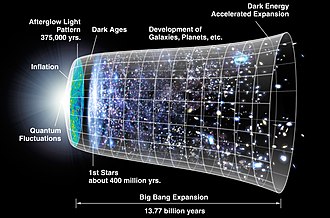](https://en.wikipedia.org/wiki/File:CMB_Timeline300_no_WMAP.jpg)
The idea that the vacuum energy can have multiple stable energy states is a leading hypothesis for the cause of [cosmic inflation](https://en.wikipedia.org/wiki/Cosmic_inflation "Cosmic inflation"). In fact, it has been argued that these early vacuum fluctuations led to the expansion of the universe and in turn have guaranteed the non-equilibrium conditions necessary to drive order from chaos, as without such expansion the universe would have reached thermal equilibrium and no complexity could have existed. With the continued accelerated expansion of the universe, the cosmos generates an energy gradient that increases the "free energy" (i.e. the available, usable or potential energy for useful work) which the universe is able to utilize to create ever more complex forms of order.<sup id="cite_ref-193"><a href="https://en.wikipedia.org/wiki/Zero-point_energy#cite_note-193">[193]</a></sup><sup id="cite_ref-194"><a href="https://en.wikipedia.org/wiki/Zero-point_energy#cite_note-194">[194]</a></sup> The only reason Earth's environment does not decay into an equilibrium state is that it receives a daily dose of sunshine and that, in turn, is due to the sun "polluting" interstellar space with decreasing entropy. The sun's fusion power is only possible due to the gravitational disequilibrium of matter that arose from cosmic expansion. In this essence, the vacuum energy can be viewed as the key cause of the negative entropy (i.e. structure) throughout the universe. That humanity might alter the morphology of the vacuum energy to create an energy gradient for useful work is the subject of much controversy.
## Purported applications\[[edit](https://en.wikipedia.org/w/index.php?title=Zero-point_energy&action=edit§ion=26 "Edit section: Purported applications")\]
Physicists overwhelmingly reject any possibility that the zero-point energy field can be exploited to obtain useful energy ([work](https://en.wikipedia.org/wiki/Work_(physics) "Work (physics)")) or uncompensated momentum; such efforts are seen as tantamount to [perpetual motion machines](https://en.wikipedia.org/wiki/Perpetual_motion_machine "Perpetual motion machine").
Nevertheless, the allure of free energy has motivated such research, usually falling in the category of [fringe science](https://en.wikipedia.org/wiki/Fringe_science "Fringe science"). As long ago as 1889 (before quantum theory or discovery of the zero point energy) [Nikola Tesla](https://en.wikipedia.org/wiki/Nikola_Tesla "Nikola Tesla") proposed that useful energy could be obtained from free space, or what was assumed at that time to be an all-pervasive [aether](https://en.wikipedia.org/wiki/Aether_(classical_element) "Aether (classical element)").<sup id="cite_ref-195"><a href="https://en.wikipedia.org/wiki/Zero-point_energy#cite_note-195">[195]</a></sup> Others have since claimed to exploit zero-point or vacuum energy with a large amount of [pseudoscientific](https://en.wikipedia.org/wiki/Pseudoscience "Pseudoscience") literature causing ridicule around the subject.<sup id="cite_ref-army_196-0"><a href="https://en.wikipedia.org/wiki/Zero-point_energy#cite_note-army-196">[196]</a></sup><sup id="cite_ref-saf_197-0"><a href="https://en.wikipedia.org/wiki/Zero-point_energy#cite_note-saf-197">[197]</a></sup> Despite rejection by the scientific community, harnessing zero-point energy remains an interest of research, particularly in the US where it has attracted the attention of major aerospace/defence contractors and the [U.S. Department of Defense](https://en.wikipedia.org/wiki/DoD "DoD") as well as in China, Germany, Russia and Brazil.<sup id="cite_ref-army_196-1"><a href="https://en.wikipedia.org/wiki/Zero-point_energy#cite_note-army-196">[196]</a></sup><sup id="cite_ref-FOOTNOTEScott2004_198-0"><a href="https://en.wikipedia.org/wiki/Zero-point_energy#cite_note-FOOTNOTEScott2004-198">[198]</a></sup>
### Casimir batteries and engines\[[edit](https://en.wikipedia.org/w/index.php?title=Zero-point_energy&action=edit§ion=27 "Edit section: Casimir batteries and engines")\]
A common assumption is that the [Casimir force](https://en.wikipedia.org/wiki/Casimir_effect "Casimir effect") is of little practical use; the argument is made that the only way to actually gain energy from the two plates is to allow them to come together (getting them apart again would then require more energy), and therefore it is a one-use-only tiny force in nature.<sup id="cite_ref-army_196-2"><a href="https://en.wikipedia.org/wiki/Zero-point_energy#cite_note-army-196">[196]</a></sup> In 1984 [Robert Forward](https://en.wikipedia.org/wiki/Robert_L._Forward "Robert L. Forward")<sup id="cite_ref-199"><a href="https://en.wikipedia.org/wiki/Zero-point_energy#cite_note-199">[199]</a></sup> published work showing how a "vacuum-fluctuation battery" could be constructed. The battery can be recharged by making the electrical forces slightly stronger than the Casimir force to reexpand the plates.<sup>[<i><a href="https://en.wikipedia.org/wiki/Wikipedia:Citation_needed" title="Wikipedia:Citation needed"><span title="This claim needs references to reliable sources. (September 2021)">citation needed</span></a></i>]</sup>
In 1995 and 1998 Maclay et al.<sup id="cite_ref-200"><a href="https://en.wikipedia.org/wiki/Zero-point_energy#cite_note-200">[200]</a></sup><sup id="cite_ref-201"><a href="https://en.wikipedia.org/wiki/Zero-point_energy#cite_note-201">[201]</a></sup> published the first models of a [microelectromechanical system](https://en.wikipedia.org/wiki/Microelectromechanical_system "Microelectromechanical system") (MEMS) with Casimir forces. While not exploiting the Casimir force for useful work, the papers drew attention from the MEMS community due to the revelation that Casimir effect needs to be considered as a vital factor in the future design of MEMS. In particular, Casimir effect might be the critical factor in the [stiction](https://en.wikipedia.org/wiki/Stiction "Stiction") failure of MEMS.<sup id="cite_ref-FOOTNOTEBordag_et_al.2009[[Category:Wikipedia_articles_needing_page_number_citations_from_May_2020]]<sup_class="noprint_Inline-Template_"_style="white-space:nowrap;">[<i>[[Wikipedia:Citing_sources|<span_title="This_citation_requires_a_reference_to_the_specific_page_or_range_of_pages_in_which_the_material_appears.&#32;(May_2020)">page&nbsp;needed</span>]]</i>]</sup>_202-0"><a href="https://en.wikipedia.org/wiki/Zero-point_energy#cite_note-FOOTNOTEBordag_et_al.2009[[Category:Wikipedia_articles_needing_page_number_citations_from_May_2020]]%3Csup_class=%22noprint_Inline-Template_%22_style=%22white-space:nowrap;%22%3E&#91;%3Ci%3E[[Wikipedia:Citing_sources|%3Cspan_title=%22This_citation_requires_a_reference_to_the_specific_page_or_range_of_pages_in_which_the_material_appears.&#32;(May_2020)%22%3Epage&nbsp;needed%3C/span%3E]]%3C/i%3E&#93;%3C/sup%3E-202">[202]</a></sup>
In 1999, Pinto, a former scientist at [NASA](https://en.wikipedia.org/wiki/NASA "NASA")'s [Jet Propulsion Laboratory at Caltech](https://en.wikipedia.org/wiki/Jet_Propulsion_Laboratory "Jet Propulsion Laboratory") in Pasadena, published in _[Physical Review](https://en.wikipedia.org/wiki/Physical_Review "Physical Review")_ his [thought experiment](https://en.wikipedia.org/wiki/Thought_experiment "Thought experiment") (Gedankenexperiment) for a "Casimir engine". The paper showed that continuous positive net exchange of energy from the [Casimir effect](https://en.wikipedia.org/wiki/Casimir_effect "Casimir effect") was possible, even stating in the abstract "In the event of no other alternative explanations, one should conclude that major technological advances in the area of endless, by-product free-energy production could be achieved."<sup id="cite_ref-FOOTNOTEPinto1999_203-0"><a href="https://en.wikipedia.org/wiki/Zero-point_energy#cite_note-FOOTNOTEPinto1999-203">[203]</a></sup>
In 2001, Capasso et al. showed how the force can be used to control the mechanical motion of a MEMS device, The researchers suspended a polysilicon plate from a torsional rod – a twisting horizontal bar just a few microns in diameter. When they brought a metallized sphere close up to the plate, the attractive Casimir force between the two objects made the plate rotate. They also studied the dynamical behaviour of the MEMS device by making the plate oscillate. The Casimir force reduced the rate of oscillation and led to nonlinear phenomena, such as [hysteresis](https://en.wikipedia.org/wiki/Hysteresis "Hysteresis") and [bistability](https://en.wikipedia.org/wiki/Bistability "Bistability") in the frequency response of the oscillator. According to the team, the system's behaviour agreed well with theoretical calculations.<sup id="cite_ref-FOOTNOTEChan_et_al.2001_112-1"><a href="https://en.wikipedia.org/wiki/Zero-point_energy#cite_note-FOOTNOTEChan_et_al.2001-112">[112]</a></sup>
Despite this and several similar peer reviewed papers, there is not a consensus as to whether such devices can produce a continuous output of work. Garret Moddel at [University of Colorado](https://en.wikipedia.org/wiki/University_of_Colorado_Boulder "University of Colorado Boulder") has highlighted that he believes such devices hinge on the assumption that the Casimir force is a [nonconservative force](https://en.wikipedia.org/wiki/Conservative_force "Conservative force"), he argues that there is sufficient evidence (e.g. analysis by Scandurra (2001)<sup id="cite_ref-204"><a href="https://en.wikipedia.org/wiki/Zero-point_energy#cite_note-204">[204]</a></sup>) to say that the Casimir effect is a conservative force and therefore even though such an engine can exploit the Casimir force for useful work it cannot produce more output energy than has been input into the system.<sup id="cite_ref-205"><a href="https://en.wikipedia.org/wiki/Zero-point_energy#cite_note-205">[205]</a></sup>
In 2008, [DARPA](https://en.wikipedia.org/wiki/DARPA "DARPA") solicited research proposals in the area of Casimir Effect Enhancement (CEE).<sup id="cite_ref-206"><a href="https://en.wikipedia.org/wiki/Zero-point_energy#cite_note-206">[206]</a></sup> The goal of the program is to develop new methods to control and manipulate attractive and repulsive forces at surfaces based on engineering of the Casimir force.<sup>[<i><a href="https://en.wikipedia.org/wiki/Wikipedia:Citation_needed" title="Wikipedia:Citation needed"><span title="This claim needs references to reliable sources. (September 2021)">citation needed</span></a></i>]</sup>
A 2008 patent by Haisch and Moddel<sup id="cite_ref-207"><a href="https://en.wikipedia.org/wiki/Zero-point_energy#cite_note-207">[207]</a></sup> details a device that is able to extract power from zero-point fluctuations using a gas that circulates through a Casimir cavity. As gas atoms circulate around the system they enter the cavity. Upon entering the electrons spin down to release energy via electromagnetic radiation. This radiation is then extracted by an absorber. On exiting the cavity the ambient vacuum fluctuations (i.e. the zero-point field) impart energy on the electrons to return the orbitals to previous energy levels, as predicted by Senitzky (1960).<sup id="cite_ref-ReferenceG_99-1"><a href="https://en.wikipedia.org/wiki/Zero-point_energy#cite_note-ReferenceG-99">[99]</a></sup> The gas then goes through a pump and flows through the system again. A published test of this concept by Moddel<sup id="cite_ref-208"><a href="https://en.wikipedia.org/wiki/Zero-point_energy#cite_note-208">[208]</a></sup> was performed in 2012 and seemed to give excess energy that could not be attributed to another source. However it has not been conclusively shown to be from zero-point energy and the theory requires further investigation.<sup id="cite_ref-209"><a href="https://en.wikipedia.org/wiki/Zero-point_energy#cite_note-209">[209]</a></sup>
### Single heat baths\[[edit](https://en.wikipedia.org/w/index.php?title=Zero-point_energy&action=edit§ion=28 "Edit section: Single heat baths")\]
In 1951 [Callen](https://en.wikipedia.org/wiki/Herbert_Callen "Herbert Callen") and Welton<sup id="cite_ref-ReferenceB_77-2"><a href="https://en.wikipedia.org/wiki/Zero-point_energy#cite_note-ReferenceB-77">[77]</a></sup> proved the quantum [fluctuation-dissipation theorem](https://en.wikipedia.org/wiki/Fluctuation-dissipation_theorem "Fluctuation-dissipation theorem") (FDT) which was originally formulated in classical form by [Nyquist](https://en.wikipedia.org/wiki/Harry_Nyquist "Harry Nyquist") (1928)<sup id="cite_ref-ReferenceC_78-1"><a href="https://en.wikipedia.org/wiki/Zero-point_energy#cite_note-ReferenceC-78">[78]</a></sup> as an explanation for observed [Johnson noise](https://en.wikipedia.org/wiki/Johnson_noise "Johnson noise")<sup id="cite_ref-ReferenceD_79-1"><a href="https://en.wikipedia.org/wiki/Zero-point_energy#cite_note-ReferenceD-79">[79]</a></sup> in electric circuits. Fluctuation-dissipation theorem showed that when something dissipates energy, in an effectively irreversible way, a connected heat bath must also fluctuate. The fluctuations and the dissipation go hand in hand; it is impossible to have one without the other. The implication of FDT being that the vacuum could be treated as a heat bath coupled to a dissipative force and as such energy could, in part, be extracted from the vacuum for potentially useful work.<sup id="cite_ref-FOOTNOTEMilonni199454_80-1"><a href="https://en.wikipedia.org/wiki/Zero-point_energy#cite_note-FOOTNOTEMilonni199454-80">[80]</a></sup> Such a theory has met with resistance: Macdonald (1962)<sup id="cite_ref-210"><a href="https://en.wikipedia.org/wiki/Zero-point_energy#cite_note-210">[210]</a></sup> and Harris (1971)<sup id="cite_ref-211"><a href="https://en.wikipedia.org/wiki/Zero-point_energy#cite_note-211">[211]</a></sup> claimed that extracting power from the zero-point energy to be impossible, so FDT could not be true. Grau and Kleen (1982)<sup id="cite_ref-212"><a href="https://en.wikipedia.org/wiki/Zero-point_energy#cite_note-212">[212]</a></sup> and Kleen (1986),<sup id="cite_ref-213"><a href="https://en.wikipedia.org/wiki/Zero-point_energy#cite_note-213">[213]</a></sup> argued that the Johnson noise of a resistor connected to an antenna must satisfy Planck's thermal radiation formula, thus the noise must be zero at zero temperature and FDT must be invalid. Kiss (1988)<sup id="cite_ref-214"><a href="https://en.wikipedia.org/wiki/Zero-point_energy#cite_note-214">[214]</a></sup> pointed out that the existence of the zero-point term may indicate that there is a renormalization problem—i.e., a mathematical artifact—producing an unphysical term that is not actually present in measurements (in analogy with renormalization problems of ground states in quantum electrodynamics). Later, Abbott et al. (1996) arrived at a different but unclear conclusion that "zero-point energy is infinite thus it should be renormalized but not the 'zero-point fluctuations'".<sup id="cite_ref-FOOTNOTEAbbott_et_al.1996_215-0"><a href="https://en.wikipedia.org/wiki/Zero-point_energy#cite_note-FOOTNOTEAbbott_et_al.1996-215">[215]</a></sup> Despite such criticism, FDT has been shown to be true experimentally under certain quantum, non-classical conditions. Zero-point fluctuations can, and do, contribute towards systems which dissipate energy.<sup id="cite_ref-cloudfront.escholarship.org_81-1"><a href="https://en.wikipedia.org/wiki/Zero-point_energy#cite_note-cloudfront.escholarship.org-81">[81]</a></sup> A paper by Armen Allahverdyan and Theo Nieuwenhuizen in 2000 showed the feasibility of extracting zero-point energy for useful work from a single bath, without contradicting the [laws of thermodynamics](https://en.wikipedia.org/wiki/Laws_of_thermodynamics "Laws of thermodynamics"), by exploiting certain quantum mechanical properties.<sup id="cite_ref-Allahverdyan-2000_82-1"><a href="https://en.wikipedia.org/wiki/Zero-point_energy#cite_note-Allahverdyan-2000-82">[82]</a></sup>
There have been a growing number of papers showing that in some instances the classical laws of thermodynamics, such as limits on the Carnot efficiency, can be violated by exploiting negative entropy of quantum fluctuations.<sup id="cite_ref-FOOTNOTEScully_et_al.2003_83-1"><a href="https://en.wikipedia.org/wiki/Zero-point_energy#cite_note-FOOTNOTEScully_et_al.2003-83">[83]</a></sup><sup id="cite_ref-FOOTNOTEScully2001_216-0"><a href="https://en.wikipedia.org/wiki/Zero-point_energy#cite_note-FOOTNOTEScully2001-216">[216]</a></sup><sup id="cite_ref-217"><a href="https://en.wikipedia.org/wiki/Zero-point_energy#cite_note-217">[217]</a></sup><sup id="cite_ref-218"><a href="https://en.wikipedia.org/wiki/Zero-point_energy#cite_note-218">[218]</a></sup><sup id="cite_ref-219"><a href="https://en.wikipedia.org/wiki/Zero-point_energy#cite_note-219">[219]</a></sup><sup id="cite_ref-220"><a href="https://en.wikipedia.org/wiki/Zero-point_energy#cite_note-220">[220]</a></sup><sup id="cite_ref-FOOTNOTERoßnagel_et_al.2014_221-0"><a href="https://en.wikipedia.org/wiki/Zero-point_energy#cite_note-FOOTNOTERo%C3%9Fnagel_et_al.2014-221">[221]</a></sup><sup id="cite_ref-FOOTNOTECorrea_et_al.2014_222-0"><a href="https://en.wikipedia.org/wiki/Zero-point_energy#cite_note-FOOTNOTECorrea_et_al.2014-222">[222]</a></sup><sup id="cite_ref-223"><a href="https://en.wikipedia.org/wiki/Zero-point_energy#cite_note-223">[223]</a></sup><sup id="cite_ref-224"><a href="https://en.wikipedia.org/wiki/Zero-point_energy#cite_note-224">[224]</a></sup>
Despite efforts to reconcile quantum mechanics and thermodynamics over the years, their compatibility is still an open fundamental problem. The full extent that quantum properties can alter classical thermodynamic bounds is unknown<sup id="cite_ref-225"><a href="https://en.wikipedia.org/wiki/Zero-point_energy#cite_note-225">[225]</a></sup>
### Space travel and gravitational shielding\[[edit](https://en.wikipedia.org/w/index.php?title=Zero-point_energy&action=edit§ion=29 "Edit section: Space travel and gravitational shielding")\]
The use of zero-point energy for space travel is speculative and does not form part of the mainstream scientific consensus. A complete [quantum theory of gravitation](https://en.wikipedia.org/wiki/Theory_of_everything "Theory of everything") (that would deal with the role of quantum phenomena like zero-point energy) does not yet exist. Speculative papers explaining a relationship between zero-point energy and gravitational shielding effects have been proposed,<sup id="cite_ref-Haisch_et_al._1994_17-1"><a href="https://en.wikipedia.org/wiki/Zero-point_energy#cite_note-Haisch_et_al._1994-17">[17]</a></sup><sup id="cite_ref-226"><a href="https://en.wikipedia.org/wiki/Zero-point_energy#cite_note-226">[226]</a></sup><sup id="cite_ref-227"><a href="https://en.wikipedia.org/wiki/Zero-point_energy#cite_note-227">[227]</a></sup><sup id="cite_ref-228"><a href="https://en.wikipedia.org/wiki/Zero-point_energy#cite_note-228">[228]</a></sup> but the interaction (if any) is not yet fully understood. Most serious scientific research in this area depends on the theorized anti-gravitational properties of [antimatter](https://en.wikipedia.org/wiki/Antimatter "Antimatter") (currently being tested at the [alpha experiment](https://en.wikipedia.org/wiki/Antiproton_Decelerator#ALPHA "Antiproton Decelerator") at [CERN](https://en.wikipedia.org/wiki/CERN "CERN")) and/or the effects of non-Newtonian forces such as the [gravitomagnetic field](https://en.wikipedia.org/wiki/Gravitomagnetic_field "Gravitomagnetic field") under specific quantum conditions. According to the [general theory of relativity](https://en.wikipedia.org/wiki/General_theory_of_relativity "General theory of relativity"), rotating matter can generate a new force of nature, known as the gravitomagnetic interaction, whose intensity is proportional to the rate of spin.<sup id="cite_ref-229"><a href="https://en.wikipedia.org/wiki/Zero-point_energy#cite_note-229">[229]</a></sup> In certain conditions the gravitomagnetic field can be repulsive. In [neutrons stars](https://en.wikipedia.org/wiki/Neutron_star "Neutron star") for example it can produce a gravitational analogue of the [Meissner effect](https://en.wikipedia.org/wiki/Meissner_effect "Meissner effect"), but the force produced in such an example is theorized to be exceedingly weak.<sup id="cite_ref-230"><a href="https://en.wikipedia.org/wiki/Zero-point_energy#cite_note-230">[230]</a></sup>
In 1963 [Robert Forward](https://en.wikipedia.org/wiki/Robert_L._Forward "Robert L. Forward"), a physicist and aerospace engineer at [Hughes Research Laboratories](https://en.wikipedia.org/wiki/Hughes_Research_Laboratories "Hughes Research Laboratories"), published a paper showing how within the framework of general relativity "anti-gravitational" effects might be achieved.<sup id="cite_ref-231"><a href="https://en.wikipedia.org/wiki/Zero-point_energy#cite_note-231">[231]</a></sup> Since all atoms have [spin](https://en.wikipedia.org/wiki/Spin_(physics) "Spin (physics)"), gravitational permeability may be able to differ from material to material. A strong [toroidal](https://en.wikipedia.org/wiki/Toroid "Toroid") gravitational field that acts against the force of gravity could be generated by materials that have [nonlinear properties](https://en.wikipedia.org/wiki/Chaos_theory "Chaos theory") that enhance time-varying gravitational fields. Such an effect would be analogous to the nonlinear electromagnetic permeability of iron making it an effective core (i.e. the doughnut of iron) in a transformer, whose properties are dependent on magnetic permeability.<sup id="cite_ref-232"><a href="https://en.wikipedia.org/wiki/Zero-point_energy#cite_note-232">[232]</a></sup><sup id="cite_ref-233"><a href="https://en.wikipedia.org/wiki/Zero-point_energy#cite_note-233">[233]</a></sup><sup id="cite_ref-234"><a href="https://en.wikipedia.org/wiki/Zero-point_energy#cite_note-234">[234]</a></sup> In 1966 [Dewitt](https://en.wikipedia.org/wiki/Bryce_DeWitt "Bryce DeWitt")<sup id="cite_ref-235"><a href="https://en.wikipedia.org/wiki/Zero-point_energy#cite_note-235">[235]</a></sup> was first to identify the significance of gravitational effects in superconductors. Dewitt demonstrated that a magnetic-type gravitational field must result in the presence of [fluxoid quantization](https://en.wikipedia.org/wiki/Magnetic_flux_quantum "Magnetic flux quantum"). In 1983, Dewitt's work was substantially expanded by Ross.<sup id="cite_ref-236"><a href="https://en.wikipedia.org/wiki/Zero-point_energy#cite_note-236">[236]</a></sup>
From 1971 to 1974 Henry William Wallace, a scientist at [GE Aerospace](https://en.wikipedia.org/wiki/GE_Aerospace_(1960s) "GE Aerospace (1960s)") was issued with three patents.<sup id="cite_ref-237"><a href="https://en.wikipedia.org/wiki/Zero-point_energy#cite_note-237">[237]</a></sup><sup id="cite_ref-238"><a href="https://en.wikipedia.org/wiki/Zero-point_energy#cite_note-238">[238]</a></sup><sup id="cite_ref-239"><a href="https://en.wikipedia.org/wiki/Zero-point_energy#cite_note-239">[239]</a></sup> Wallace used [Dewitt's](https://en.wikipedia.org/wiki/Bryce_DeWitt "Bryce DeWitt") theory to develop an experimental apparatus for generating and detecting a secondary gravitational field, which he named the kinemassic field (now better known as the [gravitomagnetic field](https://en.wikipedia.org/wiki/Gravitomagnetic_field "Gravitomagnetic field")). In his three patents, Wallace describes three different methods used for detection of the gravitomagnetic field – change in the motion of a body on a pivot, detection of a transverse voltage in a semiconductor crystal, and a change in the specific heat of a crystal material having spin-aligned nuclei. There are no publicly available independent tests verifying Wallace's devices. Such an effect if any would be small.<sup id="cite_ref-240"><a href="https://en.wikipedia.org/wiki/Zero-point_energy#cite_note-240">[240]</a></sup><sup id="cite_ref-241"><a href="https://en.wikipedia.org/wiki/Zero-point_energy#cite_note-241">[241]</a></sup><sup id="cite_ref-242"><a href="https://en.wikipedia.org/wiki/Zero-point_energy#cite_note-242">[242]</a></sup><sup id="cite_ref-243"><a href="https://en.wikipedia.org/wiki/Zero-point_energy#cite_note-243">[243]</a></sup><sup id="cite_ref-244"><a href="https://en.wikipedia.org/wiki/Zero-point_energy#cite_note-244">[244]</a></sup><sup id="cite_ref-245"><a href="https://en.wikipedia.org/wiki/Zero-point_energy#cite_note-245">[245]</a></sup> Referring to Wallace's patents, a [New Scientist](https://en.wikipedia.org/wiki/New_Scientist "New Scientist") article in 1980 stated "Although the Wallace patents were initially ignored as cranky, observers believe that his invention is now under serious but secret investigation by the military authorities in the USA. The military may now regret that the patents have already been granted and so are available for anyone to read."<sup id="cite_ref-246"><a href="https://en.wikipedia.org/wiki/Zero-point_energy#cite_note-246">[246]</a></sup> A further reference to Wallace's patents occur in an electric propulsion study prepared for the [Astronautics Laboratory](https://en.wikipedia.org/wiki/Air_Force_Research_Laboratory "Air Force Research Laboratory") at [Edwards Air Force Base](https://en.wikipedia.org/wiki/Edwards_Air_Force_Base "Edwards Air Force Base") which states: "The patents are written in a very believable style which include part numbers, sources for some components, and diagrams of data. Attempts were made to contact Wallace using patent addresses and other sources but he was not located nor is there a trace of what became of his work. The concept can be somewhat justified on general relativistic grounds since rotating frames of time varying fields are expected to emit gravitational waves."<sup id="cite_ref-247"><a href="https://en.wikipedia.org/wiki/Zero-point_energy#cite_note-247">[247]</a></sup>
In 1986 the [U.S. Air Force](https://en.wikipedia.org/wiki/U.S._Air_Force "U.S. Air Force")'s then Rocket Propulsion Laboratory (RPL) at [Edwards Air Force Base](https://en.wikipedia.org/wiki/Edwards_Air_Force_Base "Edwards Air Force Base") solicited "Non Conventional Propulsion Concepts" under a small business research and innovation program. One of the six areas of interest was "Esoteric energy sources for propulsion, including the quantum dynamic energy of vacuum space..." In the same year [BAE Systems](https://en.wikipedia.org/wiki/BAE_Systems "BAE Systems") launched "Project Greenglow" to provide a "focus for research into novel propulsion systems and the means to power them".<sup id="cite_ref-FOOTNOTEScott2004_198-1"><a href="https://en.wikipedia.org/wiki/Zero-point_energy#cite_note-FOOTNOTEScott2004-198">[198]</a></sup><sup id="cite_ref-248"><a href="https://en.wikipedia.org/wiki/Zero-point_energy#cite_note-248">[248]</a></sup>
In 1988 [Kip Thorne](https://en.wikipedia.org/wiki/Kip_Thorne "Kip Thorne") et al.<sup id="cite_ref-249"><a href="https://en.wikipedia.org/wiki/Zero-point_energy#cite_note-249">[249]</a></sup> published work showing how traversable [wormholes](https://en.wikipedia.org/wiki/Lorentzian_wormhole "Lorentzian wormhole") can exist in spacetime only if they are threaded by quantum fields generated by some form of [exotic matter](https://en.wikipedia.org/wiki/Exotic_matter "Exotic matter") that has [negative energy](https://en.wikipedia.org/wiki/Negative_energy "Negative energy"). In 1993 Scharnhorst and Barton<sup id="cite_ref-Scharnhorst_1993_118-1"><a href="https://en.wikipedia.org/wiki/Zero-point_energy#cite_note-Scharnhorst_1993-118">[118]</a></sup> showed that [the speed of a photon will be increased](https://en.wikipedia.org/wiki/Scharnhorst_effect "Scharnhorst effect") if it travels between two Casimir plates, an example of negative energy. In the most general sense, the exotic matter needed to create wormholes would share the repulsive properties of the [inflationary energy](https://en.wikipedia.org/wiki/Inflation_(cosmology) "Inflation (cosmology)"), [dark energy](https://en.wikipedia.org/wiki/Dark_energy "Dark energy") or zero-point radiation of the vacuum.<sup id="cite_ref-250"><a href="https://en.wikipedia.org/wiki/Zero-point_energy#cite_note-250">[250]</a></sup> Building on the work of Thorne, in 1994 [Miguel Alcubierre](https://en.wikipedia.org/wiki/Miguel_Alcubierre "Miguel Alcubierre")<sup id="cite_ref-251"><a href="https://en.wikipedia.org/wiki/Zero-point_energy#cite_note-251">[251]</a></sup> proposed a method for changing the geometry of space by creating a wave that would cause the fabric of space ahead of a spacecraft to contract and the space behind it to expand (see [Alcubierre drive](https://en.wikipedia.org/wiki/Alcubierre_drive "Alcubierre drive")). The ship would then ride this wave inside a region of flat space, known as a _warp bubble_ and would not move within this bubble but instead be carried along as the region itself moves due to the actions of the drive.
In 1992 [Evgeny Podkletnov](https://en.wikipedia.org/wiki/Evgeny_Podkletnov "Evgeny Podkletnov")<sup id="cite_ref-252"><a href="https://en.wikipedia.org/wiki/Zero-point_energy#cite_note-252">[252]</a></sup> published a heavily debated<sup id="cite_ref-253"><a href="https://en.wikipedia.org/wiki/Zero-point_energy#cite_note-253">[253]</a></sup><sup id="cite_ref-FOOTNOTEWoods_et_al.2001_254-0"><a href="https://en.wikipedia.org/wiki/Zero-point_energy#cite_note-FOOTNOTEWoods_et_al.2001-254">[254]</a></sup><sup id="cite_ref-255"><a href="https://en.wikipedia.org/wiki/Zero-point_energy#cite_note-255">[255]</a></sup><sup id="cite_ref-256"><a href="https://en.wikipedia.org/wiki/Zero-point_energy#cite_note-256">[256]</a></sup> journal article claiming a specific type of rotating superconductor could shield gravitational force. Independently of this, from 1991 to 1993 [Ning Li](https://en.wikipedia.org/wiki/Ning_Li_(physicist) "Ning Li (physicist)") and Douglas Torr published a number of articles<sup id="cite_ref-257"><a href="https://en.wikipedia.org/wiki/Zero-point_energy#cite_note-257">[257]</a></sup><sup id="cite_ref-258"><a href="https://en.wikipedia.org/wiki/Zero-point_energy#cite_note-258">[258]</a></sup><sup id="cite_ref-259"><a href="https://en.wikipedia.org/wiki/Zero-point_energy#cite_note-259">[259]</a></sup> about gravitational effects in superconductors. One finding they derived is the source of [gravitomagnetic flux](https://en.wikipedia.org/wiki/Gravitomagnetic_field "Gravitomagnetic field") in a [type II superconductor](https://en.wikipedia.org/wiki/Type_II_superconductor "Type II superconductor") material is due to [spin alignment](https://en.wikipedia.org/wiki/Spin_(physics) "Spin (physics)") of the lattice ions. Quoting from their third paper: "It is shown that the coherent alignment of lattice ion spins will generate a detectable gravitomagnetic field, and in the presence of a time-dependent applied magnetic vector potential field, a detectable gravitoelectric field." The claimed size of the generated force has been disputed by some<sup id="cite_ref-FOOTNOTEKowitt1994_260-0"><a href="https://en.wikipedia.org/wiki/Zero-point_energy#cite_note-FOOTNOTEKowitt1994-260">[260]</a></sup><sup id="cite_ref-261"><a href="https://en.wikipedia.org/wiki/Zero-point_energy#cite_note-261">[261]</a></sup> but defended by others.<sup id="cite_ref-FOOTNOTEWoods2005_262-0"><a href="https://en.wikipedia.org/wiki/Zero-point_energy#cite_note-FOOTNOTEWoods2005-262">[262]</a></sup><sup id="cite_ref-263"><a href="https://en.wikipedia.org/wiki/Zero-point_energy#cite_note-263">[263]</a></sup> In 1997 Li published a paper attempting to replicate Podkletnov's results and showed the effect was very small, if it existed at all.<sup id="cite_ref-264"><a href="https://en.wikipedia.org/wiki/Zero-point_energy#cite_note-264">[264]</a></sup> Li is reported to have left the University of Alabama in 1999 to found the company _AC Gravity LLC_.<sup id="cite_ref-FOOTNOTELucentini2000_265-0"><a href="https://en.wikipedia.org/wiki/Zero-point_energy#cite_note-FOOTNOTELucentini2000-265">[265]</a></sup> AC Gravity was awarded a [U.S. DOD](https://en.wikipedia.org/wiki/United_States_Department_of_Defense "United States Department of Defense") grant for $448,970 in 2001 to continue anti-gravity research. The grant period ended in 2002 but no results from this research were ever made public.<sup id="cite_ref-266"><a href="https://en.wikipedia.org/wiki/Zero-point_energy#cite_note-266">[266]</a></sup>
In 2002 [Phantom Works](https://en.wikipedia.org/wiki/Phantom_Works "Phantom Works"), [Boeing](https://en.wikipedia.org/wiki/Boeing "Boeing")'s advanced research and development facility in [Seattle](https://en.wikipedia.org/wiki/Seattle "Seattle"), approached [Evgeny Podkletnov](https://en.wikipedia.org/wiki/Evgeny_Podkletnov "Evgeny Podkletnov") directly. Phantom Works was blocked by Russian technology transfer controls. At this time Lieutenant General George Muellner, the outgoing head of the Boeing Phantom Works, confirmed that attempts by Boeing to work with Podkletnov had been blocked by Moscow, also commenting that "The physical principles – and Podkletnov's device is not the only one – appear to be valid... There is basic science there. They're not breaking the laws of physics. The issue is whether the science can be engineered into something workable"<sup id="cite_ref-FOOTNOTECook2002_267-0"><a href="https://en.wikipedia.org/wiki/Zero-point_energy#cite_note-FOOTNOTECook2002-267">[267]</a></sup>
Froning and Roach (2002)<sup id="cite_ref-268"><a href="https://en.wikipedia.org/wiki/Zero-point_energy#cite_note-268">[268]</a></sup> put forward a paper that builds on the work of Puthoff, Haisch and Alcubierre. They used fluid dynamic simulations to model the interaction of a vehicle (like that proposed by Alcubierre) with the zero-point field. Vacuum field perturbations are simulated by fluid field perturbations and the aerodynamic resistance of viscous drag exerted on the interior of the vehicle is compared to the Lorentz force exerted by the zero-point field (a Casimir-like force is exerted on the exterior by unbalanced zero-point radiation pressures). They find that the optimized negative energy required for an Alcubierre drive is where it is a saucer-shaped vehicle with [toroidal](https://en.wikipedia.org/wiki/Toroid "Toroid") electromagnetic fields. The EM fields distort the vacuum field perturbations surrounding the craft sufficiently to affect the permeability and permittivity of space.
In 2014 [NASA](https://en.wikipedia.org/wiki/Lyndon_B._Johnson_Space_Center "Lyndon B. Johnson Space Center")'s [Eagleworks](https://en.wikipedia.org/wiki/Advanced_Propulsion_Physics_Laboratory "Advanced Propulsion Physics Laboratory") Laboratories announced that they had successfully validated the use of a [Quantum Vacuum Plasma Thruster](https://en.wikipedia.org/wiki/Quantum_Vacuum_Plasma_Thruster "Quantum Vacuum Plasma Thruster") which makes use of the [Casimir effect](https://en.wikipedia.org/wiki/Casimir_effect "Casimir effect") for propulsion.<sup id="cite_ref-FOOTNOTEWhite,_March,_Williams_et_al.2011_269-0"><a href="https://en.wikipedia.org/wiki/Zero-point_energy#cite_note-FOOTNOTEWhite,_March,_Williams_et_al.2011-269">[269]</a></sup><sup id="cite_ref-270"><a href="https://en.wikipedia.org/wiki/Zero-point_energy#cite_note-270">[270]</a></sup><sup id="cite_ref-271"><a href="https://en.wikipedia.org/wiki/Zero-point_energy#cite_note-271">[271]</a></sup> In 2016 a scientific paper by the team of NASA scientists passed peer review for the first time.<sup id="cite_ref-FOOTNOTEWhite,_March,_Lawrence_et_al.2016_272-0"><a href="https://en.wikipedia.org/wiki/Zero-point_energy#cite_note-FOOTNOTEWhite,_March,_Lawrence_et_al.2016-272">[272]</a></sup> The paper suggests that the zero-point field acts as [pilot-wave](https://en.wikipedia.org/wiki/De_Broglie%E2%80%93Bohm_theory "De Broglie–Bohm theory") and that the thrust may be due to particles pushing off the quantum vacuum. While peer review doesn't guarantee that a finding or observation is valid, it does indicate that independent scientists looked over the experimental setup, results, and interpretation and that they could not find any obvious errors in the methodology and that they found the results reasonable. In the paper, the authors identify and discuss nine potential sources of experimental errors, including rogue air currents, leaky electromagnetic radiation, and magnetic interactions. Not all of them could be completely ruled out, and further peer reviewed experimentation is needed in order to rule these potential errors out.<sup id="cite_ref-273"><a href="https://en.wikipedia.org/wiki/Zero-point_energy#cite_note-273">[273]</a></sup>
## See also\[[edit](https://en.wikipedia.org/w/index.php?title=Zero-point_energy&action=edit§ion=30 "Edit section: See also")\]
- [Casimir effect](https://en.wikipedia.org/wiki/Casimir_effect "Casimir effect")
- [Ground state](https://en.wikipedia.org/wiki/Ground_state "Ground state")
- [Lamb shift](https://en.wikipedia.org/wiki/Lamb_shift "Lamb shift")
- [QED vacuum](https://en.wikipedia.org/wiki/QED_vacuum "QED vacuum")
- [QCD vacuum](https://en.wikipedia.org/wiki/QCD_vacuum "QCD vacuum")
- [Quantum fluctuation](https://en.wikipedia.org/wiki/Quantum_fluctuation "Quantum fluctuation")
- [Quantum foam](https://en.wikipedia.org/wiki/Quantum_foam "Quantum foam")
- [Scalar field](https://en.wikipedia.org/wiki/Scalar_field "Scalar field")
- [Time crystal](https://en.wikipedia.org/wiki/Time_crystal "Time crystal")
- [Topological order](https://en.wikipedia.org/wiki/Topological_order "Topological order")
- [Unruh effect](https://en.wikipedia.org/wiki/Unruh_effect "Unruh effect")
- [Vacuum energy](https://en.wikipedia.org/wiki/Vacuum_energy "Vacuum energy")
- [Vacuum expectation value](https://en.wikipedia.org/wiki/Vacuum_expectation_value "Vacuum expectation value")
- [Vacuum state](https://en.wikipedia.org/wiki/Vacuum_state "Vacuum state")
- [Virtual particle](https://en.wikipedia.org/wiki/Virtual_particle "Virtual particle")
## References\[[edit](https://en.wikipedia.org/w/index.php?title=Zero-point_energy&action=edit§ion=31 "Edit section: References")\]
### Notes\[[edit](https://en.wikipedia.org/w/index.php?title=Zero-point_energy&action=edit§ion=32 "Edit section: Notes")\]
1. ^ [Jump up to: <sup><i><b>a</b></i></sup>](https://en.wikipedia.org/wiki/Zero-point_energy#cite_ref-FOOTNOTESciama1991137_1-0) [<sup><i><b>b</b></i></sup>](https://en.wikipedia.org/wiki/Zero-point_energy#cite_ref-FOOTNOTESciama1991137_1-1) [<sup><i><b>c</b></i></sup>](https://en.wikipedia.org/wiki/Zero-point_energy#cite_ref-FOOTNOTESciama1991137_1-2) [Sciama (1991)](https://en.wikipedia.org/wiki/Zero-point_energy#CITEREFSciama1991), p. 137.
2. ^ [Jump up to: <sup><i><b>a</b></i></sup>](https://en.wikipedia.org/wiki/Zero-point_energy#cite_ref-FOOTNOTEMilonni199435_2-0) [<sup><i><b>b</b></i></sup>](https://en.wikipedia.org/wiki/Zero-point_energy#cite_ref-FOOTNOTEMilonni199435_2-1) [<sup><i><b>c</b></i></sup>](https://en.wikipedia.org/wiki/Zero-point_energy#cite_ref-FOOTNOTEMilonni199435_2-2) [Milonni (1994)](https://en.wikipedia.org/wiki/Zero-point_energy#CITEREFMilonni1994), p. 35.
3. **[^](https://en.wikipedia.org/wiki/Zero-point_energy#cite_ref-FOOTNOTEDavies2011_3-0 "Jump up")** [Davies (2011)](https://en.wikipedia.org/wiki/Zero-point_energy#CITEREFDavies2011).
4. **[^](https://en.wikipedia.org/wiki/Zero-point_energy#cite_ref-4 "Jump up")** See [Weinberg (1989)](https://en.wikipedia.org/wiki/Zero-point_energy#CITEREFWeinberg1989) and [Peebles & Ratra (2003)](https://en.wikipedia.org/wiki/Zero-point_energy#CITEREFPeeblesRatra2003) for review articles and [Shiga (2005)](https://en.wikipedia.org/wiki/Zero-point_energy#CITEREFShiga2005), [Siegel (2016)](https://en.wikipedia.org/wiki/Zero-point_energy#CITEREFSiegel2016) for press comment
5. **[^](https://en.wikipedia.org/wiki/Zero-point_energy#cite_ref-FOOTNOTEPilkington2003_5-0 "Jump up")** [Pilkington (2003)](https://en.wikipedia.org/wiki/Zero-point_energy#CITEREFPilkington2003).
6. ^ [Jump up to: <sup><i><b>a</b></i></sup>](https://en.wikipedia.org/wiki/Zero-point_energy#cite_ref-FOOTNOTEWeinberg2015376_6-0) [<sup><i><b>b</b></i></sup>](https://en.wikipedia.org/wiki/Zero-point_energy#cite_ref-FOOTNOTEWeinberg2015376_6-1) [Weinberg (2015)](https://en.wikipedia.org/wiki/Zero-point_energy#CITEREFWeinberg2015), p. 376.
7. ^ [Jump up to: <sup><i><b>a</b></i></sup>](https://en.wikipedia.org/wiki/Zero-point_energy#cite_ref-FOOTNOTESciama1991138_7-0) [<sup><i><b>b</b></i></sup>](https://en.wikipedia.org/wiki/Zero-point_energy#cite_ref-FOOTNOTESciama1991138_7-1) [Sciama (1991)](https://en.wikipedia.org/wiki/Zero-point_energy#CITEREFSciama1991), p. 138.
8. ^ [Jump up to: <sup><i><b>a</b></i></sup>](https://en.wikipedia.org/wiki/Zero-point_energy#cite_ref-FOOTNOTEDavies1985104_8-0) [<sup><i><b>b</b></i></sup>](https://en.wikipedia.org/wiki/Zero-point_energy#cite_ref-FOOTNOTEDavies1985104_8-1) [Davies (1985)](https://en.wikipedia.org/wiki/Zero-point_energy#CITEREFDavies1985), p. 104.
9. **[^](https://en.wikipedia.org/wiki/Zero-point_energy#cite_ref-FOOTNOTEEinstein1995270%E2%80%93285_9-0 "Jump up")** [Einstein (1995)](https://en.wikipedia.org/wiki/Zero-point_energy#CITEREFEinstein1995), pp. 270–285.
10. ^ [Jump up to: <sup><i><b>a</b></i></sup>](https://en.wikipedia.org/wiki/Zero-point_energy#cite_ref-FOOTNOTEBattersby2008_10-0) [<sup><i><b>b</b></i></sup>](https://en.wikipedia.org/wiki/Zero-point_energy#cite_ref-FOOTNOTEBattersby2008_10-1) [Battersby (2008)](https://en.wikipedia.org/wiki/Zero-point_energy#CITEREFBattersby2008).
11. ^ [Jump up to: <sup><i><b>a</b></i></sup>](https://en.wikipedia.org/wiki/Zero-point_energy#cite_ref-FOOTNOTEItzyksonZuber1980111_11-0) [<sup><i><b>b</b></i></sup>](https://en.wikipedia.org/wiki/Zero-point_energy#cite_ref-FOOTNOTEItzyksonZuber1980111_11-1) [Itzykson & Zuber (1980)](https://en.wikipedia.org/wiki/Zero-point_energy#CITEREFItzyksonZuber1980), p. 111.
12. ^ [Jump up to: <sup><i><b>a</b></i></sup>](https://en.wikipedia.org/wiki/Zero-point_energy#cite_ref-FOOTNOTEMilonni1994111_12-0) [<sup><i><b>b</b></i></sup>](https://en.wikipedia.org/wiki/Zero-point_energy#cite_ref-FOOTNOTEMilonni1994111_12-1) [<sup><i><b>c</b></i></sup>](https://en.wikipedia.org/wiki/Zero-point_energy#cite_ref-FOOTNOTEMilonni1994111_12-2) [Milonni (1994)](https://en.wikipedia.org/wiki/Zero-point_energy#CITEREFMilonni1994), p. 111.
13. **[^](https://en.wikipedia.org/wiki/Zero-point_energy#cite_ref-FOOTNOTEGreinerM%C3%BCllerRafelski201212_13-0 "Jump up")** [Greiner, Müller & Rafelski (2012)](https://en.wikipedia.org/wiki/Zero-point_energy#CITEREFGreinerM%C3%BCllerRafelski2012), p. 12.
14. **[^](https://en.wikipedia.org/wiki/Zero-point_energy#cite_ref-FOOTNOTEBordag_et_al.20094_14-0 "Jump up")** [Bordag et al. (2009)](https://en.wikipedia.org/wiki/Zero-point_energy#CITEREFBordag_et_al.2009), p. 4.
15. **[^](https://en.wikipedia.org/wiki/Zero-point_energy#cite_ref-FOOTNOTECho2015_15-0 "Jump up")** [Cho (2015)](https://en.wikipedia.org/wiki/Zero-point_energy#CITEREFCho2015).
16. **[^](https://en.wikipedia.org/wiki/Zero-point_energy#cite_ref-FOOTNOTEChoi2013_16-0 "Jump up")** [Choi (2013)](https://en.wikipedia.org/wiki/Zero-point_energy#CITEREFChoi2013).
17. ^ [Jump up to: <sup><i><b>a</b></i></sup>](https://en.wikipedia.org/wiki/Zero-point_energy#cite_ref-Haisch_et_al._1994_17-0) [<sup><i><b>b</b></i></sup>](https://en.wikipedia.org/wiki/Zero-point_energy#cite_ref-Haisch_et_al._1994_17-1) See [Haisch, Rueda & Puthoff (1994)](https://en.wikipedia.org/wiki/Zero-point_energy#CITEREFHaischRuedaPuthoff1994) for proposal and Matthews ([1994](https://en.wikipedia.org/wiki/Zero-point_energy#CITEREFMatthews1994), [1995](https://en.wikipedia.org/wiki/Zero-point_energy#CITEREFMatthews1995)), [Powell (1994)](https://en.wikipedia.org/wiki/Zero-point_energy#CITEREFPowell1994) and [Davies (1994)](https://en.wikipedia.org/wiki/Zero-point_energy#CITEREFDavies1994) for comment.
18. **[^](https://en.wikipedia.org/wiki/Zero-point_energy#cite_ref-18 "Jump up")** See [Urban et al. (2013)](https://en.wikipedia.org/wiki/Zero-point_energy#CITEREFUrban_et_al.2013), [Leuchs & Sánchez-Soto (2013)](https://en.wikipedia.org/wiki/Zero-point_energy#CITEREFLeuchsS%C3%A1nchez-Soto2013) and [O'Carroll (2013)](https://en.wikipedia.org/wiki/Zero-point_energy#CITEREFO'Carroll2013) for comment.
19. ^ [Jump up to: <sup><i><b>a</b></i></sup>](https://en.wikipedia.org/wiki/Zero-point_energy#cite_ref-FOOTNOTERughZinkernagel2002_19-0) [<sup><i><b>b</b></i></sup>](https://en.wikipedia.org/wiki/Zero-point_energy#cite_ref-FOOTNOTERughZinkernagel2002_19-1) [<sup><i><b>c</b></i></sup>](https://en.wikipedia.org/wiki/Zero-point_energy#cite_ref-FOOTNOTERughZinkernagel2002_19-2) [Rugh & Zinkernagel (2002)](https://en.wikipedia.org/wiki/Zero-point_energy#CITEREFRughZinkernagel2002).
20. ^ [Jump up to: <sup><i><b>a</b></i></sup>](https://en.wikipedia.org/wiki/Zero-point_energy#cite_ref-Dark_Energy_May_Be_Vacuum_20-0) [<sup><i><b>b</b></i></sup>](https://en.wikipedia.org/wiki/Zero-point_energy#cite_ref-Dark_Energy_May_Be_Vacuum_20-1) ["Dark Energy May Be Vacuum"](https://archive.today/20170531094844/http://dark.nbi.ku.dk/Public_Outreach/pressreleases/dark_energy_may_be_vacuum/) (Press release). Niels Bohr Institute. 19 January 2007. Archived from [the original](http://dark.nbi.ku.dk/Public_Outreach/pressreleases/dark_energy_may_be_vacuum/) on 31 May 2017.
21. ^ [Jump up to: <sup><i><b>a</b></i></sup>](https://en.wikipedia.org/wiki/Zero-point_energy#cite_ref-FOOTNOTEWall2014_21-0) [<sup><i><b>b</b></i></sup>](https://en.wikipedia.org/wiki/Zero-point_energy#cite_ref-FOOTNOTEWall2014_21-1) [Wall (2014)](https://en.wikipedia.org/wiki/Zero-point_energy#CITEREFWall2014).
22. **[^](https://en.wikipedia.org/wiki/Zero-point_energy#cite_ref-FOOTNOTESaundersBrown19911_22-0 "Jump up")** [Saunders & Brown (1991)](https://en.wikipedia.org/wiki/Zero-point_energy#CITEREFSaundersBrown1991), p. 1.
23. **[^](https://en.wikipedia.org/wiki/Zero-point_energy#cite_ref-FOOTNOTEConlon2011225_23-0 "Jump up")** [Conlon (2011)](https://en.wikipedia.org/wiki/Zero-point_energy#CITEREFConlon2011), p. 225.
24. **[^](https://en.wikipedia.org/wiki/Zero-point_energy#cite_ref-FOOTNOTEKraghOverduin20147_24-0 "Jump up")** [Kragh & Overduin (2014)](https://en.wikipedia.org/wiki/Zero-point_energy#CITEREFKraghOverduin2014), p. 7.
25. **[^](https://en.wikipedia.org/wiki/Zero-point_energy#cite_ref-FOOTNOTEPlanck1900_25-0 "Jump up")** [Planck (1900)](https://en.wikipedia.org/wiki/Zero-point_energy#CITEREFPlanck1900).
26. **[^](https://en.wikipedia.org/wiki/Zero-point_energy#cite_ref-FOOTNOTELoudon20009_26-0 "Jump up")** [Loudon (2000)](https://en.wikipedia.org/wiki/Zero-point_energy#CITEREFLoudon2000), p. 9.
27. ^ [Jump up to: <sup><i><b>a</b></i></sup>](https://en.wikipedia.org/wiki/Zero-point_energy#cite_ref-FOOTNOTEKragh20127_27-0) [<sup><i><b>b</b></i></sup>](https://en.wikipedia.org/wiki/Zero-point_energy#cite_ref-FOOTNOTEKragh20127_27-1) [Kragh (2012)](https://en.wikipedia.org/wiki/Zero-point_energy#CITEREFKragh2012), p. 7.
28. **[^](https://en.wikipedia.org/wiki/Zero-point_energy#cite_ref-FOOTNOTEPlanck1912a_28-0 "Jump up")** [Planck (1912a)](https://en.wikipedia.org/wiki/Zero-point_energy#CITEREFPlanck1912a).
29. **[^](https://en.wikipedia.org/wiki/Zero-point_energy#cite_ref-FOOTNOTEMilonni199410_29-0 "Jump up")** [Milonni (1994)](https://en.wikipedia.org/wiki/Zero-point_energy#CITEREFMilonni1994), p. 10.
30. **[^](https://en.wikipedia.org/wiki/Zero-point_energy#cite_ref-30 "Jump up")** See (Planck [1911](https://en.wikipedia.org/wiki/Zero-point_energy#CITEREFPlanck1911), [1912a](https://en.wikipedia.org/wiki/Zero-point_energy#CITEREFPlanck1912a), [1912b](https://en.wikipedia.org/wiki/Zero-point_energy#CITEREFPlanck1912b), [1913](https://en.wikipedia.org/wiki/Zero-point_energy#CITEREFPlanck1913)) and [Planck (1958)](https://en.wikipedia.org/wiki/Zero-point_energy#CITEREFPlanck1958) for reprints
31. **[^](https://en.wikipedia.org/wiki/Zero-point_energy#cite_ref-FOOTNOTEKuhn1978235_31-0 "Jump up")** [Kuhn (1978)](https://en.wikipedia.org/wiki/Zero-point_energy#CITEREFKuhn1978), p. 235.
32. **[^](https://en.wikipedia.org/wiki/Zero-point_energy#cite_ref-32 "Jump up")** Einstein, Albert; Stern, Otto (1913). ["Einige Argumente für die Annahme einer molekularen Agitation beim absoluten Nullpunkt"](https://zenodo.org/record/1424262). _Annalen der Physik_. **345** (3): 551–560. [Bibcode](https://en.wikipedia.org/wiki/Bibcode_(identifier) "Bibcode (identifier)"):[1913AnP...345..551E](https://ui.adsabs.harvard.edu/abs/1913AnP...345..551E). [doi](https://en.wikipedia.org/wiki/Doi_(identifier) "Doi (identifier)"):[10.1002/andp.19133450309](https://doi.org/10.1002%2Fandp.19133450309).
33. **[^](https://en.wikipedia.org/wiki/Zero-point_energy#cite_ref-FOOTNOTEEinstein1993563%E2%80%93565_33-0 "Jump up")** [Einstein (1993)](https://en.wikipedia.org/wiki/Zero-point_energy#CITEREFEinstein1993), pp. 563–565.
34. **[^](https://en.wikipedia.org/wiki/Zero-point_energy#cite_ref-34 "Jump up")** Debye, Peter (1913). ["Interferenz von Röntgenstrahlen und Wärmebewegung"](https://zenodo.org/record/1424272). _Annalen der Physik_. **348** (1): 49–92. [Bibcode](https://en.wikipedia.org/wiki/Bibcode_(identifier) "Bibcode (identifier)"):[1913AnP...348...49D](https://ui.adsabs.harvard.edu/abs/1913AnP...348...49D). [doi](https://en.wikipedia.org/wiki/Doi_(identifier) "Doi (identifier)"):[10.1002/andp.19133480105](https://doi.org/10.1002%2Fandp.19133480105).
35. **[^](https://en.wikipedia.org/wiki/Zero-point_energy#cite_ref-35 "Jump up")** Nernst, Walther (1916). "Über einen Versuch, von quantentheoretischen Betrachtungen zur Annahme stetiger Energieänderungen zurückzukehren". _Verhandlungen der Deutschen Physikalischen_. **18**: 83–116.
36. **[^](https://en.wikipedia.org/wiki/Zero-point_energy#cite_ref-36 "Jump up")** Einstein, Albert (1920). _Äther und relativitäts-theorie_. Berlin: Springer.
37. **[^](https://en.wikipedia.org/wiki/Zero-point_energy#cite_ref-37 "Jump up")** Einstein, Albert (1922). Jeffery, G. B.; Perrett, W. (eds.). [_Sidelights on Relativity: Ether and the Theory of Relativity_](https://archive.org/details/sidelightsonrela00einsuoft). New York: Methuen & Co. pp. [1](https://archive.org/details/sidelightsonrela00einsuoft/page/n8)–24.
38. **[^](https://en.wikipedia.org/wiki/Zero-point_energy#cite_ref-38 "Jump up")** Bennewitz, Kurt; Simon, Franz (1923). "Zur Frage der Nullpunktsenergie". _Zeitschrift für Physik_. **16** (1): 183–199. [Bibcode](https://en.wikipedia.org/wiki/Bibcode_(identifier) "Bibcode (identifier)"):[1923ZPhy...16..183B](https://ui.adsabs.harvard.edu/abs/1923ZPhy...16..183B). [doi](https://en.wikipedia.org/wiki/Doi_(identifier) "Doi (identifier)"):[10.1007/BF01327389](https://doi.org/10.1007%2FBF01327389). [S2CID](https://en.wikipedia.org/wiki/S2CID_(identifier) "S2CID (identifier)") [121049183](https://api.semanticscholar.org/CorpusID:121049183).
39. **[^](https://en.wikipedia.org/wiki/Zero-point_energy#cite_ref-39 "Jump up")** Simon, F. (1934). "Behaviour of Condensed Helium near Absolute Zero". _Nature_. **133** (3362): 529. [Bibcode](https://en.wikipedia.org/wiki/Bibcode_(identifier) "Bibcode (identifier)"):[1934Natur.133Q.529S](https://ui.adsabs.harvard.edu/abs/1934Natur.133Q.529S). [doi](https://en.wikipedia.org/wiki/Doi_(identifier) "Doi (identifier)"):[10.1038/133529a0](https://doi.org/10.1038%2F133529a0). [S2CID](https://en.wikipedia.org/wiki/S2CID_(identifier) "S2CID (identifier)") [4130047](https://api.semanticscholar.org/CorpusID:4130047).
40. **[^](https://en.wikipedia.org/wiki/Zero-point_energy#cite_ref-40 "Jump up")** Dugdale, J. S.; Simon, F. E. (1953). "Thermodynamic Properties and Melting of Solid Helium". _Proc. R. Soc_. **218** (1134): 291. [Bibcode](https://en.wikipedia.org/wiki/Bibcode_(identifier) "Bibcode (identifier)"):[1953RSPSA.218..291D](https://ui.adsabs.harvard.edu/abs/1953RSPSA.218..291D). [doi](https://en.wikipedia.org/wiki/Doi_(identifier) "Doi (identifier)"):[10.1098/rspa.1953.0105](https://doi.org/10.1098%2Frspa.1953.0105). [S2CID](https://en.wikipedia.org/wiki/S2CID_(identifier) "S2CID (identifier)") [98061516](https://api.semanticscholar.org/CorpusID:98061516).
41. **[^](https://en.wikipedia.org/wiki/Zero-point_energy#cite_ref-41 "Jump up")** Mulliken, Robert S. (1924). "The band spectrum of boron monoxide". _Nature_. **114** (2862): 349–350. [Bibcode](https://en.wikipedia.org/wiki/Bibcode_(identifier) "Bibcode (identifier)"):[1924Natur.114..349M](https://ui.adsabs.harvard.edu/abs/1924Natur.114..349M). [doi](https://en.wikipedia.org/wiki/Doi_(identifier) "Doi (identifier)"):[10.1038/114349a0](https://doi.org/10.1038%2F114349a0). [S2CID](https://en.wikipedia.org/wiki/S2CID_(identifier) "S2CID (identifier)") [4121118](https://api.semanticscholar.org/CorpusID:4121118).
42. **[^](https://en.wikipedia.org/wiki/Zero-point_energy#cite_ref-42 "Jump up")** Heisenberg, W. (1925). "Uber quantentheoretische Umdeutung kinematischer und mechanischer Beziehungen". In Blum, Walter; [Rechenberg, Helmut](https://en.wikipedia.org/wiki/Helmut_Rechenberg "Helmut Rechenberg"); Dürr, Hans-Peter (eds.). _Original Scientific Papers Wissenschaftliche Originalarbeiten_. Berlin, Heidelberg: Springer (published 1985). pp. 382–396. [doi](https://en.wikipedia.org/wiki/Doi_(identifier) "Doi (identifier)"):[10.1007/978-3-642-61659-4\_26](https://doi.org/10.1007%2F978-3-642-61659-4_26). [ISBN](https://en.wikipedia.org/wiki/ISBN_(identifier) "ISBN (identifier)") [978-3-642-64900-4](https://en.wikipedia.org/wiki/Special:BookSources/978-3-642-64900-4 "Special:BookSources/978-3-642-64900-4"). [OCLC](https://en.wikipedia.org/wiki/OCLC_(identifier) "OCLC (identifier)") [7331244990](https://www.worldcat.org/oclc/7331244990).
43. **[^](https://en.wikipedia.org/wiki/Zero-point_energy#cite_ref-FOOTNOTEKragh2002162_43-0 "Jump up")** [Kragh (2002)](https://en.wikipedia.org/wiki/Zero-point_energy#CITEREFKragh2002), p. 162.
44. **[^](https://en.wikipedia.org/wiki/Zero-point_energy#cite_ref-44 "Jump up")** Niels Bohr (1913). ["On the Constitution of Atoms and Molecules, Part I"](http://web.ihep.su/dbserv/compas/src/bohr13/eng.pdf) (PDF). _Philosophical Magazine_. **26** (151): 1–24. [Bibcode](https://en.wikipedia.org/wiki/Bibcode_(identifier) "Bibcode (identifier)"):[1913PMag...26....1B](https://ui.adsabs.harvard.edu/abs/1913PMag...26....1B). [doi](https://en.wikipedia.org/wiki/Doi_(identifier) "Doi (identifier)"):[10.1080/14786441308634955](https://doi.org/10.1080%2F14786441308634955).
45. **[^](https://en.wikipedia.org/wiki/Zero-point_energy#cite_ref-45 "Jump up")** Niels Bohr (1913). ["On the Constitution of Atoms and Molecules, Part II Systems Containing Only a Single Nucleus"](http://web.ihep.su/dbserv/compas/src/bohr13b/eng.pdf) (PDF). _Philosophical Magazine_. **26** (153): 476–502. [Bibcode](https://en.wikipedia.org/wiki/Bibcode_(identifier) "Bibcode (identifier)"):[1913PMag...26..476B](https://ui.adsabs.harvard.edu/abs/1913PMag...26..476B). [doi](https://en.wikipedia.org/wiki/Doi_(identifier) "Doi (identifier)"):[10.1080/14786441308634993](https://doi.org/10.1080%2F14786441308634993).
46. **[^](https://en.wikipedia.org/wiki/Zero-point_energy#cite_ref-46 "Jump up")** Niels Bohr (1913). ["On the Constitution of Atoms and Molecules, Part III Systems containing several nuclei"](https://zenodo.org/record/1430922). _Philosophical Magazine_. **26** (155): 857–875. [Bibcode](https://en.wikipedia.org/wiki/Bibcode_(identifier) "Bibcode (identifier)"):[1913PMag...26..857B](https://ui.adsabs.harvard.edu/abs/1913PMag...26..857B). [doi](https://en.wikipedia.org/wiki/Doi_(identifier) "Doi (identifier)"):[10.1080/14786441308635031](https://doi.org/10.1080%2F14786441308635031).
47. **[^](https://en.wikipedia.org/wiki/Zero-point_energy#cite_ref-47 "Jump up")** Jeans, James Hopwood (1915). [_The mathematical theory of electricity and magnetism_](https://archive.org/details/cu31924012330589) (3rd ed.). Cambridge: Cambridge University Press. p. [168](https://archive.org/details/cu31924012330589/page/n179).
48. **[^](https://en.wikipedia.org/wiki/Zero-point_energy#cite_ref-48 "Jump up")** Schrödinger, Erwin (1926). "Quantisierung als Eigenwertproblem". _Annalen der Physik_. **79** (13): 361–376. [Bibcode](https://en.wikipedia.org/wiki/Bibcode_(identifier) "Bibcode (identifier)"):[1926AnP...385..437S](https://ui.adsabs.harvard.edu/abs/1926AnP...385..437S). [doi](https://en.wikipedia.org/wiki/Doi_(identifier) "Doi (identifier)"):[10.1002/andp.19263851302](https://doi.org/10.1002%2Fandp.19263851302).
49. **[^](https://en.wikipedia.org/wiki/Zero-point_energy#cite_ref-49 "Jump up")** Lieb, E. H.; Seiringer, R. (2009). [_The Stability of Matter in Quantum Mechanics_](https://archive.org/details/stabilitymatterq00hlie). Cambridge: Cambridge University Press. pp. [2](https://archive.org/details/stabilitymatterq00hlie/page/n19)–3. [ISBN](https://en.wikipedia.org/wiki/ISBN_(identifier) "ISBN (identifier)") [978-0-521-19118-0](https://en.wikipedia.org/wiki/Special:BookSources/978-0-521-19118-0 "Special:BookSources/978-0-521-19118-0"). [OCLC](https://en.wikipedia.org/wiki/OCLC_(identifier) "OCLC (identifier)") [638472161](https://www.worldcat.org/oclc/638472161).
50. **[^](https://en.wikipedia.org/wiki/Zero-point_energy#cite_ref-50 "Jump up")** Born, M.; Heisenberg, W.; Jordan, P. (1926). "Zur Quantenmechanik. II". _Zeitschrift für Physik_. **35** (8): 557–615. [Bibcode](https://en.wikipedia.org/wiki/Bibcode_(identifier) "Bibcode (identifier)"):[1926ZPhy...35..557B](https://ui.adsabs.harvard.edu/abs/1926ZPhy...35..557B). [doi](https://en.wikipedia.org/wiki/Doi_(identifier) "Doi (identifier)"):[10.1007/BF01379806](https://doi.org/10.1007%2FBF01379806). [S2CID](https://en.wikipedia.org/wiki/S2CID_(identifier) "S2CID (identifier)") [186237037](https://api.semanticscholar.org/CorpusID:186237037).
51. **[^](https://en.wikipedia.org/wiki/Zero-point_energy#cite_ref-51 "Jump up")** Einstein, Albert (1909). "Zum gegenwärtigen Stand des Strahlungsproblems". _Phys. Z_. **10**: 185–193. [Bibcode](https://en.wikipedia.org/wiki/Bibcode_(identifier) "Bibcode (identifier)"):[1909PhyZ...10..185E](https://ui.adsabs.harvard.edu/abs/1909PhyZ...10..185E).
52. **[^](https://en.wikipedia.org/wiki/Zero-point_energy#cite_ref-52 "Jump up")** [Mehra, J.](https://en.wikipedia.org/wiki/Jagdish_Mehra "Jagdish Mehra"); [Rechenberg, H.](https://en.wikipedia.org/wiki/Helmut_Rechenberg "Helmut Rechenberg") (2002). _The Historical Development of Quantum Theory Vol. 6_. Springer. p. 57. [ISBN](https://en.wikipedia.org/wiki/ISBN_(identifier) "ISBN (identifier)") [978-0-387-95262-8](https://en.wikipedia.org/wiki/Special:BookSources/978-0-387-95262-8 "Special:BookSources/978-0-387-95262-8"). [OCLC](https://en.wikipedia.org/wiki/OCLC_(identifier) "OCLC (identifier)") [722601833](https://www.worldcat.org/oclc/722601833).
53. **[^](https://en.wikipedia.org/wiki/Zero-point_energy#cite_ref-53 "Jump up")** Jordan, P.; Pauli, W. (1928). "Zur Quantenelektrodynamik ladungsfreier Felder". _Zeitschrift für Physik_. **47** (3): 151–173. [Bibcode](https://en.wikipedia.org/wiki/Bibcode_(identifier) "Bibcode (identifier)"):[1928ZPhy...47..151J](https://ui.adsabs.harvard.edu/abs/1928ZPhy...47..151J). [doi](https://en.wikipedia.org/wiki/Doi_(identifier) "Doi (identifier)"):[10.1007/BF02055793](https://doi.org/10.1007%2FBF02055793). [S2CID](https://en.wikipedia.org/wiki/S2CID_(identifier) "S2CID (identifier)") [120536476](https://api.semanticscholar.org/CorpusID:120536476).
54. **[^](https://en.wikipedia.org/wiki/Zero-point_energy#cite_ref-54 "Jump up")** Schweber, Silvan S. (1994). [_QED and the Men Who Made It: Dyson, Feynman, Schwinger and Tomonaga_](https://archive.org/details/qedmenwhomadeitd0000schw). Princeton University Press. pp. [108](https://archive.org/details/qedmenwhomadeitd0000schw/page/108)–112. [ISBN](https://en.wikipedia.org/wiki/ISBN_(identifier) "ISBN (identifier)") [978-0-691-03327-3](https://en.wikipedia.org/wiki/Special:BookSources/978-0-691-03327-3 "Special:BookSources/978-0-691-03327-3"). [OCLC](https://en.wikipedia.org/wiki/OCLC_(identifier) "OCLC (identifier)") [439849774](https://www.worldcat.org/oclc/439849774).
55. ^ [Jump up to: <sup><i><b>a</b></i></sup>](https://en.wikipedia.org/wiki/Zero-point_energy#cite_ref-FOOTNOTEDirac1927_55-0) [<sup><i><b>b</b></i></sup>](https://en.wikipedia.org/wiki/Zero-point_energy#cite_ref-FOOTNOTEDirac1927_55-1) [<sup><i><b>c</b></i></sup>](https://en.wikipedia.org/wiki/Zero-point_energy#cite_ref-FOOTNOTEDirac1927_55-2) [Dirac (1927)](https://en.wikipedia.org/wiki/Zero-point_energy#CITEREFDirac1927).
56. **[^](https://en.wikipedia.org/wiki/Zero-point_energy#cite_ref-56 "Jump up")** Weinberg, Steven (1977). "The Search for Unity: Notes for a History of Quantum Field Theory". _Daedalus_. **106** (4): 17–35. [JSTOR](https://en.wikipedia.org/wiki/JSTOR_(identifier) "JSTOR (identifier)") [20024506](https://www.jstor.org/stable/20024506).
57. **[^](https://en.wikipedia.org/wiki/Zero-point_energy#cite_ref-Yokoyama,_57-0 "Jump up")** Yokoyama, H.; Ujihara, K. (1995). _Spontaneous emission and laser oscillation in microcavities_. Boca Raton: CRC Press. p. [6](https://books.google.com/books?id=J_0ZAwf6AQ0C&pg=PA6). [ISBN](https://en.wikipedia.org/wiki/ISBN_(identifier) "ISBN (identifier)") [978-0-8493-3786-4](https://en.wikipedia.org/wiki/Special:BookSources/978-0-8493-3786-4 "Special:BookSources/978-0-8493-3786-4"). [OCLC](https://en.wikipedia.org/wiki/OCLC_(identifier) "OCLC (identifier)") [832589969](https://www.worldcat.org/oclc/832589969).
58. **[^](https://en.wikipedia.org/wiki/Zero-point_energy#cite_ref-FOOTNOTEScullyZubairy1997[httpsbooksgooglecombooksid20ISsQCKKmQCpgPA22_%C2%A71.5.2_pp._22%E2%80%9323]_58-0 "Jump up")** [Scully & Zubairy (1997)](https://en.wikipedia.org/wiki/Zero-point_energy#CITEREFScullyZubairy1997), [§1.5.2 pp. 22–23](https://books.google.com/books?id=20ISsQCKKmQC&pg=PA22).
59. **[^](https://en.wikipedia.org/wiki/Zero-point_energy#cite_ref-59 "Jump up")** Weisskopf, Viktor (1935). "Probleme der neueren Quantentheorie des Elektrons". _Naturwissenschaften_. **23** (37): 631–637. [Bibcode](https://en.wikipedia.org/wiki/Bibcode_(identifier) "Bibcode (identifier)"):[1935NW.....23..631W](https://ui.adsabs.harvard.edu/abs/1935NW.....23..631W). [doi](https://en.wikipedia.org/wiki/Doi_(identifier) "Doi (identifier)"):[10.1007/BF01492012](https://doi.org/10.1007%2FBF01492012). [S2CID](https://en.wikipedia.org/wiki/S2CID_(identifier) "S2CID (identifier)") [6780937](https://api.semanticscholar.org/CorpusID:6780937).
60. **[^](https://en.wikipedia.org/wiki/Zero-point_energy#cite_ref-60 "Jump up")** Welton, Theodore Allen (1948). "Some observable effects of the quantum-mechanical fluctuations of the electromagnetic field". _Physical Review_. **74** (9): 1157. [Bibcode](https://en.wikipedia.org/wiki/Bibcode_(identifier) "Bibcode (identifier)"):[1948PhRv...74.1157W](https://ui.adsabs.harvard.edu/abs/1948PhRv...74.1157W). [doi](https://en.wikipedia.org/wiki/Doi_(identifier) "Doi (identifier)"):[10.1103/PhysRev.74.1157](https://doi.org/10.1103%2FPhysRev.74.1157).
61. **[^](https://en.wikipedia.org/wiki/Zero-point_energy#cite_ref-lamb_61-0 "Jump up")** [Lamb, Willis](https://en.wikipedia.org/wiki/Willis_Lamb "Willis Lamb"); [Retherford, Robert](https://en.wikipedia.org/wiki/Robert_Retherford "Robert Retherford") (1947). ["Fine Structure of the Hydrogen Atom by a Microwave Method"](https://doi.org/10.1103%2FPhysRev.72.241). _[Physical Review](https://en.wikipedia.org/wiki/Physical_Review "Physical Review")_. **72** (3): 241–243. [Bibcode](https://en.wikipedia.org/wiki/Bibcode_(identifier) "Bibcode (identifier)"):[1947PhRv...72..241L](https://ui.adsabs.harvard.edu/abs/1947PhRv...72..241L). [doi](https://en.wikipedia.org/wiki/Doi_(identifier) "Doi (identifier)"):[10.1103/PhysRev.72.241](https://doi.org/10.1103%2FPhysRev.72.241).
62. **[^](https://en.wikipedia.org/wiki/Zero-point_energy#cite_ref-foley_62-0 "Jump up")** [Foley, H.](https://en.wikipedia.org/wiki/Henry_M._Foley "Henry M. Foley"); [Kusch, P.](https://en.wikipedia.org/wiki/Polykarp_Kusch "Polykarp Kusch") (1948). "On the Intrinsic Moment of the Electron". _[Physical Review](https://en.wikipedia.org/wiki/Physical_Review "Physical Review")_. **73** (3): 412. [Bibcode](https://en.wikipedia.org/wiki/Bibcode_(identifier) "Bibcode (identifier)"):[1948PhRv...73..412F](https://ui.adsabs.harvard.edu/abs/1948PhRv...73..412F). [doi](https://en.wikipedia.org/wiki/Doi_(identifier) "Doi (identifier)"):[10.1103/PhysRev.73.412](https://doi.org/10.1103%2FPhysRev.73.412).
63. **[^](https://en.wikipedia.org/wiki/Zero-point_energy#cite_ref-63 "Jump up")** Dresden, M. (1987). _H. A. Kramers: Between Tradition and Revolution_. New York: Springer. [ISBN](https://en.wikipedia.org/wiki/ISBN_(identifier) "ISBN (identifier)") [978-1-461-29087-2](https://en.wikipedia.org/wiki/Special:BookSources/978-1-461-29087-2 "Special:BookSources/978-1-461-29087-2"). [OCLC](https://en.wikipedia.org/wiki/OCLC_(identifier) "OCLC (identifier)") [1015092892](https://www.worldcat.org/oclc/1015092892).
64. **[^](https://en.wikipedia.org/wiki/Zero-point_energy#cite_ref-FOOTNOTEWeisskopf19366_64-0 "Jump up")** [Weisskopf (1936)](https://en.wikipedia.org/wiki/Zero-point_energy#CITEREFWeisskopf1936), p. 6.
65. **[^](https://en.wikipedia.org/wiki/Zero-point_energy#cite_ref-65 "Jump up")** Bethe, Hans Albrecht (1947). "The Electromagnetic Shift of Energy Levels". _Physical Review_. **72** (4): 339. [Bibcode](https://en.wikipedia.org/wiki/Bibcode_(identifier) "Bibcode (identifier)"):[1947PhRv...72..339B](https://ui.adsabs.harvard.edu/abs/1947PhRv...72..339B). [doi](https://en.wikipedia.org/wiki/Doi_(identifier) "Doi (identifier)"):[10.1103/PhysRev.72.339](https://doi.org/10.1103%2FPhysRev.72.339). [S2CID](https://en.wikipedia.org/wiki/S2CID_(identifier) "S2CID (identifier)") [120434909](https://api.semanticscholar.org/CorpusID:120434909).
66. **[^](https://en.wikipedia.org/wiki/Zero-point_energy#cite_ref-FOOTNOTEPower196435_66-0 "Jump up")** [Power (1964)](https://en.wikipedia.org/wiki/Zero-point_energy#CITEREFPower1964), p. 35.
67. **[^](https://en.wikipedia.org/wiki/Zero-point_energy#cite_ref-67 "Jump up")** Pauli, Wolfgang (1946). ["Exclusion principle and quantum mechanics"](https://www.nobelprize.org/nobel_prizes/physics/laureates/1945/pauli-lecture.pdf) (PDF). _nobelprize.org_. Royal Swedish Academy of Sciences. Retrieved 20 October 2016.
68. **[^](https://en.wikipedia.org/wiki/Zero-point_energy#cite_ref-68 "Jump up")** Casimir, Hendrik Brugt Gerhard; Polder, Dirk (1948). "The Influence of Retardation on the London–Van der Waals Forces". _Physical Review_. **73** (4): 360. [Bibcode](https://en.wikipedia.org/wiki/Bibcode_(identifier) "Bibcode (identifier)"):[1948PhRv...73..360C](https://ui.adsabs.harvard.edu/abs/1948PhRv...73..360C). [doi](https://en.wikipedia.org/wiki/Doi_(identifier) "Doi (identifier)"):[10.1103/PhysRev.73.360](https://doi.org/10.1103%2FPhysRev.73.360).
69. **[^](https://en.wikipedia.org/wiki/Zero-point_energy#cite_ref-69 "Jump up")** Casimir, Hendrik Brugt Gerhard (1948). ["On the attraction between two perfectly conducting plates"](http://www.dwc.knaw.nl/DL/publications/PU00018547.pdf) (PDF). _Proceedings of the Royal Netherlands Academy of Arts and Sciences_. **51**: 793–795. Retrieved 19 October 2016.
70. **[^](https://en.wikipedia.org/wiki/Zero-point_energy#cite_ref-70 "Jump up")** R. Eisenschitz & F. London (1930), "Über das Verhältnis der Van der Waalsschen Kräfte zu den homöopolaren Bindungskräften", _Zeitschrift für Physik_, **60** (7–8): 491–527, [Bibcode](https://en.wikipedia.org/wiki/Bibcode_(identifier) "Bibcode (identifier)"):[1930ZPhy...60..491E](https://ui.adsabs.harvard.edu/abs/1930ZPhy...60..491E), [doi](https://en.wikipedia.org/wiki/Doi_(identifier) "Doi (identifier)"):[10.1007/BF01341258](https://doi.org/10.1007%2FBF01341258), [S2CID](https://en.wikipedia.org/wiki/S2CID_(identifier) "S2CID (identifier)") [125644826](https://api.semanticscholar.org/CorpusID:125644826)
71. **[^](https://en.wikipedia.org/wiki/Zero-point_energy#cite_ref-71 "Jump up")** London, F. (1930), "Zur Theorie und Systematik der Molekularkräfte", _Zeitschrift für Physik_, **63** (3–4): 245, [Bibcode](https://en.wikipedia.org/wiki/Bibcode_(identifier) "Bibcode (identifier)"):[1930ZPhy...63..245L](https://ui.adsabs.harvard.edu/abs/1930ZPhy...63..245L), [doi](https://en.wikipedia.org/wiki/Doi_(identifier) "Doi (identifier)"):[10.1007/BF01421741](https://doi.org/10.1007%2FBF01421741), [S2CID](https://en.wikipedia.org/wiki/S2CID_(identifier) "S2CID (identifier)") [123122363](https://api.semanticscholar.org/CorpusID:123122363)
72. **[^](https://en.wikipedia.org/wiki/Zero-point_energy#cite_ref-72 "Jump up")** Lambrecht, Astrid (2002). ["The Casimir effect: a force from nothing"](https://indico.cern.ch/event/247728/contributions/1569920/attachments/426300/591724/Casimir_Force_PhysWorld_2002.pdf) (PDF). _Physics World_. Institute of Physics Publishing. **15** (9): 29–32. [doi](https://en.wikipedia.org/wiki/Doi_(identifier) "Doi (identifier)"):[10.1088/2058-7058/15/9/29](https://doi.org/10.1088%2F2058-7058%2F15%2F9%2F29). [ISSN](https://en.wikipedia.org/wiki/ISSN_(identifier) "ISSN (identifier)") [0953-8585](https://www.worldcat.org/issn/0953-8585). Retrieved 24 October 2016.
73. **[^](https://en.wikipedia.org/wiki/Zero-point_energy#cite_ref-73 "Jump up")** Lifshitz, E. M. (1954). "The Theory of Molecular Attractive Forces between Solids". _Journal of Experimental Theoretical Physics USSR_. **29**: 94–110.
74. **[^](https://en.wikipedia.org/wiki/Zero-point_energy#cite_ref-74 "Jump up")** Lifshitz, E. M. (1956). "The theory of molecular Attractive Forces between Solids". _Soviet Physics_. **2** (1): 73–83.
75. **[^](https://en.wikipedia.org/wiki/Zero-point_energy#cite_ref-75 "Jump up")** Derjaguin, B.V.; Abrikosova, I.I.; Lifshitz, E.M. (1956). "Direct measurement of molecular attraction between solids separated by a narrow gap". _Quarterly Reviews, Chemical Society_. **10** (3): 295–329. [doi](https://en.wikipedia.org/wiki/Doi_(identifier) "Doi (identifier)"):[10.1039/qr9561000295](https://doi.org/10.1039%2Fqr9561000295).
76. **[^](https://en.wikipedia.org/wiki/Zero-point_energy#cite_ref-76 "Jump up")** Mahanty, J.; Ninham, B. W. (1976). _Dispersion Forces_. Academic Press. [ISBN](https://en.wikipedia.org/wiki/ISBN_(identifier) "ISBN (identifier)") [978-0-124-65050-3](https://en.wikipedia.org/wiki/Special:BookSources/978-0-124-65050-3 "Special:BookSources/978-0-124-65050-3"). [OCLC](https://en.wikipedia.org/wiki/OCLC_(identifier) "OCLC (identifier)") [925046024](https://www.worldcat.org/oclc/925046024).
77. ^ [Jump up to: <sup><i><b>a</b></i></sup>](https://en.wikipedia.org/wiki/Zero-point_energy#cite_ref-ReferenceB_77-0) [<sup><i><b>b</b></i></sup>](https://en.wikipedia.org/wiki/Zero-point_energy#cite_ref-ReferenceB_77-1) [<sup><i><b>c</b></i></sup>](https://en.wikipedia.org/wiki/Zero-point_energy#cite_ref-ReferenceB_77-2) Callen, Herbert; Welton, Theodore A. (1951). "Irreversibility and Generalized Noise". _Physical Review_. **83** (1): 34–40. [Bibcode](https://en.wikipedia.org/wiki/Bibcode_(identifier) "Bibcode (identifier)"):[1951PhRv...83...34C](https://ui.adsabs.harvard.edu/abs/1951PhRv...83...34C). [doi](https://en.wikipedia.org/wiki/Doi_(identifier) "Doi (identifier)"):[10.1103/PhysRev.83.34](https://doi.org/10.1103%2FPhysRev.83.34).
78. ^ [Jump up to: <sup><i><b>a</b></i></sup>](https://en.wikipedia.org/wiki/Zero-point_energy#cite_ref-ReferenceC_78-0) [<sup><i><b>b</b></i></sup>](https://en.wikipedia.org/wiki/Zero-point_energy#cite_ref-ReferenceC_78-1) Nyquist, Harry (1928). "Thermal Agitation of Electric Charge in Conductors". _Physical Review_. **32** (1): 110–113. [Bibcode](https://en.wikipedia.org/wiki/Bibcode_(identifier) "Bibcode (identifier)"):[1928PhRv...32..110N](https://ui.adsabs.harvard.edu/abs/1928PhRv...32..110N). [doi](https://en.wikipedia.org/wiki/Doi_(identifier) "Doi (identifier)"):[10.1103/PhysRev.32.110](https://doi.org/10.1103%2FPhysRev.32.110).
79. ^ [Jump up to: <sup><i><b>a</b></i></sup>](https://en.wikipedia.org/wiki/Zero-point_energy#cite_ref-ReferenceD_79-0) [<sup><i><b>b</b></i></sup>](https://en.wikipedia.org/wiki/Zero-point_energy#cite_ref-ReferenceD_79-1) Johnson, John Bertrand (1928). "Thermal Agitation of Electricity in Conductors". _Physical Review_. **32** (1): 97–109. [Bibcode](https://en.wikipedia.org/wiki/Bibcode_(identifier) "Bibcode (identifier)"):[1928PhRv...32...97J](https://ui.adsabs.harvard.edu/abs/1928PhRv...32...97J). [doi](https://en.wikipedia.org/wiki/Doi_(identifier) "Doi (identifier)"):[10.1103/PhysRev.32.97](https://doi.org/10.1103%2FPhysRev.32.97).
80. ^ [Jump up to: <sup><i><b>a</b></i></sup>](https://en.wikipedia.org/wiki/Zero-point_energy#cite_ref-FOOTNOTEMilonni199454_80-0) [<sup><i><b>b</b></i></sup>](https://en.wikipedia.org/wiki/Zero-point_energy#cite_ref-FOOTNOTEMilonni199454_80-1) [Milonni (1994)](https://en.wikipedia.org/wiki/Zero-point_energy#CITEREFMilonni1994), p. 54.
81. ^ [Jump up to: <sup><i><b>a</b></i></sup>](https://en.wikipedia.org/wiki/Zero-point_energy#cite_ref-cloudfront.escholarship.org_81-0) [<sup><i><b>b</b></i></sup>](https://en.wikipedia.org/wiki/Zero-point_energy#cite_ref-cloudfront.escholarship.org_81-1) Koch, Roger H.; Van Harlingen, D. J.; Clarke, John (1981). ["Observation of Zero-Point Fluctuations in a Resistively Shunted Josephson Tunnel Junction"](https://cloudfront.escholarship.org/dist/prd/content/qt7cb912p9/qt7cb912p9.pdf?t=maz7le) (PDF). _Physical Review Letters_. **47** (17): 1216–1219. [Bibcode](https://en.wikipedia.org/wiki/Bibcode_(identifier) "Bibcode (identifier)"):[1981PhRvL..47.1216K](https://ui.adsabs.harvard.edu/abs/1981PhRvL..47.1216K). [doi](https://en.wikipedia.org/wiki/Doi_(identifier) "Doi (identifier)"):[10.1103/PhysRevLett.47.1216](https://doi.org/10.1103%2FPhysRevLett.47.1216). [OSTI](https://en.wikipedia.org/wiki/OSTI_(identifier) "OSTI (identifier)") [1136482](https://www.osti.gov/biblio/1136482). [S2CID](https://en.wikipedia.org/wiki/S2CID_(identifier) "S2CID (identifier)") [119728862](https://api.semanticscholar.org/CorpusID:119728862).
82. ^ [Jump up to: <sup><i><b>a</b></i></sup>](https://en.wikipedia.org/wiki/Zero-point_energy#cite_ref-Allahverdyan-2000_82-0) [<sup><i><b>b</b></i></sup>](https://en.wikipedia.org/wiki/Zero-point_energy#cite_ref-Allahverdyan-2000_82-1) Allahverdyan, A. E.; Nieuwenhuizen, Th. M. (2000). ["Extraction of Work from a Single Thermal Bath in the Quantum Regime"](https://pure.uva.nl/ws/files/3031844/12613_88222y.pdf) (PDF). _Physical Review Letters_. **85** (9): 1799–1802. [arXiv](https://en.wikipedia.org/wiki/ArXiv_(identifier) "ArXiv (identifier)"):[cond-mat/0006404](https://arxiv.org/abs/cond-mat/0006404). [Bibcode](https://en.wikipedia.org/wiki/Bibcode_(identifier) "Bibcode (identifier)"):[2000PhRvL..85.1799A](https://ui.adsabs.harvard.edu/abs/2000PhRvL..85.1799A). [doi](https://en.wikipedia.org/wiki/Doi_(identifier) "Doi (identifier)"):[10.1103/PhysRevLett.85.1799](https://doi.org/10.1103%2FPhysRevLett.85.1799). [PMID](https://en.wikipedia.org/wiki/PMID_(identifier) "PMID (identifier)") [10970617](https://pubmed.ncbi.nlm.nih.gov/10970617). [S2CID](https://en.wikipedia.org/wiki/S2CID_(identifier) "S2CID (identifier)") [32579381](https://api.semanticscholar.org/CorpusID:32579381).
83. ^ [Jump up to: <sup><i><b>a</b></i></sup>](https://en.wikipedia.org/wiki/Zero-point_energy#cite_ref-FOOTNOTEScully_et_al.2003_83-0) [<sup><i><b>b</b></i></sup>](https://en.wikipedia.org/wiki/Zero-point_energy#cite_ref-FOOTNOTEScully_et_al.2003_83-1) [Scully et al. (2003)](https://en.wikipedia.org/wiki/Zero-point_energy#CITEREFScully_et_al.2003).
84. **[^](https://en.wikipedia.org/wiki/Zero-point_energy#cite_ref-84 "Jump up")** Jaynes, E. T.; Cummings, F. W. (1963). "Comparison of quantum and semiclassical radiation theories with application to the beam maser". _Proceedings of the IEEE_. **51** (1): 89–109. [doi](https://en.wikipedia.org/wiki/Doi_(identifier) "Doi (identifier)"):[10.1109/PROC.1963.1664](https://doi.org/10.1109%2FPROC.1963.1664).
85. **[^](https://en.wikipedia.org/wiki/Zero-point_energy#cite_ref-FOOTNOTEDrexhage1970_85-0 "Jump up")** [Drexhage (1970)](https://en.wikipedia.org/wiki/Zero-point_energy#CITEREFDrexhage1970).
86. **[^](https://en.wikipedia.org/wiki/Zero-point_energy#cite_ref-FOOTNOTEDrexhage1974[[Category:Wikipedia_articles_needing_page_number_citations_from_May_2020]]%3Csup_class=%22noprint_Inline-Template_%22_style=%22white-space:nowrap;%22%3E[%3Ci%3E[[Wikipedia:Citing_sources|%3Cspan_title=%22This_citation_requires_a_reference_to_the_specific_page_or_range_of_pages_in_which_the_material_appears. (May_2020)%22%3Epage needed%3C/span%3E]]%3C/i%3E]%3C/sup%3E_86-0 "Jump up")** [Drexhage (1974)](https://en.wikipedia.org/wiki/Zero-point_energy#CITEREFDrexhage1974), p. <sup>[<i><a href="https://en.wikipedia.org/wiki/Wikipedia:Citing_sources" title="Wikipedia:Citing sources"><span title="This citation requires a reference to the specific page or range of pages in which the material appears. (May 2020)">page needed</span></a></i>]</sup>.
87. **[^](https://en.wikipedia.org/wiki/Zero-point_energy#cite_ref-87 "Jump up")** Hulet, Randall G.; Hilfer, Eric S.; Kleppner, Daniel (1985). ["Inhibited Spontaneous Emission by a Rydberg Atom"](https://scholarship.rice.edu/bitstream/1911/79433/1/PhysRevLett.55.2137.pdf) (PDF). _Physical Review Letters_. **55** (20): 2137–2140. [Bibcode](https://en.wikipedia.org/wiki/Bibcode_(identifier) "Bibcode (identifier)"):[1985PhRvL..55.2137H](https://ui.adsabs.harvard.edu/abs/1985PhRvL..55.2137H). [doi](https://en.wikipedia.org/wiki/Doi_(identifier) "Doi (identifier)"):[10.1103/PhysRevLett.55.2137](https://doi.org/10.1103%2FPhysRevLett.55.2137). [hdl](https://en.wikipedia.org/wiki/Hdl_(identifier) "Hdl (identifier)"):[1911/79433](https://hdl.handle.net/1911%2F79433). [PMID](https://en.wikipedia.org/wiki/PMID_(identifier) "PMID (identifier)") [10032058](https://pubmed.ncbi.nlm.nih.gov/10032058).
88. **[^](https://en.wikipedia.org/wiki/Zero-point_energy#cite_ref-88 "Jump up")** Yablonovitch, Eli (1987). ["Inhibited Spontaneous Emission in Solid-State Physics and Electronics"](https://doi.org/10.1103%2FPhysRevLett.58.2059). _Physical Review Letters_. **58** (20): 2059–2062. [Bibcode](https://en.wikipedia.org/wiki/Bibcode_(identifier) "Bibcode (identifier)"):[1987PhRvL..58.2059Y](https://ui.adsabs.harvard.edu/abs/1987PhRvL..58.2059Y). [doi](https://en.wikipedia.org/wiki/Doi_(identifier) "Doi (identifier)"):[10.1103/PhysRevLett.58.2059](https://doi.org/10.1103%2FPhysRevLett.58.2059). [PMID](https://en.wikipedia.org/wiki/PMID_(identifier) "PMID (identifier)") [10034639](https://pubmed.ncbi.nlm.nih.gov/10034639).
89. **[^](https://en.wikipedia.org/wiki/Zero-point_energy#cite_ref-89 "Jump up")** Purcell, E. M. (1946). "Proceedings of the American Physical Society". _Physical Review_. **69** (11–12): 674. [Bibcode](https://en.wikipedia.org/wiki/Bibcode_(identifier) "Bibcode (identifier)"):[1946PhRv...69Q.674.](https://ui.adsabs.harvard.edu/abs/1946PhRv...69Q.674.). [doi](https://en.wikipedia.org/wiki/Doi_(identifier) "Doi (identifier)"):[10.1103/PhysRev.69.674](https://doi.org/10.1103%2FPhysRev.69.674).
90. **[^](https://en.wikipedia.org/wiki/Zero-point_energy#cite_ref-FOOTNOTEGoy_et_al.1983_90-0 "Jump up")** [Goy et al. (1983)](https://en.wikipedia.org/wiki/Zero-point_energy#CITEREFGoy_et_al.1983).
91. **[^](https://en.wikipedia.org/wiki/Zero-point_energy#cite_ref-FOOTNOTEMilonni1983_91-0 "Jump up")** [Milonni (1983)](https://en.wikipedia.org/wiki/Zero-point_energy#CITEREFMilonni1983).
92. **[^](https://en.wikipedia.org/wiki/Zero-point_energy#cite_ref-Heisenberg_1927_92-0 "Jump up")** W. Heisenberg (1927). ["Über den anschaulichen Inhalt der quantentheoretischen Kinematik und Mechanik"](http://scarc.library.oregonstate.edu/coll/pauling/bond/papers/corr155.1.html). _Zeitschrift für Physik_ (in German). **43** (3): 172–198. [Bibcode](https://en.wikipedia.org/wiki/Bibcode_(identifier) "Bibcode (identifier)"):[1927ZPhy...43..172H](https://ui.adsabs.harvard.edu/abs/1927ZPhy...43..172H). [doi](https://en.wikipedia.org/wiki/Doi_(identifier) "Doi (identifier)"):[10.1007/BF01397280](https://doi.org/10.1007%2FBF01397280). [S2CID](https://en.wikipedia.org/wiki/S2CID_(identifier) "S2CID (identifier)") [122763326](https://api.semanticscholar.org/CorpusID:122763326).
93. **[^](https://en.wikipedia.org/wiki/Zero-point_energy#cite_ref-93 "Jump up")** Gribbin, J. R. (1998). Gribbin, M. (ed.). _Q is for Quantum: An Encyclopedia of Particle Physics_. [Touchstone Books](https://en.wikipedia.org/wiki/Touchstone_Books "Touchstone Books"). [Bibcode](https://en.wikipedia.org/wiki/Bibcode_(identifier) "Bibcode (identifier)"):[1999qqep.book.....G](https://ui.adsabs.harvard.edu/abs/1999qqep.book.....G). [ISBN](https://en.wikipedia.org/wiki/ISBN_(identifier) "ISBN (identifier)") [978-0-684-86315-3](https://en.wikipedia.org/wiki/Special:BookSources/978-0-684-86315-3 "Special:BookSources/978-0-684-86315-3"). [OCLC](https://en.wikipedia.org/wiki/OCLC_(identifier) "OCLC (identifier)") [869069919](https://www.worldcat.org/oclc/869069919).
94. **[^](https://en.wikipedia.org/wiki/Zero-point_energy#cite_ref-FOOTNOTEPeskinSchroeder1995786%E2%80%93791_94-0 "Jump up")** [Peskin & Schroeder (1995)](https://en.wikipedia.org/wiki/Zero-point_energy#CITEREFPeskinSchroeder1995), pp. 786–791.
95. **[^](https://en.wikipedia.org/wiki/Zero-point_energy#cite_ref-FOOTNOTEMilonni199473%E2%80%9374_95-0 "Jump up")** [Milonni (1994)](https://en.wikipedia.org/wiki/Zero-point_energy#CITEREFMilonni1994), pp. 73–74.
96. **[^](https://en.wikipedia.org/wiki/Zero-point_energy#cite_ref-96 "Jump up")** Wheeler, John Archibald (1955). "Geons". _Physical Review_. **97** (2): 511. [Bibcode](https://en.wikipedia.org/wiki/Bibcode_(identifier) "Bibcode (identifier)"):[1955PhRv...97..511W](https://ui.adsabs.harvard.edu/abs/1955PhRv...97..511W). [doi](https://en.wikipedia.org/wiki/Doi_(identifier) "Doi (identifier)"):[10.1103/PhysRev.97.511](https://doi.org/10.1103%2FPhysRev.97.511).
97. **[^](https://en.wikipedia.org/wiki/Zero-point_energy#cite_ref-FOOTNOTEPower196431%E2%80%9333_97-0 "Jump up")** [Power (1964)](https://en.wikipedia.org/wiki/Zero-point_energy#CITEREFPower1964), pp. 31–33.
98. ^ [Jump up to: <sup><i><b>a</b></i></sup>](https://en.wikipedia.org/wiki/Zero-point_energy#cite_ref-FOOTNOTEMilonni1981_98-0) [<sup><i><b>b</b></i></sup>](https://en.wikipedia.org/wiki/Zero-point_energy#cite_ref-FOOTNOTEMilonni1981_98-1) [Milonni (1981)](https://en.wikipedia.org/wiki/Zero-point_energy#CITEREFMilonni1981).
99. ^ [Jump up to: <sup><i><b>a</b></i></sup>](https://en.wikipedia.org/wiki/Zero-point_energy#cite_ref-ReferenceG_99-0) [<sup><i><b>b</b></i></sup>](https://en.wikipedia.org/wiki/Zero-point_energy#cite_ref-ReferenceG_99-1) Senitzky, I. R. (1960). "Dissipation in Quantum Mechanics. The Harmonic Oscillator". _Physical Review_. **119** (2): 670. [Bibcode](https://en.wikipedia.org/wiki/Bibcode_(identifier) "Bibcode (identifier)"):[1960PhRv..119..670S](https://ui.adsabs.harvard.edu/abs/1960PhRv..119..670S). [doi](https://en.wikipedia.org/wiki/Doi_(identifier) "Doi (identifier)"):[10.1103/PhysRev.119.670](https://doi.org/10.1103%2FPhysRev.119.670).
100. **[^](https://en.wikipedia.org/wiki/Zero-point_energy#cite_ref-PDGreview2012_100-0 "Jump up")** ["Higgs bosons: theory and searches"](http://pdg.lbl.gov/2012/reviews/rpp2012-rev-higgs-boson.pdf) (PDF). _PDGLive_. Particle Data Group. 12 July 2012. Retrieved 15 August 2012.
101. **[^](https://en.wikipedia.org/wiki/Zero-point_energy#cite_ref-FOOTNOTEMilonni199442%E2%80%9343_101-0 "Jump up")** [Milonni (1994)](https://en.wikipedia.org/wiki/Zero-point_energy#CITEREFMilonni1994), pp. 42–43.
102. **[^](https://en.wikipedia.org/wiki/Zero-point_energy#cite_ref-FOOTNOTEPeskinSchroeder199522_102-0 "Jump up")** [Peskin & Schroeder (1995)](https://en.wikipedia.org/wiki/Zero-point_energy#CITEREFPeskinSchroeder1995), p. 22.
103. **[^](https://en.wikipedia.org/wiki/Zero-point_energy#cite_ref-FOOTNOTEMilonni2009865_103-0 "Jump up")** [Milonni (2009)](https://en.wikipedia.org/wiki/Zero-point_energy#CITEREFMilonni2009), p. 865.
104. ^ [Jump up to: <sup><i><b>a</b></i></sup>](https://en.wikipedia.org/wiki/Zero-point_energy#cite_ref-scientificamerican0588-106_104-0) [<sup><i><b>b</b></i></sup>](https://en.wikipedia.org/wiki/Zero-point_energy#cite_ref-scientificamerican0588-106_104-1) Abbott, Larry (1988). ["The Mystery of the Cosmological Constant"](http://pages.erau.edu/~reynodb2/blog/Abbott_CosmologicalConstant_SciAm.pdf) (PDF). _Scientific American_. **258** (5): 106–113. [Bibcode](https://en.wikipedia.org/wiki/Bibcode_(identifier) "Bibcode (identifier)"):[1988SciAm.258e.106A](https://ui.adsabs.harvard.edu/abs/1988SciAm.258e.106A). [doi](https://en.wikipedia.org/wiki/Doi_(identifier) "Doi (identifier)"):[10.1038/scientificamerican0588-106](https://doi.org/10.1038%2Fscientificamerican0588-106).
105. **[^](https://en.wikipedia.org/wiki/Zero-point_energy#cite_ref-105 "Jump up")** Derjaguin, B. V.; Abrikosova, I. I.; Lifshitz, E. M. (1956). "Direct measurement of molecular attraction between solids separated by a narrow gap". _Quarterly Reviews, Chemical Society_. **10** (3): 295–329. [doi](https://en.wikipedia.org/wiki/Doi_(identifier) "Doi (identifier)"):[10.1039/QR9561000295](https://doi.org/10.1039%2FQR9561000295).
106. **[^](https://en.wikipedia.org/wiki/Zero-point_energy#cite_ref-106 "Jump up")** Sparnaay, M. J. (1958). "Measurements of attractive forces between flat plates". _Physica_. **24** (6–10): 751–764. [Bibcode](https://en.wikipedia.org/wiki/Bibcode_(identifier) "Bibcode (identifier)"):[1958Phy....24..751S](https://ui.adsabs.harvard.edu/abs/1958Phy....24..751S). [doi](https://en.wikipedia.org/wiki/Doi_(identifier) "Doi (identifier)"):[10.1016/S0031-8914(58)80090-7](https://doi.org/10.1016%2FS0031-8914%2858%2980090-7).
107. **[^](https://en.wikipedia.org/wiki/Zero-point_energy#cite_ref-107 "Jump up")** Tabor, D.; Winterton, R. H. S. (1968). "Surface Forces: Direct Measurement of Normal and Retarded Van der Waals Forces". _Nature_. **219** (5159): 1120–1121. [Bibcode](https://en.wikipedia.org/wiki/Bibcode_(identifier) "Bibcode (identifier)"):[1968Natur.219.1120T](https://ui.adsabs.harvard.edu/abs/1968Natur.219.1120T). [doi](https://en.wikipedia.org/wiki/Doi_(identifier) "Doi (identifier)"):[10.1038/2191120a0](https://doi.org/10.1038%2F2191120a0). [PMID](https://en.wikipedia.org/wiki/PMID_(identifier) "PMID (identifier)") [5675624](https://pubmed.ncbi.nlm.nih.gov/5675624). [S2CID](https://en.wikipedia.org/wiki/S2CID_(identifier) "S2CID (identifier)") [4258508](https://api.semanticscholar.org/CorpusID:4258508).
108. **[^](https://en.wikipedia.org/wiki/Zero-point_energy#cite_ref-108 "Jump up")** Hunklinger, S.; Geisselmann, H.; Arnold, W. (1972). "A Dynamic Method for Measuring the Van der Waals Forces between Macroscopic Bodies". _Rev. Sci. Instrum_. **43** (4): 584–587. [Bibcode](https://en.wikipedia.org/wiki/Bibcode_(identifier) "Bibcode (identifier)"):[1972RScI...43..584H](https://ui.adsabs.harvard.edu/abs/1972RScI...43..584H). [doi](https://en.wikipedia.org/wiki/Doi_(identifier) "Doi (identifier)"):[10.1063/1.1685696](https://doi.org/10.1063%2F1.1685696).
109. **[^](https://en.wikipedia.org/wiki/Zero-point_energy#cite_ref-109 "Jump up")** Van Blokland, Peter H. G. M.; Overbeek, J. Theodoor G. (1978). "Van der Waals forces between objects covered with a chromium layer". _J. Chem. Soc., Faraday Trans. 1_. **74**: 2637–2651. [doi](https://en.wikipedia.org/wiki/Doi_(identifier) "Doi (identifier)"):[10.1039/F19787402637](https://doi.org/10.1039%2FF19787402637).
110. **[^](https://en.wikipedia.org/wiki/Zero-point_energy#cite_ref-110 "Jump up")** Lamoreaux, S. K. (1997). ["Demonstration of the Casimir Force in the 0.6 to 6 μm Range"](http://web.mit.edu/~kardar/www/research/seminars/Casimir/PRL-Lamoreaux.pdf) (PDF). _Physical Review Letters_. **78** (1): 5–8. [Bibcode](https://en.wikipedia.org/wiki/Bibcode_(identifier) "Bibcode (identifier)"):[1997PhRvL..78....5L](https://ui.adsabs.harvard.edu/abs/1997PhRvL..78....5L). [doi](https://en.wikipedia.org/wiki/Doi_(identifier) "Doi (identifier)"):[10.1103/PhysRevLett.78.5](https://doi.org/10.1103%2FPhysRevLett.78.5).
111. **[^](https://en.wikipedia.org/wiki/Zero-point_energy#cite_ref-111 "Jump up")** Mohideen, Umar; Roy, Anushree (1998). "Precision Measurement of the Casimir Force from 0.1 to 0.9 μm". _Physical Review Letters_. **81** (21): 4549–4552. [arXiv](https://en.wikipedia.org/wiki/ArXiv_(identifier) "ArXiv (identifier)"):[physics/9805038](https://arxiv.org/abs/physics/9805038). [Bibcode](https://en.wikipedia.org/wiki/Bibcode_(identifier) "Bibcode (identifier)"):[1998PhRvL..81.4549M](https://ui.adsabs.harvard.edu/abs/1998PhRvL..81.4549M). [doi](https://en.wikipedia.org/wiki/Doi_(identifier) "Doi (identifier)"):[10.1103/PhysRevLett.81.4549](https://doi.org/10.1103%2FPhysRevLett.81.4549). [S2CID](https://en.wikipedia.org/wiki/S2CID_(identifier) "S2CID (identifier)") [56132451](https://api.semanticscholar.org/CorpusID:56132451).
112. ^ [Jump up to: <sup><i><b>a</b></i></sup>](https://en.wikipedia.org/wiki/Zero-point_energy#cite_ref-FOOTNOTEChan_et_al.2001_112-0) [<sup><i><b>b</b></i></sup>](https://en.wikipedia.org/wiki/Zero-point_energy#cite_ref-FOOTNOTEChan_et_al.2001_112-1) [Chan et al. (2001)](https://en.wikipedia.org/wiki/Zero-point_energy#CITEREFChan_et_al.2001).
113. **[^](https://en.wikipedia.org/wiki/Zero-point_energy#cite_ref-FOOTNOTEBressi_et_al.2002_113-0 "Jump up")** [Bressi et al. (2002)](https://en.wikipedia.org/wiki/Zero-point_energy#CITEREFBressi_et_al.2002).
114. **[^](https://en.wikipedia.org/wiki/Zero-point_energy#cite_ref-FOOTNOTEDecca_et_al.2003_114-0 "Jump up")** [Decca et al. (2003)](https://en.wikipedia.org/wiki/Zero-point_energy#CITEREFDecca_et_al.2003).
115. **[^](https://en.wikipedia.org/wiki/Zero-point_energy#cite_ref-115 "Jump up")** Munday, J. N.; Capasso, Federico; Parsegian, V. Adrian (2009). ["Measured long-range repulsive Casimir–Lifshitz forces"](http://nanoqed.synthasite.com/resources/nature07610.pdf) (PDF). _Nature_. **457** (7226): 170–173. [Bibcode](https://en.wikipedia.org/wiki/Bibcode_(identifier) "Bibcode (identifier)"):[2009Natur.457..170M](https://ui.adsabs.harvard.edu/abs/2009Natur.457..170M). [doi](https://en.wikipedia.org/wiki/Doi_(identifier) "Doi (identifier)"):[10.1038/nature07610](https://doi.org/10.1038%2Fnature07610). [PMC](https://en.wikipedia.org/wiki/PMC_(identifier) "PMC (identifier)") [4169270](https://www.ncbi.nlm.nih.gov/pmc/articles/PMC4169270). [PMID](https://en.wikipedia.org/wiki/PMID_(identifier) "PMID (identifier)") [19129843](https://pubmed.ncbi.nlm.nih.gov/19129843).
116. **[^](https://en.wikipedia.org/wiki/Zero-point_energy#cite_ref-116 "Jump up")** Dzyaloshinskii, I. E.; Lifshitz, E. M.; Pitaevskii, Lev P. (1961). "General Theory of Van der Waals' Forces". _Soviet Physics Uspekhi_. **4** (2): 154. [Bibcode](https://en.wikipedia.org/wiki/Bibcode_(identifier) "Bibcode (identifier)"):[1961SvPhU...4..153D](https://ui.adsabs.harvard.edu/abs/1961SvPhU...4..153D). [doi](https://en.wikipedia.org/wiki/Doi_(identifier) "Doi (identifier)"):[10.1070/PU1961v004n02ABEH003330](https://doi.org/10.1070%2FPU1961v004n02ABEH003330).
117. **[^](https://en.wikipedia.org/wiki/Zero-point_energy#cite_ref-FOOTNOTECapasso_et_al.2007_117-0 "Jump up")** [Capasso et al. (2007)](https://en.wikipedia.org/wiki/Zero-point_energy#CITEREFCapasso_et_al.2007).
118. ^ [Jump up to: <sup><i><b>a</b></i></sup>](https://en.wikipedia.org/wiki/Zero-point_energy#cite_ref-Scharnhorst_1993_118-0) [<sup><i><b>b</b></i></sup>](https://en.wikipedia.org/wiki/Zero-point_energy#cite_ref-Scharnhorst_1993_118-1) See [Barton & Scharnhorst (1993)](https://en.wikipedia.org/wiki/Zero-point_energy#CITEREFBartonScharnhorst1993) and [Chown (1990)](https://en.wikipedia.org/wiki/Zero-point_energy#CITEREFChown1990)
119. **[^](https://en.wikipedia.org/wiki/Zero-point_energy#cite_ref-FOOTNOTEItzyksonZuber198080_119-0 "Jump up")** [Itzykson & Zuber (1980)](https://en.wikipedia.org/wiki/Zero-point_energy#CITEREFItzyksonZuber1980), p. 80.
120. **[^](https://en.wikipedia.org/wiki/Zero-point_energy#cite_ref-120 "Jump up")** Hawton, M. (1993). "Self-consistent frequencies of the electron–photon system". _[Physical Review A](https://en.wikipedia.org/wiki/Physical_Review_A "Physical Review A")_. **48** (3): 1824–1831. [Bibcode](https://en.wikipedia.org/wiki/Bibcode_(identifier) "Bibcode (identifier)"):[1993PhRvA..48.1824H](https://ui.adsabs.harvard.edu/abs/1993PhRvA..48.1824H). [doi](https://en.wikipedia.org/wiki/Doi_(identifier) "Doi (identifier)"):[10.1103/PhysRevA.48.1824](https://doi.org/10.1103%2FPhysRevA.48.1824). [PMID](https://en.wikipedia.org/wiki/PMID_(identifier) "PMID (identifier)") [9909797](https://pubmed.ncbi.nlm.nih.gov/9909797).
121. **[^](https://en.wikipedia.org/wiki/Zero-point_energy#cite_ref-FOOTNOTELe_Bellac2006381_121-0 "Jump up")** [Le Bellac (2006)](https://en.wikipedia.org/wiki/Zero-point_energy#CITEREFLe_Bellac2006), p. 381.
122. **[^](https://en.wikipedia.org/wiki/Zero-point_energy#cite_ref-FOOTNOTELe_Bellac200633_122-0 "Jump up")** [Le Bellac (2006)](https://en.wikipedia.org/wiki/Zero-point_energy#CITEREFLe_Bellac2006), p. 33.
123. **[^](https://en.wikipedia.org/wiki/Zero-point_energy#cite_ref-123 "Jump up")** Aitchison, Ian; Hey, Anthony (2012). _Gauge Theories in Particle Physics: A Practical Introduction: Volume 1: From Relativistic Quantum Mechanics to QED_ (4th ed.). CRC Press. p. 343. [ISBN](https://en.wikipedia.org/wiki/ISBN_(identifier) "ISBN (identifier)") [9781466512993](https://en.wikipedia.org/wiki/Special:BookSources/9781466512993 "Special:BookSources/9781466512993").
124. **[^](https://en.wikipedia.org/wiki/Zero-point_energy#cite_ref-124 "Jump up")** Quigg, C (1998). Espriu, D; Pich, A (eds.). _Advanced School on Electroweak Theory: Hadron Colliders, the Top Quark, and the Higgs Sector_. World Scientific. p. 143. [ISBN](https://en.wikipedia.org/wiki/ISBN_(identifier) "ISBN (identifier)") [9789814545143](https://en.wikipedia.org/wiki/Special:BookSources/9789814545143 "Special:BookSources/9789814545143").
125. **[^](https://en.wikipedia.org/wiki/Zero-point_energy#cite_ref-FOOTNOTEHeisenbergEuler1936_125-0 "Jump up")** [Heisenberg & Euler (1936)](https://en.wikipedia.org/wiki/Zero-point_energy#CITEREFHeisenbergEuler1936).
126. **[^](https://en.wikipedia.org/wiki/Zero-point_energy#cite_ref-FOOTNOTEWeisskopf19363_126-0 "Jump up")** [Weisskopf (1936)](https://en.wikipedia.org/wiki/Zero-point_energy#CITEREFWeisskopf1936), p. 3.
127. **[^](https://en.wikipedia.org/wiki/Zero-point_energy#cite_ref-FOOTNOTEGreinerM%C3%BCllerRafelski2012278_127-0 "Jump up")** [Greiner, Müller & Rafelski (2012)](https://en.wikipedia.org/wiki/Zero-point_energy#CITEREFGreinerM%C3%BCllerRafelski2012), p. 278.
128. **[^](https://en.wikipedia.org/wiki/Zero-point_energy#cite_ref-FOOTNOTEGreinerM%C3%BCllerRafelski2012291_128-0 "Jump up")** [Greiner, Müller & Rafelski (2012)](https://en.wikipedia.org/wiki/Zero-point_energy#CITEREFGreinerM%C3%BCllerRafelski2012), p. 291.
129. **[^](https://en.wikipedia.org/wiki/Zero-point_energy#cite_ref-129 "Jump up")** See [Dunne (2012)](https://en.wikipedia.org/wiki/Zero-point_energy#CITEREFDunne2012) for a historical review of the subject.
130. **[^](https://en.wikipedia.org/wiki/Zero-point_energy#cite_ref-FOOTNOTEHeylShaviv20001_130-0 "Jump up")** [Heyl & Shaviv (2000)](https://en.wikipedia.org/wiki/Zero-point_energy#CITEREFHeylShaviv2000), p. 1.
131. **[^](https://en.wikipedia.org/wiki/Zero-point_energy#cite_ref-131 "Jump up")** See [Carroll & Field (1997)](https://en.wikipedia.org/wiki/Zero-point_energy#CITEREFCarrollField1997) and Kostelecký and Mewes ([2009](https://en.wikipedia.org/wiki/Zero-point_energy#CITEREFKosteleck%C3%BDMewes2009), [2013](https://en.wikipedia.org/wiki/Zero-point_energy#CITEREFKosteleck%C3%BDMewes2013)) for an overview of this area.
132. **[^](https://en.wikipedia.org/wiki/Zero-point_energy#cite_ref-132 "Jump up")** See [Mignani et al. (2017)](https://en.wikipedia.org/wiki/Zero-point_energy#CITEREFMignani_et_al.2017) for experiment and [Cho (2016)](https://en.wikipedia.org/wiki/Zero-point_energy#CITEREFCho2016), [Crane (2016)](https://en.wikipedia.org/wiki/Zero-point_energy#CITEREFCrane2016) and [Bennett (2016)](https://en.wikipedia.org/wiki/Zero-point_energy#CITEREFBennett2016) for comment.
133. **[^](https://en.wikipedia.org/wiki/Zero-point_energy#cite_ref-FOOTNOTERees2012528_133-0 "Jump up")** [Rees (2012)](https://en.wikipedia.org/wiki/Zero-point_energy#CITEREFRees2012), p. 528.
134. **[^](https://en.wikipedia.org/wiki/Zero-point_energy#cite_ref-FOOTNOTECrane2016_134-0 "Jump up")** [Crane (2016)](https://en.wikipedia.org/wiki/Zero-point_energy#CITEREFCrane2016).
135. **[^](https://en.wikipedia.org/wiki/Zero-point_energy#cite_ref-FOOTNOTECho2016_135-0 "Jump up")** [Cho (2016)](https://en.wikipedia.org/wiki/Zero-point_energy#CITEREFCho2016).
136. **[^](https://en.wikipedia.org/wiki/Zero-point_energy#cite_ref-FOOTNOTEBattersby2016_136-0 "Jump up")** [Battersby (2016)](https://en.wikipedia.org/wiki/Zero-point_energy#CITEREFBattersby2016).
137. **[^](https://en.wikipedia.org/wiki/Zero-point_energy#cite_ref-FOOTNOTERiess_et_al.1998_137-0 "Jump up")** [Riess et al. (1998)](https://en.wikipedia.org/wiki/Zero-point_energy#CITEREFRiess_et_al.1998).
138. **[^](https://en.wikipedia.org/wiki/Zero-point_energy#cite_ref-FOOTNOTEPerlmutter_et_al.1998_138-0 "Jump up")** [Perlmutter et al. (1998)](https://en.wikipedia.org/wiki/Zero-point_energy#CITEREFPerlmutter_et_al.1998).
139. **[^](https://en.wikipedia.org/wiki/Zero-point_energy#cite_ref-139 "Jump up")** Clark, Stuart (2016). ["The Universe is Flat as a Pancake"](https://archive.org/details/NewScientistOctober29/page/n35/mode/2up). _New Scientist_. Vol. 232, no. 3097. p. 35.
140. **[^](https://en.wikipedia.org/wiki/Zero-point_energy#cite_ref-Carroll1998_140-0 "Jump up")** Carroll, Sean M. (1998). ["Quintessence and the Rest of the World: Suppressing Long-Range Interactions"](http://cds.cern.ch/record/356711/files/9806099.pdf) (PDF). _Physical Review Letters_. **81** (15): 3067–3070. [arXiv](https://en.wikipedia.org/wiki/ArXiv_(identifier) "ArXiv (identifier)"):[astro-ph/9806099](https://arxiv.org/abs/astro-ph/9806099). [Bibcode](https://en.wikipedia.org/wiki/Bibcode_(identifier) "Bibcode (identifier)"):[1998PhRvL..81.3067C](https://ui.adsabs.harvard.edu/abs/1998PhRvL..81.3067C). [doi](https://en.wikipedia.org/wiki/Doi_(identifier) "Doi (identifier)"):[10.1103/PhysRevLett.81.3067](https://doi.org/10.1103%2FPhysRevLett.81.3067). [ISSN](https://en.wikipedia.org/wiki/ISSN_(identifier) "ISSN (identifier)") [0031-9007](https://www.worldcat.org/issn/0031-9007). [S2CID](https://en.wikipedia.org/wiki/S2CID_(identifier) "S2CID (identifier)") [14539052](https://api.semanticscholar.org/CorpusID:14539052).
141. **[^](https://en.wikipedia.org/wiki/Zero-point_energy#cite_ref-141 "Jump up")** Tyson, Neil deGrasse and Donald Goldsmith (2004), _Origins: Fourteen Billion Years of Cosmic Evolution_, W. W. Norton & Co., pp. 84–85.
142. **[^](https://en.wikipedia.org/wiki/Zero-point_energy#cite_ref-142 "Jump up")** Enz, Charles P. (1974). Enz, C. P.; Mehra, J. (eds.). _Physical Reality and Mathematical Description Is the Zero-Point Energy Real?_. Dordrecht: D. Reidel Publishing Company. pp. 124–132. [doi](https://en.wikipedia.org/wiki/Doi_(identifier) "Doi (identifier)"):[10.1007/978-94-010-2274-3](https://doi.org/10.1007%2F978-94-010-2274-3). [ISBN](https://en.wikipedia.org/wiki/ISBN_(identifier) "ISBN (identifier)") [978-94-010-2274-3](https://en.wikipedia.org/wiki/Special:BookSources/978-94-010-2274-3 "Special:BookSources/978-94-010-2274-3"). [S2CID](https://en.wikipedia.org/wiki/S2CID_(identifier) "S2CID (identifier)") [118779716](https://api.semanticscholar.org/CorpusID:118779716).
143. **[^](https://en.wikipedia.org/wiki/Zero-point_energy#cite_ref-143 "Jump up")** See Schwinger ([1998a](https://en.wikipedia.org/wiki/Zero-point_energy#CITEREFSchwinger1998a), [1998b](https://en.wikipedia.org/wiki/Zero-point_energy#CITEREFSchwinger1998b), [1998c](https://en.wikipedia.org/wiki/Zero-point_energy#CITEREFSchwinger1998c))
144. **[^](https://en.wikipedia.org/wiki/Zero-point_energy#cite_ref-144 "Jump up")** Schwinger, Julian (1975). "Casimir effect in source theory". _Letters in Mathematical Physics_. **1** (1): 43–47. [Bibcode](https://en.wikipedia.org/wiki/Bibcode_(identifier) "Bibcode (identifier)"):[1975LMaPh...1...43S](https://ui.adsabs.harvard.edu/abs/1975LMaPh...1...43S). [doi](https://en.wikipedia.org/wiki/Doi_(identifier) "Doi (identifier)"):[10.1007/BF00405585](https://doi.org/10.1007%2FBF00405585). [S2CID](https://en.wikipedia.org/wiki/S2CID_(identifier) "S2CID (identifier)") [126297065](https://api.semanticscholar.org/CorpusID:126297065).
145. **[^](https://en.wikipedia.org/wiki/Zero-point_energy#cite_ref-145 "Jump up")** Schwinger, Julian; DeRaad, Lester L.; Milton, Kimball A. (1978). "Casimir effect in dielectrics". _Annals of Physics_. **115** (1): 1–23. [Bibcode](https://en.wikipedia.org/wiki/Bibcode_(identifier) "Bibcode (identifier)"):[1978AnPhy.115....1S](https://ui.adsabs.harvard.edu/abs/1978AnPhy.115....1S). [doi](https://en.wikipedia.org/wiki/Doi_(identifier) "Doi (identifier)"):[10.1016/0003-4916(78)90172-0](https://doi.org/10.1016%2F0003-4916%2878%2990172-0).
146. **[^](https://en.wikipedia.org/wiki/Zero-point_energy#cite_ref-146 "Jump up")** Jaffe, R. L. (2005). "Casimir effect and the quantum vacuum". _[Physical Review D](https://en.wikipedia.org/wiki/Physical_Review_D "Physical Review D")_. **72** (2): 021301. [arXiv](https://en.wikipedia.org/wiki/ArXiv_(identifier) "ArXiv (identifier)"):[hep-th/0503158](https://arxiv.org/abs/hep-th/0503158). [Bibcode](https://en.wikipedia.org/wiki/Bibcode_(identifier) "Bibcode (identifier)"):[2005PhRvD..72b1301J](https://ui.adsabs.harvard.edu/abs/2005PhRvD..72b1301J). [doi](https://en.wikipedia.org/wiki/Doi_(identifier) "Doi (identifier)"):[10.1103/PhysRevD.72.021301](https://doi.org/10.1103%2FPhysRevD.72.021301). [S2CID](https://en.wikipedia.org/wiki/S2CID_(identifier) "S2CID (identifier)") [13171179](https://api.semanticscholar.org/CorpusID:13171179).
147. **[^](https://en.wikipedia.org/wiki/Zero-point_energy#cite_ref-FOOTNOTEMilonni199448_147-0 "Jump up")** [Milonni (1994)](https://en.wikipedia.org/wiki/Zero-point_energy#CITEREFMilonni1994), p. 48.
148. **[^](https://en.wikipedia.org/wiki/Zero-point_energy#cite_ref-FOOTNOTEGreinerM%C3%BCllerRafelski201220_148-0 "Jump up")** [Greiner, Müller & Rafelski (2012)](https://en.wikipedia.org/wiki/Zero-point_energy#CITEREFGreinerM%C3%BCllerRafelski2012), p. 20.
149. **[^](https://en.wikipedia.org/wiki/Zero-point_energy#cite_ref-149 "Jump up")** Barrett, Terence W. (2008). [_Topological Foundations of Electromagnetism_](https://books.google.com/books?id=e0-QdLqT-pIC). Singapore: World Scientific. p. 2. [ISBN](https://en.wikipedia.org/wiki/ISBN_(identifier) "ISBN (identifier)") [9789812779977](https://en.wikipedia.org/wiki/Special:BookSources/9789812779977 "Special:BookSources/9789812779977").
150. **[^](https://en.wikipedia.org/wiki/Zero-point_energy#cite_ref-FOOTNOTEGreinerM%C3%BCllerRafelski201223_150-0 "Jump up")** [Greiner, Müller & Rafelski (2012)](https://en.wikipedia.org/wiki/Zero-point_energy#CITEREFGreinerM%C3%BCllerRafelski2012), p. 23.
151. **[^](https://en.wikipedia.org/wiki/Zero-point_energy#cite_ref-151 "Jump up")** Ehrenberg, W; Siday, RE (1949). "The Refractive Index in Electron Optics and the Principles of Dynamics". _[Proceedings of the Physical Society](https://en.wikipedia.org/wiki/Proceedings_of_the_Physical_Society "Proceedings of the Physical Society")_. Series B. **62** (1): 8–21. [Bibcode](https://en.wikipedia.org/wiki/Bibcode_(identifier) "Bibcode (identifier)"):[1949PPSB...62....8E](https://ui.adsabs.harvard.edu/abs/1949PPSB...62....8E). [CiteSeerX](https://en.wikipedia.org/wiki/CiteSeerX_(identifier) "CiteSeerX (identifier)") [10.1.1.205.6343](https://citeseerx.ist.psu.edu/viewdoc/summary?doi=10.1.1.205.6343). [doi](https://en.wikipedia.org/wiki/Doi_(identifier) "Doi (identifier)"):[10.1088/0370-1301/62/1/303](https://doi.org/10.1088%2F0370-1301%2F62%2F1%2F303).
152. **[^](https://en.wikipedia.org/wiki/Zero-point_energy#cite_ref-Significance_of_electromagnetic_potentials_in_quantum_theory_152-0 "Jump up")** Aharonov, Y; Bohm, D (1959). "Significance of electromagnetic potentials in quantum theory". _[Physical Review](https://en.wikipedia.org/wiki/Physical_Review "Physical Review")_. **115** (3): 485–491. [arXiv](https://en.wikipedia.org/wiki/ArXiv_(identifier) "ArXiv (identifier)"):[1911.10555](https://arxiv.org/abs/1911.10555). [Bibcode](https://en.wikipedia.org/wiki/Bibcode_(identifier) "Bibcode (identifier)"):[1959PhRv..115..485A](https://ui.adsabs.harvard.edu/abs/1959PhRv..115..485A). [doi](https://en.wikipedia.org/wiki/Doi_(identifier) "Doi (identifier)"):[10.1103/PhysRev.115.485](https://doi.org/10.1103%2FPhysRev.115.485).
153. **[^](https://en.wikipedia.org/wiki/Zero-point_energy#cite_ref-153 "Jump up")** Altshuler, B. L.; Aronov, A. G.; Spivak, B. Z. (1981). ["The Aaronov-Bohm effect in disordered conductors"](https://web.archive.org/web/20161104023602/http://www.jetpletters.ac.ru/ps/1501/article_22943.pdf) (PDF). _Pisma Zh. Eksp. Teor. Fiz_. **33**: 101. [Bibcode](https://en.wikipedia.org/wiki/Bibcode_(identifier) "Bibcode (identifier)"):[1981JETPL..33...94A](https://ui.adsabs.harvard.edu/abs/1981JETPL..33...94A). Archived from [the original](http://www.jetpletters.ac.ru/ps/1501/article_22943.pdf) (PDF) on 4 November 2016. Retrieved 3 November 2016.
154. **[^](https://en.wikipedia.org/wiki/Zero-point_energy#cite_ref-154 "Jump up")** Berry, M. V. (1984). "Quantal Phase Factors Accompanying Adiabatic Changes". _Proc. R. Soc_. **A392** (1802): 45–57. [Bibcode](https://en.wikipedia.org/wiki/Bibcode_(identifier) "Bibcode (identifier)"):[1984RSPSA.392...45B](https://ui.adsabs.harvard.edu/abs/1984RSPSA.392...45B). [doi](https://en.wikipedia.org/wiki/Doi_(identifier) "Doi (identifier)"):[10.1098/rspa.1984.0023](https://doi.org/10.1098%2Frspa.1984.0023). [S2CID](https://en.wikipedia.org/wiki/S2CID_(identifier) "S2CID (identifier)") [46623507](https://api.semanticscholar.org/CorpusID:46623507).
155. **[^](https://en.wikipedia.org/wiki/Zero-point_energy#cite_ref-155 "Jump up")** Aharonov, Y.; Anandan, J. (1987). "Phase change during a cyclic quantum evolution". _Physical Review Letters_. **58** (16): 1593–1596. [Bibcode](https://en.wikipedia.org/wiki/Bibcode_(identifier) "Bibcode (identifier)"):[1987PhRvL..58.1593A](https://ui.adsabs.harvard.edu/abs/1987PhRvL..58.1593A). [doi](https://en.wikipedia.org/wiki/Doi_(identifier) "Doi (identifier)"):[10.1103/PhysRevLett.58.1593](https://doi.org/10.1103%2FPhysRevLett.58.1593). [PMID](https://en.wikipedia.org/wiki/PMID_(identifier) "PMID (identifier)") [10034484](https://pubmed.ncbi.nlm.nih.gov/10034484).
156. **[^](https://en.wikipedia.org/wiki/Zero-point_energy#cite_ref-156 "Jump up")** Pancharatnam, S. (1956). "Generalized theory of interference, and its applications". _Proceedings of the Indian Academy of Sciences_. **44** (5): 247–262. [doi](https://en.wikipedia.org/wiki/Doi_(identifier) "Doi (identifier)"):[10.1007/BF03046050](https://doi.org/10.1007%2FBF03046050). [S2CID](https://en.wikipedia.org/wiki/S2CID_(identifier) "S2CID (identifier)") [118184376](https://api.semanticscholar.org/CorpusID:118184376).
157. **[^](https://en.wikipedia.org/wiki/Zero-point_energy#cite_ref-157 "Jump up")** Chiao, Raymond Y.; Wu, Yong-Shi (1986). "Manifestations of Berry's Topological Phase for the Photon". _Physical Review Letters_. **57** (8): 933–936. [Bibcode](https://en.wikipedia.org/wiki/Bibcode_(identifier) "Bibcode (identifier)"):[1986PhRvL..57..933C](https://ui.adsabs.harvard.edu/abs/1986PhRvL..57..933C). [doi](https://en.wikipedia.org/wiki/Doi_(identifier) "Doi (identifier)"):[10.1103/PhysRevLett.57.933](https://doi.org/10.1103%2FPhysRevLett.57.933). [PMID](https://en.wikipedia.org/wiki/PMID_(identifier) "PMID (identifier)") [10034203](https://pubmed.ncbi.nlm.nih.gov/10034203).
158. **[^](https://en.wikipedia.org/wiki/Zero-point_energy#cite_ref-158 "Jump up")** B. D. Josephson (1962). "Possible new effects in superconductive tunnelling". _Phys. Lett_. **1** (7): 251–253. [Bibcode](https://en.wikipedia.org/wiki/Bibcode_(identifier) "Bibcode (identifier)"):[1962PhL.....1..251J](https://ui.adsabs.harvard.edu/abs/1962PhL.....1..251J). [doi](https://en.wikipedia.org/wiki/Doi_(identifier) "Doi (identifier)"):[10.1016/0031-9163(62)91369-0](https://doi.org/10.1016%2F0031-9163%2862%2991369-0).
159. **[^](https://en.wikipedia.org/wiki/Zero-point_energy#cite_ref-Joe_159-0 "Jump up")** B. D. Josephson (1974). ["The discovery of tunnelling supercurrents"](https://www.europhysicsnews.org/10.1051/epn/19740503001/pdf). _Rev. Mod. Phys_. **46** (2): 251–254. [Bibcode](https://en.wikipedia.org/wiki/Bibcode_(identifier) "Bibcode (identifier)"):[1974RvMP...46..251J](https://ui.adsabs.harvard.edu/abs/1974RvMP...46..251J). [doi](https://en.wikipedia.org/wiki/Doi_(identifier) "Doi (identifier)"):[10.1103/RevModPhys.46.251](https://doi.org/10.1103%2FRevModPhys.46.251).
160. **[^](https://en.wikipedia.org/wiki/Zero-point_energy#cite_ref-vonKlitzing:1980_160-0 "Jump up")** K. v. Klitzing; G. Dorda; M. Pepper (1980). ["New method for high-accuracy determination of the fine-structure constant based on quantized Hall resistance"](https://doi.org/10.1103%2FPhysRevLett.45.494). _Physical Review Letters_. **45** (6): 494–497. [Bibcode](https://en.wikipedia.org/wiki/Bibcode_(identifier) "Bibcode (identifier)"):[1980PhRvL..45..494K](https://ui.adsabs.harvard.edu/abs/1980PhRvL..45..494K). [doi](https://en.wikipedia.org/wiki/Doi_(identifier) "Doi (identifier)"):[10.1103/PhysRevLett.45.494](https://doi.org/10.1103%2FPhysRevLett.45.494).
161. **[^](https://en.wikipedia.org/wiki/Zero-point_energy#cite_ref-161 "Jump up")** De Haas, W. J.; Van Alphen, P. M. (1930). "The dependance of the susceptibility of diamagnetic metals upon the field". _Proc. Netherlands R. Acad. Sci_. **33**: 1106.
162. **[^](https://en.wikipedia.org/wiki/Zero-point_energy#cite_ref-FOOTNOTEPenrose2004453%E2%80%93454_162-0 "Jump up")** [Penrose (2004)](https://en.wikipedia.org/wiki/Zero-point_energy#CITEREFPenrose2004), pp. 453–454.
163. **[^](https://en.wikipedia.org/wiki/Zero-point_energy#cite_ref-163 "Jump up")** Feng, J. H.; Kneubühl, F. K. (1995). Barrett, Terence William; Grimes, Dale M. (eds.). [_Solitons and Chaos in Periodic Nonlinear Optical Media and Lasers: Advanced Electromagnetism: Foundations, Theory and Applications_](https://books.google.com/books?id=OdnsCgAAQBAJ). Singapore: World Scientific. p. 438. [ISBN](https://en.wikipedia.org/wiki/ISBN_(identifier) "ISBN (identifier)") [978-981-02-2095-2](https://en.wikipedia.org/wiki/Special:BookSources/978-981-02-2095-2 "Special:BookSources/978-981-02-2095-2").
164. **[^](https://en.wikipedia.org/wiki/Zero-point_energy#cite_ref-164 "Jump up")** Hunt, Bruce J. (2005). [_The Maxwellians_](https://books.google.com/books?id=23rBH11Q9w8C). Cornell: Cornell University Press. p. 17. [ISBN](https://en.wikipedia.org/wiki/ISBN_(identifier) "ISBN (identifier)") [9780801482342](https://en.wikipedia.org/wiki/Special:BookSources/9780801482342 "Special:BookSources/9780801482342").
165. **[^](https://en.wikipedia.org/wiki/Zero-point_energy#cite_ref-165 "Jump up")** Josephs, H.J. (1959). "The Heaviside papers found at Paignton in 1957". _Proceedings of the IEE - Part C: Monographs_. **106** (9): 70. [doi](https://en.wikipedia.org/wiki/Doi_(identifier) "Doi (identifier)"):[10.1049/pi-c.1959.0012](https://doi.org/10.1049%2Fpi-c.1959.0012).
166. **[^](https://en.wikipedia.org/wiki/Zero-point_energy#cite_ref-166 "Jump up")** Hunt, Bruce J. (2005). [_The Maxwellians_](https://books.google.com/books?id=23rBH11Q9w8C). Cornell: Cornell University Press. pp. 165–166. [ISBN](https://en.wikipedia.org/wiki/ISBN_(identifier) "ISBN (identifier)") [9780801482342](https://en.wikipedia.org/wiki/Special:BookSources/9780801482342 "Special:BookSources/9780801482342").
167. **[^](https://en.wikipedia.org/wiki/Zero-point_energy#cite_ref-167 "Jump up")** Barrett, T. W. (1991). ["Tesla's Nonlinear Oscillator-Shuttle-Circuit (OSC) Theory"](http://www.cheniere.org/references/TeslaOSC.pdf) (PDF). _Annales de la Fondation Louis de Broglie_. **16** (1): 23–41. [ISSN](https://en.wikipedia.org/wiki/ISSN_(identifier) "ISSN (identifier)") [0182-4295](https://www.worldcat.org/issn/0182-4295).
168. **[^](https://en.wikipedia.org/wiki/Zero-point_energy#cite_ref-FOOTNOTEPenrose2004201_168-0 "Jump up")** [Penrose (2004)](https://en.wikipedia.org/wiki/Zero-point_energy#CITEREFPenrose2004), p. 201.
169. **[^](https://en.wikipedia.org/wiki/Zero-point_energy#cite_ref-169 "Jump up")** Rocher, E. Y. (1972). "Noumenon: Elementary entity of a new mechanics". _J. Math. Phys_. **13** (12): 1919. [Bibcode](https://en.wikipedia.org/wiki/Bibcode_(identifier) "Bibcode (identifier)"):[1972JMP....13.1919R](https://ui.adsabs.harvard.edu/abs/1972JMP....13.1919R). [doi](https://en.wikipedia.org/wiki/Doi_(identifier) "Doi (identifier)"):[10.1063/1.1665933](https://doi.org/10.1063%2F1.1665933).
170. **[^](https://en.wikipedia.org/wiki/Zero-point_energy#cite_ref-170 "Jump up")** Imaeda, K. (1976). "A new formulation of classical electrodynamics". _Il Nuovo Cimento B_. **32** (1): 138–162. [Bibcode](https://en.wikipedia.org/wiki/Bibcode_(identifier) "Bibcode (identifier)"):[1976NCimB..32..138I](https://ui.adsabs.harvard.edu/abs/1976NCimB..32..138I). [doi](https://en.wikipedia.org/wiki/Doi_(identifier) "Doi (identifier)"):[10.1007/BF02726749](https://doi.org/10.1007%2FBF02726749). [S2CID](https://en.wikipedia.org/wiki/S2CID_(identifier) "S2CID (identifier)") [123315936](https://api.semanticscholar.org/CorpusID:123315936).
171. **[^](https://en.wikipedia.org/wiki/Zero-point_energy#cite_ref-171 "Jump up")** Kauffmann, T.; Sun, Wen IyJ (1993). "Quaternion mechanics and electromagnetism". _Annales de la Fondation Louis de Broglie_. **18** (2): 213–219.
172. **[^](https://en.wikipedia.org/wiki/Zero-point_energy#cite_ref-172 "Jump up")** Lambek, Joachim. ["QUATERNIONS AND THREE TEMPORAL DIMENSIONS"](https://www.math.mcgill.ca/barr/lambek/pdffiles/Quater2014.pdf) (PDF).
173. **[^](https://en.wikipedia.org/wiki/Zero-point_energy#cite_ref-FOOTNOTEBostick_et_al.1966_173-0 "Jump up")** [Bostick et al. (1966)](https://en.wikipedia.org/wiki/Zero-point_energy#CITEREFBostick_et_al.1966).
174. **[^](https://en.wikipedia.org/wiki/Zero-point_energy#cite_ref-174 "Jump up")** Ferraro, V .; Plumpton, C. (1961). [_An Introduction to Magneto-Fluid Mechanics_](https://archive.org/details/introductiontoma00ferr). Oxford: Oxford University Press.
175. **[^](https://en.wikipedia.org/wiki/Zero-point_energy#cite_ref-175 "Jump up")** White, Carol (1977). _Energy potential: Toward a new electro-magnetic field theory_. New York: Campaigner Pub. [ISBN](https://en.wikipedia.org/wiki/ISBN_(identifier) "ISBN (identifier)") [978-0918388049](https://en.wikipedia.org/wiki/Special:BookSources/978-0918388049 "Special:BookSources/978-0918388049").
176. **[^](https://en.wikipedia.org/wiki/Zero-point_energy#cite_ref-176 "Jump up")** Noether, E. (1918). "Invariante Variationsprobleme". _Nachr. D. König. Gesellsch. D. Wiss. Zu Göttingen, Math-phys. Klasse_. **1918**: 235–257.
177. **[^](https://en.wikipedia.org/wiki/Zero-point_energy#cite_ref-FOOTNOTEScott2006[httpsbooksgooglecombooksidKC7gZmIEAiwCpgPA163_163]_177-0 "Jump up")** [Scott (2006)](https://en.wikipedia.org/wiki/Zero-point_energy#CITEREFScott2006), p. [163](https://books.google.com/books?id=KC7gZmIEAiwC&pg=PA163).
178. **[^](https://en.wikipedia.org/wiki/Zero-point_energy#cite_ref-178 "Jump up")** Pismen, L. M. (2006). [_Patterns and Interfaces in Dissipative Dynamics_](https://books.google.com/books?id=Wje3RXlQdaMC). Springer. p. 3. [ISBN](https://en.wikipedia.org/wiki/ISBN_(identifier) "ISBN (identifier)") [9783540304319](https://en.wikipedia.org/wiki/Special:BookSources/9783540304319 "Special:BookSources/9783540304319").
179. **[^](https://en.wikipedia.org/wiki/Zero-point_energy#cite_ref-179 "Jump up")** The Nobel Foundation (1977). ["The Nobel Prize in Chemistry 1977"](https://www.nobelprize.org/nobel_prizes/chemistry/laureates/1977/). _nobelprize.org_. Royal Swedish Academy of Sciences. Retrieved 3 November 2016.
180. **[^](https://en.wikipedia.org/wiki/Zero-point_energy#cite_ref-180 "Jump up")** Nicolis, G.; Prigogine, I. (1977). _Self-organization in Nonequilibrium Systems: From Dissipative Structures to Order Through Fluctuations_. Wiley-Blackwell. [ISBN](https://en.wikipedia.org/wiki/ISBN_(identifier) "ISBN (identifier)") [978-0471024019](https://en.wikipedia.org/wiki/Special:BookSources/978-0471024019 "Special:BookSources/978-0471024019").
181. **[^](https://en.wikipedia.org/wiki/Zero-point_energy#cite_ref-181 "Jump up")** Prigogine, Ilya; Stengers, Isabelle (1984). _Order out of Chaos_. Flamingo. [ISBN](https://en.wikipedia.org/wiki/ISBN_(identifier) "ISBN (identifier)") [978-0-00-654115-8](https://en.wikipedia.org/wiki/Special:BookSources/978-0-00-654115-8 "Special:BookSources/978-0-00-654115-8").
182. **[^](https://en.wikipedia.org/wiki/Zero-point_energy#cite_ref-182 "Jump up")** Gleick, James (1987). _Chaos: Making a New Science_ (1998 ed.). Vintage. p. 308. [ISBN](https://en.wikipedia.org/wiki/ISBN_(identifier) "ISBN (identifier)") [9780749386061](https://en.wikipedia.org/wiki/Special:BookSources/9780749386061 "Special:BookSources/9780749386061").
183. **[^](https://en.wikipedia.org/wiki/Zero-point_energy#cite_ref-183 "Jump up")** Chaisson, Eric J. (2002). [_Cosmic Evolution: The Rise of Complexity in Nature_](https://books.google.com/books?id=KG2SZouhFuIC). Harvard University Press. p. 139. [ISBN](https://en.wikipedia.org/wiki/ISBN_(identifier) "ISBN (identifier)") [978-0674009875](https://en.wikipedia.org/wiki/Special:BookSources/978-0674009875 "Special:BookSources/978-0674009875").
184. **[^](https://en.wikipedia.org/wiki/Zero-point_energy#cite_ref-184 "Jump up")** Kais, Sabre (2011). Popelier, Paul (ed.). [_Finite Size Scaling for Criticality of the Schrödinger Equation: Solving the Schrödinger Equation: Has Everything Been Tried?_](https://books.google.com/books?id=zFK7CgAAQBAJ). Singapore: Imperial College Press. pp. 91–92. [ISBN](https://en.wikipedia.org/wiki/ISBN_(identifier) "ISBN (identifier)") [978-1-84816-724-7](https://en.wikipedia.org/wiki/Special:BookSources/978-1-84816-724-7 "Special:BookSources/978-1-84816-724-7").
185. **[^](https://en.wikipedia.org/wiki/Zero-point_energy#cite_ref-185 "Jump up")** "Classical Physics Makes a Comeback". _The Times_. London. 14 January 1982.
186. **[^](https://en.wikipedia.org/wiki/Zero-point_energy#cite_ref-186 "Jump up")** Bostick, W. (1985). ["On the Controversy over Whether Classical Systems Like Plasmas Can Behave Like Superconductors (Which Have Heretofore Been Supposed to Be Strictly Quantum Mechanically Dominated)"](https://wlym.com/archive/fusion/ijfe/19850404-IJFE.pdf) (PDF). _International Journal of Fusion Energy_. **3** (2): 47–51. [Archived](https://web.archive.org/web/20160403190424/http://wlym.com/archive/fusion/ijfe/19850404-IJFE.pdf) (PDF) from the original on 3 April 2016. Retrieved 22 May 2020.
187. **[^](https://en.wikipedia.org/wiki/Zero-point_energy#cite_ref-187 "Jump up")** Bostick, W. (1985). ["The Morphology of the Electron"](http://wlym.com/archive/fusion/ijfe/19850101-IJFE.pdf) (PDF). _International Journal of Fusion Energy_. **3** (1): 9–52. [Archived](https://web.archive.org/web/20160403183310/http://wlym.com/archive/fusion/ijfe/19850101-IJFE.pdf) (PDF) from the original on 3 April 2016. Retrieved 22 May 2020.
188. **[^](https://en.wikipedia.org/wiki/Zero-point_energy#cite_ref-188 "Jump up")** Bostick, W. (1985). ["Recent Experimental Results of The Plasma-Focus Group at Darmstadt, West Germany: A Review and Critique"](http://wlym.com/archive/fusion/ijfe/19850101-IJFE.pdf) (PDF). _International Journal of Fusion Energy_. **3** (1): 68. [Archived](https://web.archive.org/web/20160403183310/http://wlym.com/archive/fusion/ijfe/19850101-IJFE.pdf) (PDF) from the original on 3 April 2016. Retrieved 22 May 2020.
189. **[^](https://en.wikipedia.org/wiki/Zero-point_energy#cite_ref-189 "Jump up")** Edwards, W. Farrell (1981). "Classical Derivation of the London Equations". _Physical Review Letters_. **47** (26): 1863–1866. [Bibcode](https://en.wikipedia.org/wiki/Bibcode_(identifier) "Bibcode (identifier)"):[1981PhRvL..47.1863E](https://ui.adsabs.harvard.edu/abs/1981PhRvL..47.1863E). [doi](https://en.wikipedia.org/wiki/Doi_(identifier) "Doi (identifier)"):[10.1103/PhysRevLett.47.1863](https://doi.org/10.1103%2FPhysRevLett.47.1863).
190. **[^](https://en.wikipedia.org/wiki/Zero-point_energy#cite_ref-190 "Jump up")** Fröhlich, H (1966). "Macroscopic wave functions in superconductors". _Proceedings of the Physical Society_. **87** (1): 330–332. [Bibcode](https://en.wikipedia.org/wiki/Bibcode_(identifier) "Bibcode (identifier)"):[1966PPS....87..330F](https://ui.adsabs.harvard.edu/abs/1966PPS....87..330F). [doi](https://en.wikipedia.org/wiki/Doi_(identifier) "Doi (identifier)"):[10.1088/0370-1328/87/1/137](https://doi.org/10.1088%2F0370-1328%2F87%2F1%2F137).
191. **[^](https://en.wikipedia.org/wiki/Zero-point_energy#cite_ref-FOOTNOTEReed1995[httpsbooksgooglecombooksidOdnsCgAAQBAJpgPA226_226]_191-0 "Jump up")** [Reed (1995)](https://en.wikipedia.org/wiki/Zero-point_energy#CITEREFReed1995), p. [226](https://books.google.com/books?id=OdnsCgAAQBAJ&pg=PA226).
192. **[^](https://en.wikipedia.org/wiki/Zero-point_energy#cite_ref-192 "Jump up")** Chen, Xie; Gu, Zheng-Cheng; Wen, Xiao-Gang (2010). "Local unitary transformation, long-range quantum entanglement, wave function renormalization, and topological order". _Physical Review B_. **82** (15): 155138. [arXiv](https://en.wikipedia.org/wiki/ArXiv_(identifier) "ArXiv (identifier)"):[1004.3835](https://arxiv.org/abs/1004.3835). [Bibcode](https://en.wikipedia.org/wiki/Bibcode_(identifier) "Bibcode (identifier)"):[2010PhRvB..82o5138C](https://ui.adsabs.harvard.edu/abs/2010PhRvB..82o5138C). [doi](https://en.wikipedia.org/wiki/Doi_(identifier) "Doi (identifier)"):[10.1103/PhysRevB.82.155138](https://doi.org/10.1103%2FPhysRevB.82.155138). [S2CID](https://en.wikipedia.org/wiki/S2CID_(identifier) "S2CID (identifier)") [14593420](https://api.semanticscholar.org/CorpusID:14593420).
193. **[^](https://en.wikipedia.org/wiki/Zero-point_energy#cite_ref-193 "Jump up")** Chaisson, Eric J. (2005). "2 Non-equilibrium Thermodynamics in an Energy-Rich Universe". _Non-equilibrium Thermodynamics in an Energy-Rich Universe_. Understanding Complex Systems. pp. 21–31. [doi](https://en.wikipedia.org/wiki/Doi_(identifier) "Doi (identifier)"):[10.1007/11672906\_2](https://doi.org/10.1007%2F11672906_2). [ISBN](https://en.wikipedia.org/wiki/ISBN_(identifier) "ISBN (identifier)") [978-3-540-22495-2](https://en.wikipedia.org/wiki/Special:BookSources/978-3-540-22495-2 "Special:BookSources/978-3-540-22495-2").
194. **[^](https://en.wikipedia.org/wiki/Zero-point_energy#cite_ref-194 "Jump up")** Chaisson, Eric J. (2002). [_Cosmic Evolution: The Rise of Complexity in Nature_](https://books.google.com/books?id=KG2SZouhFuIC). Harvard University Press. p. 216. [ISBN](https://en.wikipedia.org/wiki/ISBN_(identifier) "ISBN (identifier)") [978-0674009875](https://en.wikipedia.org/wiki/Special:BookSources/978-0674009875 "Special:BookSources/978-0674009875").
195. **[^](https://en.wikipedia.org/wiki/Zero-point_energy#cite_ref-195 "Jump up")** Peterson, I (1997). ["Peeking inside an electron's screen"](https://www.sciencenews.org/archive/physics-5). _Science News_. **151**: 89. Retrieved 24 October 2016.
196. ^ [Jump up to: <sup><i><b>a</b></i></sup>](https://en.wikipedia.org/wiki/Zero-point_energy#cite_ref-army_196-0) [<sup><i><b>b</b></i></sup>](https://en.wikipedia.org/wiki/Zero-point_energy#cite_ref-army_196-1) [<sup><i><b>c</b></i></sup>](https://en.wikipedia.org/wiki/Zero-point_energy#cite_ref-army_196-2) Amber M. Aiken. ["Zero-Point Energy: Can We Get Something From Nothing?"](https://info.publicintelligence.net/USArmy-ZeroPointEnergy.pdf) (PDF). [U.S. Army](https://en.wikipedia.org/wiki/U.S._Army "U.S. Army") [National Ground Intelligence Center](https://en.wikipedia.org/wiki/National_Ground_Intelligence_Center "National Ground Intelligence Center"). Forays into "free energy" inventions and perpetual-motion machines using ZPE are considered by the broader scientific community to be pseudoscience.
197. **[^](https://en.wikipedia.org/wiki/Zero-point_energy#cite_ref-saf_197-0 "Jump up")** ["Zero-point energy, on season 8 , episode 2"](http://www.chedd-angier.com/frontiers/season8.html). _[Scientific American Frontiers](https://en.wikipedia.org/wiki/Scientific_American_Frontiers "Scientific American Frontiers")_. Chedd-Angier Production Company. 1997–1998. [PBS](https://en.wikipedia.org/wiki/PBS "PBS"). [Archived](https://web.archive.org/web/20060000000000/http://www.pbs.org/saf/transcripts/transcript802.htm) from the original on 2006.
198. ^ [Jump up to: <sup><i><b>a</b></i></sup>](https://en.wikipedia.org/wiki/Zero-point_energy#cite_ref-FOOTNOTEScott2004_198-0) [<sup><i><b>b</b></i></sup>](https://en.wikipedia.org/wiki/Zero-point_energy#cite_ref-FOOTNOTEScott2004_198-1) [Scott (2004)](https://en.wikipedia.org/wiki/Zero-point_energy#CITEREFScott2004).
199. **[^](https://en.wikipedia.org/wiki/Zero-point_energy#cite_ref-199 "Jump up")** Forward, Robert L. (1985). "Extracting electrical energy from the vacuum by cohesion of charged foliated conductors". _Physical Review B_. **30** (4): 1700. [Bibcode](https://en.wikipedia.org/wiki/Bibcode_(identifier) "Bibcode (identifier)"):[1984PhRvB..30.1700F](https://ui.adsabs.harvard.edu/abs/1984PhRvB..30.1700F). [doi](https://en.wikipedia.org/wiki/Doi_(identifier) "Doi (identifier)"):[10.1103/PhysRevB.30.1700](https://doi.org/10.1103%2FPhysRevB.30.1700).
200. **[^](https://en.wikipedia.org/wiki/Zero-point_energy#cite_ref-200 "Jump up")** Serry, F. M.; Walliser, D.; Maclay, G. J. (1995). ["The anharmonic Casimir oscillator (ACO)-the Casimir effect in a model microelectromechanical system"](http://www.quantumfields.com/IEEEJMEMSACO.pdf) (PDF). _Journal of Microelectromechanical Systems_. **4** (4): 193–205. [doi](https://en.wikipedia.org/wiki/Doi_(identifier) "Doi (identifier)"):[10.1109/84.475546](https://doi.org/10.1109%2F84.475546). Retrieved 24 October 2016.
201. **[^](https://en.wikipedia.org/wiki/Zero-point_energy#cite_ref-201 "Jump up")** Serry, F. Michael; Walliser, Dirk; Maclay, G. Jordan (1998). ["The role of the casimir effect in the static deflection and stiction of membrane strips in microelectromechanical systems (MEMS)"](https://www.mit.edu/~kardar/research/seminars/Casimir/SerryMEMS.pdf) (PDF). _Journal of Applied Physics_. **84** (5): 2501–2506. [Bibcode](https://en.wikipedia.org/wiki/Bibcode_(identifier) "Bibcode (identifier)"):[1998JAP....84.2501S](https://ui.adsabs.harvard.edu/abs/1998JAP....84.2501S). [doi](https://en.wikipedia.org/wiki/Doi_(identifier) "Doi (identifier)"):[10.1063/1.368410](https://doi.org/10.1063%2F1.368410). Retrieved 24 October 2016.
202. **[^](https://en.wikipedia.org/wiki/Zero-point_energy#cite_ref-FOOTNOTEBordag_et_al.2009[[Category:Wikipedia_articles_needing_page_number_citations_from_May_2020]]%3Csup_class=%22noprint_Inline-Template_%22_style=%22white-space:nowrap;%22%3E[%3Ci%3E[[Wikipedia:Citing_sources|%3Cspan_title=%22This_citation_requires_a_reference_to_the_specific_page_or_range_of_pages_in_which_the_material_appears. (May_2020)%22%3Epage needed%3C/span%3E]]%3C/i%3E]%3C/sup%3E_202-0 "Jump up")** [Bordag et al. (2009)](https://en.wikipedia.org/wiki/Zero-point_energy#CITEREFBordag_et_al.2009), p. <sup>[<i><a href="https://en.wikipedia.org/wiki/Wikipedia:Citing_sources" title="Wikipedia:Citing sources"><span title="This citation requires a reference to the specific page or range of pages in which the material appears. (May 2020)">page needed</span></a></i>]</sup>.
203. **[^](https://en.wikipedia.org/wiki/Zero-point_energy#cite_ref-FOOTNOTEPinto1999_203-0 "Jump up")** [Pinto (1999)](https://en.wikipedia.org/wiki/Zero-point_energy#CITEREFPinto1999).
204. **[^](https://en.wikipedia.org/wiki/Zero-point_energy#cite_ref-204 "Jump up")** Scandurra, M. (2001). "Thermodynamic properties of the quantum vacuum". [arXiv](https://en.wikipedia.org/wiki/ArXiv_(identifier) "ArXiv (identifier)"):[hep-th/0104127](https://arxiv.org/abs/hep-th/0104127).
205. **[^](https://en.wikipedia.org/wiki/Zero-point_energy#cite_ref-205 "Jump up")** Moddel, Garret; Dmitriyevaa, Olga (2009). ["Extraction of Zero-Point Energy from the Vacuum: Assessment of Stochastic Electrodynamics-Based Approach as Compared to Other Methods"](https://doi.org/10.3390%2Fatoms7020051). _Atoms_. **7** (2). 51. [arXiv](https://en.wikipedia.org/wiki/ArXiv_(identifier) "ArXiv (identifier)"):[0910.5893](https://arxiv.org/abs/0910.5893). [doi](https://en.wikipedia.org/wiki/Doi_(identifier) "Doi (identifier)"):[10.3390/atoms7020051](https://doi.org/10.3390%2Fatoms7020051). [S2CID](https://en.wikipedia.org/wiki/S2CID_(identifier) "S2CID (identifier)") [17095906](https://api.semanticscholar.org/CorpusID:17095906).
206. **[^](https://en.wikipedia.org/wiki/Zero-point_energy#cite_ref-206 "Jump up")** ["DARPA-BAA-08-59"](https://www.fbo.gov/index?id=0bb7cc8cf76384af4cc4732914ac55ce). _www.fbo.gov_. DARPA. 2008. Retrieved 24 October 2016.
207. **[^](https://en.wikipedia.org/wiki/Zero-point_energy#cite_ref-207 "Jump up")** [U.S. Patent 7,379,286](https://patents.google.com/patent/US7379286)
208. **[^](https://en.wikipedia.org/wiki/Zero-point_energy#cite_ref-208 "Jump up")** Dmitriyevaa, Olga; Moddel, Garret (2012). ["Test of zero-point energy emission from gases flowing through Casimir cavities"](http://ecee.colorado.edu/~moddel/QEL/Papers/DmitriyevaModdel12.pdf) (PDF). _Physics Procedia_. **38**: 8–17. [Bibcode](https://en.wikipedia.org/wiki/Bibcode_(identifier) "Bibcode (identifier)"):[2012PhPro..38....8D](https://ui.adsabs.harvard.edu/abs/2012PhPro..38....8D). [doi](https://en.wikipedia.org/wiki/Doi_(identifier) "Doi (identifier)"):[10.1016/j.phpro.2012.08.007](https://doi.org/10.1016%2Fj.phpro.2012.08.007).
209. **[^](https://en.wikipedia.org/wiki/Zero-point_energy#cite_ref-209 "Jump up")** Henriques, Carlos (2014). _Study of atomic energy shifts induced by Casimir cavities_ (Thesis for: MS). Advisors: Fernandes, Luis & Amaro, F. [doi](https://en.wikipedia.org/wiki/Doi_(identifier) "Doi (identifier)"):[10.13140/RG.2.1.4297.1608](https://doi.org/10.13140%2FRG.2.1.4297.1608).
210. **[^](https://en.wikipedia.org/wiki/Zero-point_energy#cite_ref-210 "Jump up")** MacDonald, D.K.C. (1962). "On Brownian Movement and irreversibility". _Physica_. **28** (4): 409–416. [Bibcode](https://en.wikipedia.org/wiki/Bibcode_(identifier) "Bibcode (identifier)"):[1962Phy....28..409M](https://ui.adsabs.harvard.edu/abs/1962Phy....28..409M). [doi](https://en.wikipedia.org/wiki/Doi_(identifier) "Doi (identifier)"):[10.1016/0031-8914(62)90019-8](https://doi.org/10.1016%2F0031-8914%2862%2990019-8).
211. **[^](https://en.wikipedia.org/wiki/Zero-point_energy#cite_ref-211 "Jump up")** Harris, I. A. (1971). "Zero-point fluctuations and thermal-noise standards". _Electron. Lett_. **7** (7): 148–149. [Bibcode](https://en.wikipedia.org/wiki/Bibcode_(identifier) "Bibcode (identifier)"):[1971ElL.....7..148H](https://ui.adsabs.harvard.edu/abs/1971ElL.....7..148H). [doi](https://en.wikipedia.org/wiki/Doi_(identifier) "Doi (identifier)"):[10.1049/el:19710095](https://doi.org/10.1049%2Fel%3A19710095).
212. **[^](https://en.wikipedia.org/wiki/Zero-point_energy#cite_ref-212 "Jump up")** Grau, G.; Kleen, W. (1982). "Comments on zero-point energy, quantum noise and spontaneous-emission noise". _Solid-State Electronics_. **25** (8): 749–751. [Bibcode](https://en.wikipedia.org/wiki/Bibcode_(identifier) "Bibcode (identifier)"):[1982SSEle..25..749G](https://ui.adsabs.harvard.edu/abs/1982SSEle..25..749G). [doi](https://en.wikipedia.org/wiki/Doi_(identifier) "Doi (identifier)"):[10.1016/0038-1101(82)90204-0](https://doi.org/10.1016%2F0038-1101%2882%2990204-0).
213. **[^](https://en.wikipedia.org/wiki/Zero-point_energy#cite_ref-213 "Jump up")** Kleen, W. (1985). "Thermal noise and zero-point-energy". [_Noise in Physical Systems and 1/F Noise 1985_](https://archive.org/details/noiseinphysicals00dami). _Noise in Physical Systems and 1/F Noise_. pp. 331–332. [doi](https://en.wikipedia.org/wiki/Doi_(identifier) "Doi (identifier)"):[10.1016/B978-0-444-86992-0.50072-2](https://doi.org/10.1016%2FB978-0-444-86992-0.50072-2). [ISBN](https://en.wikipedia.org/wiki/ISBN_(identifier) "ISBN (identifier)") [9780444869920](https://en.wikipedia.org/wiki/Special:BookSources/9780444869920 "Special:BookSources/9780444869920").
214. **[^](https://en.wikipedia.org/wiki/Zero-point_energy#cite_ref-214 "Jump up")** Kiss, L. B. (1988). "To the problem of zero-point energy and thermal noise". _Solid State Communications_. **67** (7): 749–751. [Bibcode](https://en.wikipedia.org/wiki/Bibcode_(identifier) "Bibcode (identifier)"):[1988SSCom..67..749K](https://ui.adsabs.harvard.edu/abs/1988SSCom..67..749K). [doi](https://en.wikipedia.org/wiki/Doi_(identifier) "Doi (identifier)"):[10.1016/0038-1098(88)91020-4](https://doi.org/10.1016%2F0038-1098%2888%2991020-4).
215. **[^](https://en.wikipedia.org/wiki/Zero-point_energy#cite_ref-FOOTNOTEAbbott_et_al.1996_215-0 "Jump up")** [Abbott et al. (1996)](https://en.wikipedia.org/wiki/Zero-point_energy#CITEREFAbbott_et_al.1996).
216. **[^](https://en.wikipedia.org/wiki/Zero-point_energy#cite_ref-FOOTNOTEScully2001_216-0 "Jump up")** [Scully (2001)](https://en.wikipedia.org/wiki/Zero-point_energy#CITEREFScully2001).
217. **[^](https://en.wikipedia.org/wiki/Zero-point_energy#cite_ref-217 "Jump up")** Galve, Fernando; Lutz, Eric (2009). "Nonequilibrium thermodynamic analysis of squeezing". _Physical Review A_. **79** (5): 055804. [Bibcode](https://en.wikipedia.org/wiki/Bibcode_(identifier) "Bibcode (identifier)"):[2009PhRvA..79e5804G](https://ui.adsabs.harvard.edu/abs/2009PhRvA..79e5804G). [doi](https://en.wikipedia.org/wiki/Doi_(identifier) "Doi (identifier)"):[10.1103/PhysRevA.79.055804](https://doi.org/10.1103%2FPhysRevA.79.055804).
218. **[^](https://en.wikipedia.org/wiki/Zero-point_energy#cite_ref-218 "Jump up")** Dillenschneider, R.; Lutz, E. (2009). "Energetics of quantum correlations". _EPL_. **88** (5): 50003. [arXiv](https://en.wikipedia.org/wiki/ArXiv_(identifier) "ArXiv (identifier)"):[0803.4067](https://arxiv.org/abs/0803.4067). [Bibcode](https://en.wikipedia.org/wiki/Bibcode_(identifier) "Bibcode (identifier)"):[2009EL.....8850003D](https://ui.adsabs.harvard.edu/abs/2009EL.....8850003D). [doi](https://en.wikipedia.org/wiki/Doi_(identifier) "Doi (identifier)"):[10.1209/0295-5075/88/50003](https://doi.org/10.1209%2F0295-5075%2F88%2F50003). [S2CID](https://en.wikipedia.org/wiki/S2CID_(identifier) "S2CID (identifier)") [119262651](https://api.semanticscholar.org/CorpusID:119262651).
219. **[^](https://en.wikipedia.org/wiki/Zero-point_energy#cite_ref-219 "Jump up")** Huang, X. L.; Wang, Tao; Yi, X. X. (2012). ["Effects of reservoir squeezing on quantum systems and work extraction"](https://doi.org/10.1103%2FPhysRevE.86.051105). _Physical Review E_. **86** (5): 051105. [Bibcode](https://en.wikipedia.org/wiki/Bibcode_(identifier) "Bibcode (identifier)"):[2012PhRvE..86e1105H](https://ui.adsabs.harvard.edu/abs/2012PhRvE..86e1105H). [doi](https://en.wikipedia.org/wiki/Doi_(identifier) "Doi (identifier)"):[10.1103/PhysRevE.86.051105](https://doi.org/10.1103%2FPhysRevE.86.051105). [PMID](https://en.wikipedia.org/wiki/PMID_(identifier) "PMID (identifier)") [23214736](https://pubmed.ncbi.nlm.nih.gov/23214736).
220. **[^](https://en.wikipedia.org/wiki/Zero-point_energy#cite_ref-220 "Jump up")** Boukobza, E.; Ritsch, H. (2013). "Breaking the Carnot limit without violating the second law: A thermodynamic analysis of off-resonant quantum light generation". _Physical Review A_. **87** (6): 063845. [Bibcode](https://en.wikipedia.org/wiki/Bibcode_(identifier) "Bibcode (identifier)"):[2013PhRvA..87f3845B](https://ui.adsabs.harvard.edu/abs/2013PhRvA..87f3845B). [doi](https://en.wikipedia.org/wiki/Doi_(identifier) "Doi (identifier)"):[10.1103/PhysRevA.87.063845](https://doi.org/10.1103%2FPhysRevA.87.063845).
221. **[^](https://en.wikipedia.org/wiki/Zero-point_energy#cite_ref-FOOTNOTERo%C3%9Fnagel_et_al.2014_221-0 "Jump up")** [Roßnagel et al. (2014)](https://en.wikipedia.org/wiki/Zero-point_energy#CITEREFRo%C3%9Fnagel_et_al.2014).
222. **[^](https://en.wikipedia.org/wiki/Zero-point_energy#cite_ref-FOOTNOTECorrea_et_al.2014_222-0 "Jump up")** [Correa et al. (2014)](https://en.wikipedia.org/wiki/Zero-point_energy#CITEREFCorrea_et_al.2014).
223. **[^](https://en.wikipedia.org/wiki/Zero-point_energy#cite_ref-223 "Jump up")** Abah, Obinna; Lutz, Eric (2014). "Efficiency of heat engines coupled to nonequilibrium reservoirs". _EPL_. **106** (2): 20001. [arXiv](https://en.wikipedia.org/wiki/ArXiv_(identifier) "ArXiv (identifier)"):[1303.6558](https://arxiv.org/abs/1303.6558). [Bibcode](https://en.wikipedia.org/wiki/Bibcode_(identifier) "Bibcode (identifier)"):[2014EL....10620001A](https://ui.adsabs.harvard.edu/abs/2014EL....10620001A). [doi](https://en.wikipedia.org/wiki/Doi_(identifier) "Doi (identifier)"):[10.1209/0295-5075/106/20001](https://doi.org/10.1209%2F0295-5075%2F106%2F20001). [S2CID](https://en.wikipedia.org/wiki/S2CID_(identifier) "S2CID (identifier)") [118468331](https://api.semanticscholar.org/CorpusID:118468331).
224. **[^](https://en.wikipedia.org/wiki/Zero-point_energy#cite_ref-224 "Jump up")** Gardas, Bartłomiej; Deffner, Sebastian; Saxena, Avadh (2016). ["Non-hermitian quantum thermodynamics"](https://www.ncbi.nlm.nih.gov/pmc/articles/PMC4802220). _Scientific Reports_. **6**: 23408. [arXiv](https://en.wikipedia.org/wiki/ArXiv_(identifier) "ArXiv (identifier)"):[1511.06256](https://arxiv.org/abs/1511.06256). [Bibcode](https://en.wikipedia.org/wiki/Bibcode_(identifier) "Bibcode (identifier)"):[2016NatSR...623408G](https://ui.adsabs.harvard.edu/abs/2016NatSR...623408G). [doi](https://en.wikipedia.org/wiki/Doi_(identifier) "Doi (identifier)"):[10.1038/srep23408](https://doi.org/10.1038%2Fsrep23408). [PMC](https://en.wikipedia.org/wiki/PMC_(identifier) "PMC (identifier)") [4802220](https://www.ncbi.nlm.nih.gov/pmc/articles/PMC4802220). [PMID](https://en.wikipedia.org/wiki/PMID_(identifier) "PMID (identifier)") [27003686](https://pubmed.ncbi.nlm.nih.gov/27003686).
225. **[^](https://en.wikipedia.org/wiki/Zero-point_energy#cite_ref-225 "Jump up")** Gemmer, Jochen; Michel, M.; Mahler, Günter (2009). [_Quantum Thermodynamics: Emergence of Thermodynamic Behavior Within Composite Quantum Systems_](http://cds.cern.ch/record/1339164). Springer. [doi](https://en.wikipedia.org/wiki/Doi_(identifier) "Doi (identifier)"):[10.1007/978-3-540-70510-9](https://doi.org/10.1007%2F978-3-540-70510-9). [ISBN](https://en.wikipedia.org/wiki/ISBN_(identifier) "ISBN (identifier)") [978-3-540-70510-9](https://en.wikipedia.org/wiki/Special:BookSources/978-3-540-70510-9 "Special:BookSources/978-3-540-70510-9").
226. **[^](https://en.wikipedia.org/wiki/Zero-point_energy#cite_ref-226 "Jump up")** Noever, David; Bremner, Christopher (1999). "Large-scale Sakharov condition". _AIAA 35th Joint Propulsion Conference and Exhibit_. [doi](https://en.wikipedia.org/wiki/Doi_(identifier) "Doi (identifier)"):[10.2514/6.1999-2146](https://doi.org/10.2514%2F6.1999-2146).
227. **[^](https://en.wikipedia.org/wiki/Zero-point_energy#cite_ref-227 "Jump up")** Haisch, B.; Rueda, A.; Dobyns, Y. (2001). ["Inertial mass and the quantum vacuum fields"](http://www.calphysics.org/articles/annalen.pdf) (PDF). _[Annalen der Physik](https://en.wikipedia.org/wiki/Annalen_der_Physik "Annalen der Physik")_. **10** (5): 393–414. [arXiv](https://en.wikipedia.org/wiki/ArXiv_(identifier) "ArXiv (identifier)"):[gr-qc/0009036](https://arxiv.org/abs/gr-qc/0009036). [Bibcode](https://en.wikipedia.org/wiki/Bibcode_(identifier) "Bibcode (identifier)"):[2001AnP...513..393H](https://ui.adsabs.harvard.edu/abs/2001AnP...513..393H). [doi](https://en.wikipedia.org/wiki/Doi_(identifier) "Doi (identifier)"):[10.1002/1521-3889(200105)10:5<393::AID-ANDP393>3.0.CO;2-Z](https://doi.org/10.1002%2F1521-3889%28200105%2910%3A5%3C393%3A%3AAID-ANDP393%3E3.0.CO%3B2-Z). [S2CID](https://en.wikipedia.org/wiki/S2CID_(identifier) "S2CID (identifier)") [15382105](https://api.semanticscholar.org/CorpusID:15382105).
228. **[^](https://en.wikipedia.org/wiki/Zero-point_energy#cite_ref-228 "Jump up")** Podkletnov, Evgeny; Modanese, Giovanni (2001). "Impulse Gravity Generator Based on Charged YBa<sub>2</sub>Cu<sub>3</sub>O<sub>7−y</sub> Superconductor with Composite Crystal Structure". [arXiv](https://en.wikipedia.org/wiki/ArXiv_(identifier) "ArXiv (identifier)"):[physics/0108005](https://arxiv.org/abs/physics/0108005).
229. **[^](https://en.wikipedia.org/wiki/Zero-point_energy#cite_ref-229 "Jump up")** Matthews, Robert (21 September 1996). ["Antigravity machine weighed down by controversy"](https://www.newscientist.com/article/mg15120480-800-antigravity-machine-weighed-down-by-controversy/). _New Scientist_. Retrieved 26 October 2016.
230. **[^](https://en.wikipedia.org/wiki/Zero-point_energy#cite_ref-230 "Jump up")** Lano, R. P. (1996). "Gravitational Meissner Effect". [arXiv](https://en.wikipedia.org/wiki/ArXiv_(identifier) "ArXiv (identifier)"):[hep-th/9603077](https://arxiv.org/abs/hep-th/9603077).
231. **[^](https://en.wikipedia.org/wiki/Zero-point_energy#cite_ref-231 "Jump up")** Forward, R. L. (1963). ["Guidelines to Antigravity"](http://u2.lege.net/culture.zapto.org_82_20080124/Om%20nya%20energik%E4llor/Energy%20papers%20%20%20%20Mina%20dokument/antigravidity/guide%20to%20antigravity.pdf) (PDF). _American Journal of Physics_. **31** (3): 166–170. [Bibcode](https://en.wikipedia.org/wiki/Bibcode_(identifier) "Bibcode (identifier)"):[1963AmJPh..31..166F](https://ui.adsabs.harvard.edu/abs/1963AmJPh..31..166F). [doi](https://en.wikipedia.org/wiki/Doi_(identifier) "Doi (identifier)"):[10.1119/1.1969340](https://doi.org/10.1119%2F1.1969340).
232. **[^](https://en.wikipedia.org/wiki/Zero-point_energy#cite_ref-232 "Jump up")** Forward, R. L. (1961). "General Relativity for the Experimentalist". _Proceedings of the IRE_. **49** (5): 892–904. [Bibcode](https://en.wikipedia.org/wiki/Bibcode_(identifier) "Bibcode (identifier)"):[1961PIRE...49..892F](https://ui.adsabs.harvard.edu/abs/1961PIRE...49..892F). [doi](https://en.wikipedia.org/wiki/Doi_(identifier) "Doi (identifier)"):[10.1109/JRPROC.1961.287932](https://doi.org/10.1109%2FJRPROC.1961.287932). [S2CID](https://en.wikipedia.org/wiki/S2CID_(identifier) "S2CID (identifier)") [51650940](https://api.semanticscholar.org/CorpusID:51650940).
233. **[^](https://en.wikipedia.org/wiki/Zero-point_energy#cite_ref-233 "Jump up")** Swain, John (2010). "Gravitatomagnetic Analogs of Electric Transformers". [arXiv](https://en.wikipedia.org/wiki/ArXiv_(identifier) "ArXiv (identifier)"):[1006.5754](https://arxiv.org/abs/1006.5754) \[[gr-qc](https://arxiv.org/archive/gr-qc)\].
234. **[^](https://en.wikipedia.org/wiki/Zero-point_energy#cite_ref-234 "Jump up")** ["Physicist Predicts Gravitational Analogue Of Electrical Transformers"](https://www.technologyreview.com/s/419695/physicist-predicts-gravitational-analogue-of-electrical-transformers/). _MIT Technology Review_. 6 July 2010. Retrieved 28 October 2016.
235. **[^](https://en.wikipedia.org/wiki/Zero-point_energy#cite_ref-235 "Jump up")** DeWitt, Bryce S. (1966). "Superconductors and Gravitational Drag". _Physical Review Letters_. **16** (24): 1092–1093. [Bibcode](https://en.wikipedia.org/wiki/Bibcode_(identifier) "Bibcode (identifier)"):[1966PhRvL..16.1092D](https://ui.adsabs.harvard.edu/abs/1966PhRvL..16.1092D). [doi](https://en.wikipedia.org/wiki/Doi_(identifier) "Doi (identifier)"):[10.1103/PhysRevLett.16.1092](https://doi.org/10.1103%2FPhysRevLett.16.1092).
236. **[^](https://en.wikipedia.org/wiki/Zero-point_energy#cite_ref-236 "Jump up")** Ross, D. K. (1983). "The London equations for superconductors in a gravitational field". _Journal of Physics A_. **16** (6): 1331–1335. [Bibcode](https://en.wikipedia.org/wiki/Bibcode_(identifier) "Bibcode (identifier)"):[1983JPhA...16.1331R](https://ui.adsabs.harvard.edu/abs/1983JPhA...16.1331R). [doi](https://en.wikipedia.org/wiki/Doi_(identifier) "Doi (identifier)"):[10.1088/0305-4470/16/6/026](https://doi.org/10.1088%2F0305-4470%2F16%2F6%2F026).
237. **[^](https://en.wikipedia.org/wiki/Zero-point_energy#cite_ref-237 "Jump up")** [U.S. Patent 3,626,606](https://patents.google.com/patent/US3626606)
238. **[^](https://en.wikipedia.org/wiki/Zero-point_energy#cite_ref-238 "Jump up")** [U.S. Patent 3,626,605](https://patents.google.com/patent/US3626605)
239. **[^](https://en.wikipedia.org/wiki/Zero-point_energy#cite_ref-239 "Jump up")** [U.S. Patent 3,823,570](https://patents.google.com/patent/US3823570)
240. **[^](https://en.wikipedia.org/wiki/Zero-point_energy#cite_ref-240 "Jump up")** Barker, B. M.; O'Connell, R. F. (1979). "The gravitational interaction: Spin, rotation, and quantum effects-a review". _General Relativity and Gravitation_. **11** (2): 149–175. [Bibcode](https://en.wikipedia.org/wiki/Bibcode_(identifier) "Bibcode (identifier)"):[1979GReGr..11..149B](https://ui.adsabs.harvard.edu/abs/1979GReGr..11..149B). [doi](https://en.wikipedia.org/wiki/Doi_(identifier) "Doi (identifier)"):[10.1007/BF00756587](https://doi.org/10.1007%2FBF00756587). [S2CID](https://en.wikipedia.org/wiki/S2CID_(identifier) "S2CID (identifier)") [121728055](https://api.semanticscholar.org/CorpusID:121728055).
241. **[^](https://en.wikipedia.org/wiki/Zero-point_energy#cite_ref-241 "Jump up")** O'Connell, R. F. (1970). "The gravitational field of the electron". _Physics Letters A_. **32** (6): 402–403. [Bibcode](https://en.wikipedia.org/wiki/Bibcode_(identifier) "Bibcode (identifier)"):[1970PhLA...32..402O](https://ui.adsabs.harvard.edu/abs/1970PhLA...32..402O). [doi](https://en.wikipedia.org/wiki/Doi_(identifier) "Doi (identifier)"):[10.1016/0375-9601(70)90022-8](https://doi.org/10.1016%2F0375-9601%2870%2990022-8).
242. **[^](https://en.wikipedia.org/wiki/Zero-point_energy#cite_ref-242 "Jump up")** O'Connell, R. F.; Rasband, S. N. (1971). "Lense-Thirring Type Gravitational Forces Between Disks and Cylinders". _Nature_. **232** (35): 193–195. [Bibcode](https://en.wikipedia.org/wiki/Bibcode_(identifier) "Bibcode (identifier)"):[1971NPhS..232..193O](https://ui.adsabs.harvard.edu/abs/1971NPhS..232..193O). [doi](https://en.wikipedia.org/wiki/Doi_(identifier) "Doi (identifier)"):[10.1038/physci232193a0](https://doi.org/10.1038%2Fphysci232193a0).
243. **[^](https://en.wikipedia.org/wiki/Zero-point_energy#cite_ref-243 "Jump up")** Peres, Asher (1978). "Test of equivalence principle for particles with spin". _Physical Review D_. **18** (8): 2739–2740. [Bibcode](https://en.wikipedia.org/wiki/Bibcode_(identifier) "Bibcode (identifier)"):[1978PhRvD..18.2739P](https://ui.adsabs.harvard.edu/abs/1978PhRvD..18.2739P). [doi](https://en.wikipedia.org/wiki/Doi_(identifier) "Doi (identifier)"):[10.1103/PhysRevD.18.2739](https://doi.org/10.1103%2FPhysRevD.18.2739).
244. **[^](https://en.wikipedia.org/wiki/Zero-point_energy#cite_ref-244 "Jump up")** Obukhov, Yuri N. (2001). "Spin, gravity, and inertia". _Physical Review Letters_. **86** (2): 192–195. [arXiv](https://en.wikipedia.org/wiki/ArXiv_(identifier) "ArXiv (identifier)"):[gr-qc/0012102](https://arxiv.org/abs/gr-qc/0012102). [Bibcode](https://en.wikipedia.org/wiki/Bibcode_(identifier) "Bibcode (identifier)"):[2001PhRvL..86..192O](https://ui.adsabs.harvard.edu/abs/2001PhRvL..86..192O). [doi](https://en.wikipedia.org/wiki/Doi_(identifier) "Doi (identifier)"):[10.1103/PhysRevLett.86.192](https://doi.org/10.1103%2FPhysRevLett.86.192). [PMID](https://en.wikipedia.org/wiki/PMID_(identifier) "PMID (identifier)") [11177789](https://pubmed.ncbi.nlm.nih.gov/11177789). [S2CID](https://en.wikipedia.org/wiki/S2CID_(identifier) "S2CID (identifier)") [35509153](https://api.semanticscholar.org/CorpusID:35509153).
245. **[^](https://en.wikipedia.org/wiki/Zero-point_energy#cite_ref-245 "Jump up")** Ritter, R. C.; Winkler, L. I.; Gillies, G. T. (1993). "Search for anomalous spin-dependent forces with a polarized-mass torsion pendulum". _Physical Review Letters_. **70** (6): 701–704. [Bibcode](https://en.wikipedia.org/wiki/Bibcode_(identifier) "Bibcode (identifier)"):[1993PhRvL..70..701R](https://ui.adsabs.harvard.edu/abs/1993PhRvL..70..701R). [doi](https://en.wikipedia.org/wiki/Doi_(identifier) "Doi (identifier)"):[10.1103/PhysRevLett.70.701](https://doi.org/10.1103%2FPhysRevLett.70.701). [PMID](https://en.wikipedia.org/wiki/PMID_(identifier) "PMID (identifier)") [10054182](https://pubmed.ncbi.nlm.nih.gov/10054182).
246. **[^](https://en.wikipedia.org/wiki/Zero-point_energy#cite_ref-246 "Jump up")** ["Antigravity Not So Crazy After All"](https://books.google.com/books?id=2yIbfsnnnVgC). Patents Review. _New Scientist_. Vol. 85, no. 1194. 14 February 1980. p. 485.
247. **[^](https://en.wikipedia.org/wiki/Zero-point_energy#cite_ref-247 "Jump up")** Cravens, D. L. (1990). ["Electric Propulsion Study: Final Report"](http://apps.dtic.mil/dtic/tr/fulltext/u2/a227121.pdf) (PDF). _Contract F04611-88-C-0014, Astronautics Laboratory (AFSC), Air Force Space Technology Center, Space Systems Division, Air Force Systems Command, Edwards AFB, CA_. [Archived](https://web.archive.org/web/20110812191936/http://www.dtic.mil/dtic/tr/fulltext/u2/a227121.pdf) (PDF) from the original on 12 August 2011. Retrieved 26 October 2016.
248. **[^](https://en.wikipedia.org/wiki/Zero-point_energy#cite_ref-248 "Jump up")** Allen, J. E. (2005). "Aeronautics-1903; aerospace-2003; ? ? 2103". _Proceedings of the Institution of Mechanical Engineers, Part G: Journal of Aerospace Engineering_. **219** (3): 235–260. [doi](https://en.wikipedia.org/wiki/Doi_(identifier) "Doi (identifier)"):[10.1243/095441005X30252](https://doi.org/10.1243%2F095441005X30252). [S2CID](https://en.wikipedia.org/wiki/S2CID_(identifier) "S2CID (identifier)") [110771631](https://api.semanticscholar.org/CorpusID:110771631).
249. **[^](https://en.wikipedia.org/wiki/Zero-point_energy#cite_ref-249 "Jump up")** Thorne, Kip; Michael Morris; Ulvi Yurtsever (1988). ["Wormholes, Time Machines, and the Weak Energy Condition"](http://authors.library.caltech.edu/9262/1/MORprl88.pdf) (PDF). _[Physical Review Letters](https://en.wikipedia.org/wiki/Physical_Review_Letters "Physical Review Letters")_. **61** (13): 1446–1449. [Bibcode](https://en.wikipedia.org/wiki/Bibcode_(identifier) "Bibcode (identifier)"):[1988PhRvL..61.1446M](https://ui.adsabs.harvard.edu/abs/1988PhRvL..61.1446M). [doi](https://en.wikipedia.org/wiki/Doi_(identifier) "Doi (identifier)"):[10.1103/PhysRevLett.61.1446](https://doi.org/10.1103%2FPhysRevLett.61.1446). [PMID](https://en.wikipedia.org/wiki/PMID_(identifier) "PMID (identifier)") [10038800](https://pubmed.ncbi.nlm.nih.gov/10038800).
250. **[^](https://en.wikipedia.org/wiki/Zero-point_energy#cite_ref-250 "Jump up")** Wheeler, J Craig (2007). [_Cosmic Catastrophes_](https://archive.org/details/cosmiccatastroph0000whee) (2nd ed.). New York: Cambridge University Press. p. [228](https://archive.org/details/cosmiccatastroph0000whee/page/228). [ISBN](https://en.wikipedia.org/wiki/ISBN_(identifier) "ISBN (identifier)") [978-0521857147](https://en.wikipedia.org/wiki/Special:BookSources/978-0521857147 "Special:BookSources/978-0521857147").
251. **[^](https://en.wikipedia.org/wiki/Zero-point_energy#cite_ref-251 "Jump up")** Alcubierre, Miguel (1994). "The warp drive: hyper-fast travel within general relativity". _[Classical and Quantum Gravity](https://en.wikipedia.org/wiki/Classical_and_Quantum_Gravity "Classical and Quantum Gravity")_. **11** (5): L73–L77. [arXiv](https://en.wikipedia.org/wiki/ArXiv_(identifier) "ArXiv (identifier)"):[gr-qc/0009013](https://arxiv.org/abs/gr-qc/0009013). [Bibcode](https://en.wikipedia.org/wiki/Bibcode_(identifier) "Bibcode (identifier)"):[1994CQGra..11L..73A](https://ui.adsabs.harvard.edu/abs/1994CQGra..11L..73A). [doi](https://en.wikipedia.org/wiki/Doi_(identifier) "Doi (identifier)"):[10.1088/0264-9381/11/5/001](https://doi.org/10.1088%2F0264-9381%2F11%2F5%2F001). [S2CID](https://en.wikipedia.org/wiki/S2CID_(identifier) "S2CID (identifier)") [4797900](https://api.semanticscholar.org/CorpusID:4797900).
252. **[^](https://en.wikipedia.org/wiki/Zero-point_energy#cite_ref-252 "Jump up")** Podkletnov, E.; Nieminen, R. (1992). "A possibility of gravitational force shielding by bulk YBa<sub>2</sub>Cu<sub>3</sub>O<sub>7−x</sub> superconductor". _Physica C: Superconductivity_. **203** (3–4): 441–444. [Bibcode](https://en.wikipedia.org/wiki/Bibcode_(identifier) "Bibcode (identifier)"):[1992PhyC..203..441P](https://ui.adsabs.harvard.edu/abs/1992PhyC..203..441P). [doi](https://en.wikipedia.org/wiki/Doi_(identifier) "Doi (identifier)"):[10.1016/0921-4534(92)90055-H](https://doi.org/10.1016%2F0921-4534%2892%2990055-H).
253. **[^](https://en.wikipedia.org/wiki/Zero-point_energy#cite_ref-253 "Jump up")** Rounds, Frederic N. (1998). "Anomalous Weight Behavior in YBa<sub>2</sub>Cu<sub>3</sub>O<sub>7</sub> Compounds at Low Temperature". _Proc. NASA Breakthrough Propulsion Phys. Workshop_. **279**: physics/9705043. [arXiv](https://en.wikipedia.org/wiki/ArXiv_(identifier) "ArXiv (identifier)"):[physics/9705043](https://arxiv.org/abs/physics/9705043). [Bibcode](https://en.wikipedia.org/wiki/Bibcode_(identifier) "Bibcode (identifier)"):[1997physics...5043R](https://ui.adsabs.harvard.edu/abs/1997physics...5043R).
254. **[^](https://en.wikipedia.org/wiki/Zero-point_energy#cite_ref-FOOTNOTEWoods_et_al.2001_254-0 "Jump up")** [Woods et al. (2001)](https://en.wikipedia.org/wiki/Zero-point_energy#CITEREFWoods_et_al.2001).
255. **[^](https://en.wikipedia.org/wiki/Zero-point_energy#cite_ref-255 "Jump up")** Tajmar, M.; Plesescu, F.; Marhold, K. & de Matos, C.J. (2006). "Experimental Detection of the Gravitomagnetic London Moment". [arXiv](https://en.wikipedia.org/wiki/ArXiv_(identifier) "ArXiv (identifier)"):[gr-qc/0603033v1](https://arxiv.org/abs/gr-qc/0603033v1).
256. **[^](https://en.wikipedia.org/wiki/Zero-point_energy#cite_ref-256 "Jump up")** Robertson, Glen A. (1999). ["On the Mechanism for a Gravity Effect using Type II Superconductors"](https://ntrs.nasa.gov/archive/nasa/casi.ntrs.nasa.gov/19990046249.pdf) (PDF). _NASA Technical Reports Server_. Retrieved 26 October 2016.
257. **[^](https://en.wikipedia.org/wiki/Zero-point_energy#cite_ref-257 "Jump up")** Li, N.; Torr, D. G. (1991). "Effects of a gravitomagnetic field on pure superconductors". _Physical Review D_. **43** (2): 457–459. [Bibcode](https://en.wikipedia.org/wiki/Bibcode_(identifier) "Bibcode (identifier)"):[1991PhRvD..43..457L](https://ui.adsabs.harvard.edu/abs/1991PhRvD..43..457L). [doi](https://en.wikipedia.org/wiki/Doi_(identifier) "Doi (identifier)"):[10.1103/PhysRevD.43.457](https://doi.org/10.1103%2FPhysRevD.43.457). [PMID](https://en.wikipedia.org/wiki/PMID_(identifier) "PMID (identifier)") [10013404](https://pubmed.ncbi.nlm.nih.gov/10013404).
258. **[^](https://en.wikipedia.org/wiki/Zero-point_energy#cite_ref-258 "Jump up")** Li, Ning; Torr, D. G. (1992). "Gravitational effects on the magnetic attenuation of superconductors". _Physical Review B_. **46** (9): 5489–5495. [Bibcode](https://en.wikipedia.org/wiki/Bibcode_(identifier) "Bibcode (identifier)"):[1992PhRvB..46.5489L](https://ui.adsabs.harvard.edu/abs/1992PhRvB..46.5489L). [doi](https://en.wikipedia.org/wiki/Doi_(identifier) "Doi (identifier)"):[10.1103/PhysRevB.46.5489](https://doi.org/10.1103%2FPhysRevB.46.5489). [PMID](https://en.wikipedia.org/wiki/PMID_(identifier) "PMID (identifier)") [10004334](https://pubmed.ncbi.nlm.nih.gov/10004334).
259. **[^](https://en.wikipedia.org/wiki/Zero-point_energy#cite_ref-259 "Jump up")** Torr, Douglas G.; Li, Ning (1993). "Gravitoelectric-electric coupling via superconductivity". _Foundations of Physics Letters_. **6** (4): 371–383. [Bibcode](https://en.wikipedia.org/wiki/Bibcode_(identifier) "Bibcode (identifier)"):[1993FoPhL...6..371T](https://ui.adsabs.harvard.edu/abs/1993FoPhL...6..371T). [doi](https://en.wikipedia.org/wiki/Doi_(identifier) "Doi (identifier)"):[10.1007/BF00665654](https://doi.org/10.1007%2FBF00665654). [S2CID](https://en.wikipedia.org/wiki/S2CID_(identifier) "S2CID (identifier)") [122075917](https://api.semanticscholar.org/CorpusID:122075917).
260. **[^](https://en.wikipedia.org/wiki/Zero-point_energy#cite_ref-FOOTNOTEKowitt1994_260-0 "Jump up")** [Kowitt (1994)](https://en.wikipedia.org/wiki/Zero-point_energy#CITEREFKowitt1994).
261. **[^](https://en.wikipedia.org/wiki/Zero-point_energy#cite_ref-261 "Jump up")** Harris, Edward G. (1999). "Comments on "Gravitoelectric-Electric Coupling via Superconductivity" by Douglas G. Torr and Ning Li". _Foundations of Physics Letters_. **12** (2): 201–208. [doi](https://en.wikipedia.org/wiki/Doi_(identifier) "Doi (identifier)"):[10.1023/A:1021621425670](https://doi.org/10.1023%2FA%3A1021621425670). [S2CID](https://en.wikipedia.org/wiki/S2CID_(identifier) "S2CID (identifier)") [115204136](https://api.semanticscholar.org/CorpusID:115204136).
262. **[^](https://en.wikipedia.org/wiki/Zero-point_energy#cite_ref-FOOTNOTEWoods2005_262-0 "Jump up")** [Woods (2005)](https://en.wikipedia.org/wiki/Zero-point_energy#CITEREFWoods2005).
263. **[^](https://en.wikipedia.org/wiki/Zero-point_energy#cite_ref-263 "Jump up")** Tajmar, Martin; de Matos, Clovis (2006). ["Gravitomagnetic Fields in Rotating Superconductors to Solve Tate's Cooper Pair Mass Anomaly"](http://cds.cern.ch/record/973877/files/0607086.pdf) (PDF). _AIP Conf. Proc_. **813**: 1415–1420. [arXiv](https://en.wikipedia.org/wiki/ArXiv_(identifier) "ArXiv (identifier)"):[gr-qc/0607086](https://arxiv.org/abs/gr-qc/0607086). [Bibcode](https://en.wikipedia.org/wiki/Bibcode_(identifier) "Bibcode (identifier)"):[2006AIPC..813.1415T](https://ui.adsabs.harvard.edu/abs/2006AIPC..813.1415T). [doi](https://en.wikipedia.org/wiki/Doi_(identifier) "Doi (identifier)"):[10.1063/1.2169327](https://doi.org/10.1063%2F1.2169327). [S2CID](https://en.wikipedia.org/wiki/S2CID_(identifier) "S2CID (identifier)") [24997124](https://api.semanticscholar.org/CorpusID:24997124).
264. **[^](https://en.wikipedia.org/wiki/Zero-point_energy#cite_ref-264 "Jump up")** Li, N.; Noever, D.; Robertson, T.; Koczor, R.; Brantley, W. (August 1997). "Static Test for a Gravitational Force Coupled to Type II YBCO Superconductors". _[Physica C](https://en.wikipedia.org/wiki/Physica_C "Physica C")_. **281** (2–3): 260–267. [Bibcode](https://en.wikipedia.org/wiki/Bibcode_(identifier) "Bibcode (identifier)"):[1997PhyC..281..260L](https://ui.adsabs.harvard.edu/abs/1997PhyC..281..260L). [doi](https://en.wikipedia.org/wiki/Doi_(identifier) "Doi (identifier)"):[10.1016/S0921-4534(97)01462-7](https://doi.org/10.1016%2FS0921-4534%2897%2901462-7).
265. **[^](https://en.wikipedia.org/wiki/Zero-point_energy#cite_ref-FOOTNOTELucentini2000_265-0 "Jump up")** [Lucentini (2000)](https://en.wikipedia.org/wiki/Zero-point_energy#CITEREFLucentini2000).
266. **[^](https://en.wikipedia.org/wiki/Zero-point_energy#cite_ref-266 "Jump up")** ["Annual Report on Cooperative Agreements and Other Transactions Entered into During FY2001 Under 10 USC 2371"](http://www.acq.osd.mil/dpap/Docs/FY01RPT.doc). DOD. p. 66. Retrieved 6 March 2014.
267. **[^](https://en.wikipedia.org/wiki/Zero-point_energy#cite_ref-FOOTNOTECook2002_267-0 "Jump up")** [Cook (2002)](https://en.wikipedia.org/wiki/Zero-point_energy#CITEREFCook2002).
268. **[^](https://en.wikipedia.org/wiki/Zero-point_energy#cite_ref-268 "Jump up")** Froning, H.; Roach, R. (2002). "Preliminary Simulations of Vehicle Interactions with the Quantum Vacuum by Fluid Dynamic Approximations". _AIAA 38th Joint Propulsion Conference & Exhibit_. p. 52236. [doi](https://en.wikipedia.org/wiki/Doi_(identifier) "Doi (identifier)"):[10.2514/6.2002-3925](https://doi.org/10.2514%2F6.2002-3925). [ISBN](https://en.wikipedia.org/wiki/ISBN_(identifier) "ISBN (identifier)") [978-1-62410-115-1](https://en.wikipedia.org/wiki/Special:BookSources/978-1-62410-115-1 "Special:BookSources/978-1-62410-115-1").
269. **[^](https://en.wikipedia.org/wiki/Zero-point_energy#cite_ref-FOOTNOTEWhite,_March,_Williams_et_al.2011_269-0 "Jump up")** [White, March, Williams et al. (2011)](https://en.wikipedia.org/wiki/Zero-point_energy#CITEREFWhite,_March,_Williams_et_al.2011).
270. **[^](https://en.wikipedia.org/wiki/Zero-point_energy#cite_ref-270 "Jump up")** Maxey, Kyle (11 December 2012). ["Propulsion on an Interstellar Scale – the Quantum Vacuum Plasma Thruster"](http://www.engineering.com/DesignerEdge/DesignerEdgeArticles/ArticleID/5058/Propulsion-on-an-Interstellar-Scale-the-Quantum-Vacuum-Plasma-Thruster.aspx). _engineering.com_. Retrieved 24 October 2016.
271. **[^](https://en.wikipedia.org/wiki/Zero-point_energy#cite_ref-271 "Jump up")** Hambling, David (31 July 2014). ["Nasa validates 'impossible' space drive"](https://www.wired.co.uk/article/nasa-validates-impossible-space-drive). _Wired UK_. Retrieved 24 October 2016.
272. **[^](https://en.wikipedia.org/wiki/Zero-point_energy#cite_ref-FOOTNOTEWhite,_March,_Lawrence_et_al.2016_272-0 "Jump up")** [White, March, Lawrence et al. (2016)](https://en.wikipedia.org/wiki/Zero-point_energy#CITEREFWhite,_March,_Lawrence_et_al.2016).
273. **[^](https://en.wikipedia.org/wiki/Zero-point_energy#cite_ref-273 "Jump up")** [Drake, Nadia](https://en.wikipedia.org/wiki/Nadia_Drake "Nadia Drake"); Greshko, Michael (21 November 2016). ["NASA Team Claims 'Impossible' Space Engine Works—Get the Facts"](http://news.nationalgeographic.com/2016/11/nasa-impossible-emdrive-physics-peer-review-space-science/). _National Geographic_. Retrieved 22 November 2016.
### Articles in the press\[[edit](https://en.wikipedia.org/w/index.php?title=Zero-point_energy&action=edit§ion=33 "Edit section: Articles in the press")\]
- Battersby, S. (20 November 2008). ["It's Confirmed: Matter is Merely Vacuum Fluctuations"](https://www.newscientist.com/article/dn16095-its-confirmed-matter-is-merely-vacuum-fluctuations/). _New Scientist_. [Archived](https://archive.today/20170527103358/https://www.newscientist.com/article/dn16095-its-confirmed-matter-is-merely-vacuum-fluctuations/) from the original on 27 May 2017.
- Bennett, J. (30 November 2016). ["Scientists Catch "Virtual Particles" Hopping In and Out of Existence"](http://www.popularmechanics.com/space/a24076/neutron-star-particles-spring-into-existence/). _Popular Mechanics_. [Archived](https://archive.today/20170529125825/http://www.popularmechanics.com/space/a24076/neutron-star-particles-spring-into-existence/) from the original on 29 May 2017.
- Cho, A. (1 October 2015). ["Physicists Observe Weird Quantum Fluctuations Of Empty Space—Maybe"](https://www.science.org/content/article/physicists-observe-weird-quantum-fluctuations-empty-space-maybe). _Science_. [doi](https://en.wikipedia.org/wiki/Doi_(identifier) "Doi (identifier)"):[10.1126/science.aad4655](https://doi.org/10.1126%2Fscience.aad4655). [Archived](https://archive.today/20170527215824/http://www.sciencemag.org/news/2015/10/physicists-observe-weird-quantum-fluctuations-empty-space-maybe) from the original on 27 May 2017.
- Cho, A. (30 November 2016). ["Astronomers Spot Signs of Weird Quantum Distortion in Space"](https://www.science.org/content/article/astronomers-spot-signs-weird-quantum-distortion-space). _Science_. [doi](https://en.wikipedia.org/wiki/Doi_(identifier) "Doi (identifier)"):[10.1126/science.aal0437](https://doi.org/10.1126%2Fscience.aal0437). [Archived](https://archive.today/20170529124421/http://www.sciencemag.org/news/2016/11/astronomers-spot-signs-weird-quantum-distortion-space) from the original on 29 May 2017.
- Choi, C. Q. (12 February 2013). ["Something from Nothing? A Vacuum Can Yield Flashes of Light"](https://www.scientificamerican.com/article/something-from-nothing-vacuum-can-yield-flashes-of-light/). _Scientific American_. [Archived](https://archive.today/20170530082822/https://www.scientificamerican.com/article/something-from-nothing-vacuum-can-yield-flashes-of-light/) from the original on 30 May 2017.
- Chown, M. (7 April 1990). ["Science: Can Photons Travel 'Faster Than Light'?"](https://www.newscientist.com/article/mg12617112-900-science-can-photons-travel-faster-than-light/). _New Scientist_. [Archived](https://archive.today/20170530133947/https://www.newscientist.com/article/mg12617112-900-science-can-photons-travel-faster-than-light/) from the original on 30 May 2017.
- Cook, N. (29 July 2002). ["Anti-Gravity Propulsion Comes "Out of the Closet""](https://web.archive.org/web/20020802222642/http://www.janes.com/aerospace/civil/news/jdw/jdw020729_1_n.shtml). _Jane's Defence Weekly_. London. Archived from [the original](http://www.janes.com/aerospace/civil/news/jdw/jdw020729_1_n.shtml) on 2 August 2002.
- Crane, L. (30 November 2016). ["Quantum Particles Seen Distorting Light From a Neutron Star"](https://www.newscientist.com/article/2114797-quantum-particles-seen-distorting-light-from-a-neutron-star/#link_time=1480530002). _New Scientist_. [Archived](https://archive.today/20170529132415/https://www.newscientist.com/article/2114797-quantum-particles-seen-distorting-light-from-a-neutron-star/%23link_time=1480530002) from the original on 29 May 2017.
- [Davies, P. C. W.](https://en.wikipedia.org/wiki/Paul_Davies "Paul Davies") (22 September 1994). ["Inertia Theory: Magic Roundabout. Paul Davies on the Meaning of Mach's Principle"](https://web.archive.org/web/19990117003745/http://www.physics.adelaide.edu.au/itp/staff/pcwd/Guardian/1994/940922Mach.html). _The Guardian_. Archived from [the original](http://www.physics.adelaide.edu.au/itp/staff/pcwd/Guardian/1994/940922Mach.html) on 17 January 1999.
- [Davies, P. C. W.](https://en.wikipedia.org/wiki/Paul_Davies "Paul Davies") (19 November 2011). "Out of the Ether: The Changing Face of the Vacuum". _New Scientist_. Vol. 212, no. 2839. pp. 50–52. [Bibcode](https://en.wikipedia.org/wiki/Bibcode_(identifier) "Bibcode (identifier)"):[2011NewSc.212Q..50D](https://ui.adsabs.harvard.edu/abs/2011NewSc.212Q..50D). [doi](https://en.wikipedia.org/wiki/Doi_(identifier) "Doi (identifier)"):[10.1016/S0262-4079(11)62858-3](https://doi.org/10.1016%2FS0262-4079%2811%2962858-3).
- Lucentini, J. (28 September 2000). ["Weighty Implications: NASA Funds Controversial Gravity Shield"](https://web.archive.org/web/20001109173400/http://www.space.com/businesstechnology/technology/anti_grav_000928.html). _SPACE.com_. Archived from [the original](http://www.space.com/businesstechnology/technology/anti_grav_000928.html) on 9 November 2000.
- Matthews, R. (25 February 1995). ["Nothing Like a Vacuum"](https://www.newscientist.com/article/mg14519664-100-nothing-like-a-vacuum/). _New Scientist_. Vol. 145, no. 1966. pp. 30–33. [Archived](https://web.archive.org/web/20160413064419/https://www.newscientist.com/article/mg14519664-100-nothing-like-a-vacuum/) from the original on 13 April 2016. [Via Calphysics Institute](http://www.calphysics.org/haisch/matthews.html).
- O'Carroll, E. (25 March 2013). ["Scientists Examine Nothing, Find Something"](http://www.csmonitor.com/Science/2013/0325/Scientists-examine-nothing-find-something). _Christian Science Monitor_. [Archived](https://web.archive.org/web/20130331152355/http://www.csmonitor.com/Science/2013/0325/Scientists-examine-nothing-find-something) from the original on 31 March 2013.
- Pilkington, M. (17 July 2003). ["Zero Point Energy"](https://www.theguardian.com/education/2003/jul/17/research.highereducation). _The Guardian_. [Archived](https://archive.today/20170207125201/https://www.theguardian.com/education/2003/jul/17/research.highereducation) from the original on 7 February 2017.
- Powell, C. S. (1994). "Unbearable Lightness: A New Theory May Explain Why Objects Tend to Stay Put". _Scientific American_. **270** (5): 30–31. [doi](https://en.wikipedia.org/wiki/Doi_(identifier) "Doi (identifier)"):[10.1038/scientificamerican0594-27](https://doi.org/10.1038%2Fscientificamerican0594-27).
- Scott, W. B. (March 2004). ["To the Stars"](https://web.archive.org/web/20170226115809/http://www.zpower.com/en/documents/Paper_ToTheStars.pdf) (PDF). _Aviation Week & Space Technology_. pp. 50–53. Archived from [the original](http://www.zpower.com/en/documents/Paper_ToTheStars.pdf) (PDF) on 26 February 2017. Retrieved 25 October 2016.
- [Siegel, E.](https://en.wikipedia.org/wiki/Ethan_Siegel "Ethan Siegel") (22 September 2016). ["What Is The Physics Of Nothing?"](https://www.forbes.com/sites/startswithabang/2016/09/22/what-is-the-physics-of-nothing/#423602bc1451). _Forbes_. [Archived](https://archive.today/20170527101227/https://www.forbes.com/sites/startswithabang/2016/09/22/what-is-the-physics-of-nothing/%2358e1445375f8#423602bc1451) from the original on 27 May 2017.
- Shiga, D. (28 September 2005). ["Vacuum Energy: Something For Nothing?"](https://www.newscientist.com/article/mg18825191-800-vacuum-energy-something-for-nothing/). _New Scientist_. [Archived](https://archive.today/20170527100244/https://www.newscientist.com/article/mg18825191-800-vacuum-energy-something-for-nothing/) from the original on 27 May 2017.
- Wall, M. (27 March 2014). ["Does Dark Energy Spring From the 'Quantum Vacuum?'"](http://www.space.com/25238-dark-energy-quantum-vacuum-theory.html). _SPACE.com_. [Archived](https://archive.today/20140329030122/http://www.space.com/25238-dark-energy-quantum-vacuum-theory.html) from the original on 29 March 2014.
### Bibliography\[[edit](https://en.wikipedia.org/w/index.php?title=Zero-point_energy&action=edit§ion=34 "Edit section: Bibliography")\]
- Abbott, D.; Davis, B. R.; Phillips, N. J.; Eshraghian, K. (1996). "Simple derivation of the thermal noise formula using window-limited Fourier transforms and other conundrums". _IEEE Transactions on Education_. **39** (1): 1–13. [Bibcode](https://en.wikipedia.org/wiki/Bibcode_(identifier) "Bibcode (identifier)"):[1996ITEdu..39....1A](https://ui.adsabs.harvard.edu/abs/1996ITEdu..39....1A). [CiteSeerX](https://en.wikipedia.org/wiki/CiteSeerX_(identifier) "CiteSeerX (identifier)") [10.1.1.129.5792](https://citeseerx.ist.psu.edu/viewdoc/summary?doi=10.1.1.129.5792). [doi](https://en.wikipedia.org/wiki/Doi_(identifier) "Doi (identifier)"):[10.1109/13.485226](https://doi.org/10.1109%2F13.485226).
- Barton, G.; Scharnhorst, K. (1993). "QED Between Parallel Mirrors: Light Signals Faster Than _c_, or Amplified by the Vacuum". _Journal of Physics A: Mathematical and General_. **26** (8): 2037–2046. [Bibcode](https://en.wikipedia.org/wiki/Bibcode_(identifier) "Bibcode (identifier)"):[1993JPhA...26.2037B](https://ui.adsabs.harvard.edu/abs/1993JPhA...26.2037B). [doi](https://en.wikipedia.org/wiki/Doi_(identifier) "Doi (identifier)"):[10.1088/0305-4470/26/8/024](https://doi.org/10.1088%2F0305-4470%2F26%2F8%2F024). [ISSN](https://en.wikipedia.org/wiki/ISSN_(identifier) "ISSN (identifier)") [0305-4470](https://www.worldcat.org/issn/0305-4470).
- Battersby, Stephen (2016). "Dark energy: Staring into darkness". _Nature_. **537** (7622): 201–204. [Bibcode](https://en.wikipedia.org/wiki/Bibcode_(identifier) "Bibcode (identifier)"):[2016Natur.537S.201B](https://ui.adsabs.harvard.edu/abs/2016Natur.537S.201B). [doi](https://en.wikipedia.org/wiki/Doi_(identifier) "Doi (identifier)"):[10.1038/537S201a](https://doi.org/10.1038%2F537S201a). [PMID](https://en.wikipedia.org/wiki/PMID_(identifier) "PMID (identifier)") [27681049](https://pubmed.ncbi.nlm.nih.gov/27681049). [S2CID](https://en.wikipedia.org/wiki/S2CID_(identifier) "S2CID (identifier)") [4398296](https://api.semanticscholar.org/CorpusID:4398296).
- Bordag, M; Klimchitskaya, G. L.; Mohideen, U.; Mostepanenko, V. M. (2009). [_Advances in the Casimir Effect_](https://books.google.com/books?id=CqE1f_s5PgYC). Oxford: Oxford University Press. [ISBN](https://en.wikipedia.org/wiki/ISBN_(identifier) "ISBN (identifier)") [978-0-19-923874-3](https://en.wikipedia.org/wiki/Special:BookSources/978-0-19-923874-3 "Special:BookSources/978-0-19-923874-3"). [LCCN](https://en.wikipedia.org/wiki/LCCN_(identifier) "LCCN (identifier)") [2009279136](https://lccn.loc.gov/2009279136). [OCLC](https://en.wikipedia.org/wiki/OCLC_(identifier) "OCLC (identifier)") [319209483](https://www.worldcat.org/oclc/319209483).
- Bostick, W. H.; Prior, W.; Grunberger, L.; Emmert, G. (1966). "Pair Production of Plasma Vortices". _Physics of Fluids_. **9** (10): 2078. [Bibcode](https://en.wikipedia.org/wiki/Bibcode_(identifier) "Bibcode (identifier)"):[1966PhFl....9.2078B](https://ui.adsabs.harvard.edu/abs/1966PhFl....9.2078B). [doi](https://en.wikipedia.org/wiki/Doi_(identifier) "Doi (identifier)"):[10.1063/1.1761572](https://doi.org/10.1063%2F1.1761572).
- Bressi, G.; Carugno, G.; Onofrio, R.; Ruoso, G. (2002). "Measurement of the Casimir Force between Parallel Metallic Surfaces". _Physical Review Letters_. **88** (4): 041804. [arXiv](https://en.wikipedia.org/wiki/ArXiv_(identifier) "ArXiv (identifier)"):[quant-ph/0203002](https://arxiv.org/abs/quant-ph/0203002). [Bibcode](https://en.wikipedia.org/wiki/Bibcode_(identifier) "Bibcode (identifier)"):[2002PhRvL..88d1804B](https://ui.adsabs.harvard.edu/abs/2002PhRvL..88d1804B). [doi](https://en.wikipedia.org/wiki/Doi_(identifier) "Doi (identifier)"):[10.1103/PhysRevLett.88.041804](https://doi.org/10.1103%2FPhysRevLett.88.041804). [PMID](https://en.wikipedia.org/wiki/PMID_(identifier) "PMID (identifier)") [11801108](https://pubmed.ncbi.nlm.nih.gov/11801108). [S2CID](https://en.wikipedia.org/wiki/S2CID_(identifier) "S2CID (identifier)") [43354557](https://api.semanticscholar.org/CorpusID:43354557).
- Capasso, F.; Munday, J. N.; Iannuzzi, D.; Chan, H. B. (2007). ["Casimir Forces and Quantum Electrodynamical Torques: Physics and Nanomechanics"](http://www.seas.harvard.edu/capasso/wp-content/uploads/publications/Capasso_STJQE_13_400_2007.pdf) (PDF). _IEEE Journal of Selected Topics in Quantum Electronics_. **13** (2): 400–414. [Bibcode](https://en.wikipedia.org/wiki/Bibcode_(identifier) "Bibcode (identifier)"):[2007IJSTQ..13..400C](https://ui.adsabs.harvard.edu/abs/2007IJSTQ..13..400C). [doi](https://en.wikipedia.org/wiki/Doi_(identifier) "Doi (identifier)"):[10.1109/JSTQE.2007.893082](https://doi.org/10.1109%2FJSTQE.2007.893082). [S2CID](https://en.wikipedia.org/wiki/S2CID_(identifier) "S2CID (identifier)") [32996610](https://api.semanticscholar.org/CorpusID:32996610).
- [Carroll, S. M.](https://en.wikipedia.org/wiki/Sean_M._Carroll "Sean M. Carroll"); Field, G. B. (1997). ["Is There Evidence for Cosmic Anisotropy in the Polarization of Distant Radio Sources?"](http://cds.cern.ch/record/324872/files/9704263.pdf) (PDF). _Physical Review Letters_. **79** (13): 2394–2397. [arXiv](https://en.wikipedia.org/wiki/ArXiv_(identifier) "ArXiv (identifier)"):[astro-ph/9704263](https://arxiv.org/abs/astro-ph/9704263). [Bibcode](https://en.wikipedia.org/wiki/Bibcode_(identifier) "Bibcode (identifier)"):[1997PhRvL..79.2394C](https://ui.adsabs.harvard.edu/abs/1997PhRvL..79.2394C). [doi](https://en.wikipedia.org/wiki/Doi_(identifier) "Doi (identifier)"):[10.1103/PhysRevLett.79.2394](https://doi.org/10.1103%2FPhysRevLett.79.2394). [ISSN](https://en.wikipedia.org/wiki/ISSN_(identifier) "ISSN (identifier)") [0031-9007](https://www.worldcat.org/issn/0031-9007). [S2CID](https://en.wikipedia.org/wiki/S2CID_(identifier) "S2CID (identifier)") [13943605](https://api.semanticscholar.org/CorpusID:13943605).
- Chan, H. B.; Aksyuk, V. A.; Kleiman, R. N.; Bishop, D. J.; Capasso, F. (2001). ["Quantum Mechanical Actuation of Microelectromechanical Systems by the Casimir Force"](https://www.mit.edu/~kardar/research/seminars/Casimir/Science-Capasso.pdf) (PDF). _Science_. **291** (5510): 1941–1944. [Bibcode](https://en.wikipedia.org/wiki/Bibcode_(identifier) "Bibcode (identifier)"):[2001Sci...291.1941C](https://ui.adsabs.harvard.edu/abs/2001Sci...291.1941C). [doi](https://en.wikipedia.org/wiki/Doi_(identifier) "Doi (identifier)"):[10.1126/science.1057984](https://doi.org/10.1126%2Fscience.1057984). [PMID](https://en.wikipedia.org/wiki/PMID_(identifier) "PMID (identifier)") [11239149](https://pubmed.ncbi.nlm.nih.gov/11239149). [S2CID](https://en.wikipedia.org/wiki/S2CID_(identifier) "S2CID (identifier)") [17072357](https://api.semanticscholar.org/CorpusID:17072357).
- Conlon, T. E. (2011). [_Thinking About Nothing : Otto Von Guericke and The Magdeburg Experiments on the Vacuum_](https://books.google.com/books?id=rL9jAwAAQBAJ). San Francisco: Saint Austin Press. [ISBN](https://en.wikipedia.org/wiki/ISBN_(identifier) "ISBN (identifier)") [978-1-4478-3916-3](https://en.wikipedia.org/wiki/Special:BookSources/978-1-4478-3916-3 "Special:BookSources/978-1-4478-3916-3"). [OCLC](https://en.wikipedia.org/wiki/OCLC_(identifier) "OCLC (identifier)") [840927124](https://www.worldcat.org/oclc/840927124).
- Correa, L. A.; Palao, J. P.; Alonso, D.; Adesso, G. (2014). ["Quantum-enhanced absorption refrigerators"](https://www.ncbi.nlm.nih.gov/pmc/articles/PMC3912482). _Scientific Reports_. **4** (3949): 3949. [arXiv](https://en.wikipedia.org/wiki/ArXiv_(identifier) "ArXiv (identifier)"):[1308.4174](https://arxiv.org/abs/1308.4174). [Bibcode](https://en.wikipedia.org/wiki/Bibcode_(identifier) "Bibcode (identifier)"):[2014NatSR...4E3949C](https://ui.adsabs.harvard.edu/abs/2014NatSR...4E3949C). [doi](https://en.wikipedia.org/wiki/Doi_(identifier) "Doi (identifier)"):[10.1038/srep03949](https://doi.org/10.1038%2Fsrep03949). [PMC](https://en.wikipedia.org/wiki/PMC_(identifier) "PMC (identifier)") [3912482](https://www.ncbi.nlm.nih.gov/pmc/articles/PMC3912482). [PMID](https://en.wikipedia.org/wiki/PMID_(identifier) "PMID (identifier)") [24492860](https://pubmed.ncbi.nlm.nih.gov/24492860).
- [Davies, P. C. W.](https://en.wikipedia.org/wiki/Paul_Davies "Paul Davies") (1985). [_Superforce: The Search for a Grand Unified Theory of Nature_](https://archive.org/details/superforcesearch00davi). New York: Simon and Schuster. [ISBN](https://en.wikipedia.org/wiki/ISBN_(identifier) "ISBN (identifier)") [978-0-671-47685-4](https://en.wikipedia.org/wiki/Special:BookSources/978-0-671-47685-4 "Special:BookSources/978-0-671-47685-4"). [LCCN](https://en.wikipedia.org/wiki/LCCN_(identifier) "LCCN (identifier)") [84005473](https://lccn.loc.gov/84005473). [OCLC](https://en.wikipedia.org/wiki/OCLC_(identifier) "OCLC (identifier)") [12397205](https://www.worldcat.org/oclc/12397205).
- Decca, R. S.; López, D.; Fischbach, E.; Krause, D. E. (2003). ["Measurement of the Casimir Force between Dissimilar Metals"](http://docs.lib.purdue.edu/cgi/viewcontent.cgi?article=2101&context=physics_articles). _Physical Review Letters_. **91** (5): 050402. [arXiv](https://en.wikipedia.org/wiki/ArXiv_(identifier) "ArXiv (identifier)"):[quant-ph/0306136](https://arxiv.org/abs/quant-ph/0306136). [Bibcode](https://en.wikipedia.org/wiki/Bibcode_(identifier) "Bibcode (identifier)"):[2003PhRvL..91e0402D](https://ui.adsabs.harvard.edu/abs/2003PhRvL..91e0402D). [doi](https://en.wikipedia.org/wiki/Doi_(identifier) "Doi (identifier)"):[10.1103/PhysRevLett.91.050402](https://doi.org/10.1103%2FPhysRevLett.91.050402). [PMID](https://en.wikipedia.org/wiki/PMID_(identifier) "PMID (identifier)") [12906584](https://pubmed.ncbi.nlm.nih.gov/12906584). [S2CID](https://en.wikipedia.org/wiki/S2CID_(identifier) "S2CID (identifier)") [20243276](https://api.semanticscholar.org/CorpusID:20243276).
- Dirac, Paul A. M. (1927). ["The Quantum Theory of the Emission and Absorption of Radiation"](https://web.archive.org/web/20161025114454/http://www.imotiro.org/repositorio/howto/artigoshistoricosordemcronologica/1927%20-%20DIRAC%201927%20First%20steps%20in%20quantum%20field%20theory%20Invention%20of%20the%20second%20quantization%20method.pdf) (PDF). _Proc. R. Soc. A_. **114** (767): 243–265. [Bibcode](https://en.wikipedia.org/wiki/Bibcode_(identifier) "Bibcode (identifier)"):[1927RSPSA.114..243D](https://ui.adsabs.harvard.edu/abs/1927RSPSA.114..243D). [doi](https://en.wikipedia.org/wiki/Doi_(identifier) "Doi (identifier)"):[10.1098/rspa.1927.0039](https://doi.org/10.1098%2Frspa.1927.0039). Archived from [the original](http://www.imotiro.org/repositorio/howto/artigoshistoricosordemcronologica/1927%20-%20DIRAC%201927%20First%20steps%20in%20quantum%20field%20theory%20Invention%20of%20the%20second%20quantization%20method.pdf) (PDF) on 25 October 2016. Retrieved 17 October 2016.
- Drexhage, K. H. (1970). "Monomolecular Layers and Light". _Scientific American_. **222** (3): 108–119. [Bibcode](https://en.wikipedia.org/wiki/Bibcode_(identifier) "Bibcode (identifier)"):[1970SciAm.222c.108D](https://ui.adsabs.harvard.edu/abs/1970SciAm.222c.108D). [doi](https://en.wikipedia.org/wiki/Doi_(identifier) "Doi (identifier)"):[10.1038/scientificamerican0370-108](https://doi.org/10.1038%2Fscientificamerican0370-108).
- Drexhage, K. H. (1974). "IV Interaction of Light with Monomolecular Dye Layers". In Wolf, E. (ed.). _Progress in Optics_. Vol. 12. pp. 163–232. [doi](https://en.wikipedia.org/wiki/Doi_(identifier) "Doi (identifier)"):[10.1016/S0079-6638(08)70266-X](https://doi.org/10.1016%2FS0079-6638%2808%2970266-X). [ISBN](https://en.wikipedia.org/wiki/ISBN_(identifier) "ISBN (identifier)") [978-0-444-10571-4](https://en.wikipedia.org/wiki/Special:BookSources/978-0-444-10571-4 "Special:BookSources/978-0-444-10571-4").
- Dunne, G. V. (2012). "The Heisenberg-Euler Effective Action: 75 years on". _International Journal of Modern Physics A_. **27** (15): 1260004. [arXiv](https://en.wikipedia.org/wiki/ArXiv_(identifier) "ArXiv (identifier)"):[1202.1557](https://arxiv.org/abs/1202.1557). [Bibcode](https://en.wikipedia.org/wiki/Bibcode_(identifier) "Bibcode (identifier)"):[2012IJMPA..2760004D](https://ui.adsabs.harvard.edu/abs/2012IJMPA..2760004D). [doi](https://en.wikipedia.org/wiki/Doi_(identifier) "Doi (identifier)"):[10.1142/S0217751X12600044](https://doi.org/10.1142%2FS0217751X12600044). [ISSN](https://en.wikipedia.org/wiki/ISSN_(identifier) "ISSN (identifier)") [0217-751X](https://www.worldcat.org/issn/0217-751X). [S2CID](https://en.wikipedia.org/wiki/S2CID_(identifier) "S2CID (identifier)") [119258601](https://api.semanticscholar.org/CorpusID:119258601).
- Einstein, A. (1995). Klein, Martin J.; Kox, A. J.; Renn, Jürgen; Schulmann, Robert (eds.). [_The Collected Papers of Albert Einstein Vol. 4 The Swiss Years: Writings, 1912–1914_](http://einsteinpapers.press.princeton.edu/vol4-doc/). Princeton: Princeton University Press. [ISBN](https://en.wikipedia.org/wiki/ISBN_(identifier) "ISBN (identifier)") [978-0-691-03705-9](https://en.wikipedia.org/wiki/Special:BookSources/978-0-691-03705-9 "Special:BookSources/978-0-691-03705-9"). [OCLC](https://en.wikipedia.org/wiki/OCLC_(identifier) "OCLC (identifier)") [929349643](https://www.worldcat.org/oclc/929349643).
- Einstein, A. (1993). Klein, Martin J.; Kox, A. J.; Schulmann, Robert (eds.). [_The Collected Papers of Albert Einstein Vol. 5 The Swiss Years: Correspondence, 1902–1914_](https://einsteinpapers.press.princeton.edu/vol5-doc/). Princeton: Princeton University Press. [ISBN](https://en.wikipedia.org/wiki/ISBN_(identifier) "ISBN (identifier)") [978-0-691-03322-8](https://en.wikipedia.org/wiki/Special:BookSources/978-0-691-03322-8 "Special:BookSources/978-0-691-03322-8"). [OCLC](https://en.wikipedia.org/wiki/OCLC_(identifier) "OCLC (identifier)") [921496342](https://www.worldcat.org/oclc/921496342).
- Goy, P.; Raimond, J. M.; Gross, M.; Haroche, S. (1983). "Observation of Cavity-Enhanced Single-Atom Spontaneous Emission". _Physical Review Letters_. **50** (24): 1903–1906. [Bibcode](https://en.wikipedia.org/wiki/Bibcode_(identifier) "Bibcode (identifier)"):[1983PhRvL..50.1903G](https://ui.adsabs.harvard.edu/abs/1983PhRvL..50.1903G). [doi](https://en.wikipedia.org/wiki/Doi_(identifier) "Doi (identifier)"):[10.1103/PhysRevLett.50.1903](https://doi.org/10.1103%2FPhysRevLett.50.1903).
- Greiner, W.; Müller, B.; Rafelski, J. (2012). [_Quantum Electrodynamics of Strong Fields: With an Introduction into Modern Relativistic Quantum Mechanics_](https://books.google.com/books?id=Wh3-CAAAQBAJ). Springer. [doi](https://en.wikipedia.org/wiki/Doi_(identifier) "Doi (identifier)"):[10.1007/978-3-642-82272-8](https://doi.org/10.1007%2F978-3-642-82272-8). [ISBN](https://en.wikipedia.org/wiki/ISBN_(identifier) "ISBN (identifier)") [978-0-387-13404-8](https://en.wikipedia.org/wiki/Special:BookSources/978-0-387-13404-8 "Special:BookSources/978-0-387-13404-8"). [LCCN](https://en.wikipedia.org/wiki/LCCN_(identifier) "LCCN (identifier)") [84026824](https://lccn.loc.gov/84026824). [OCLC](https://en.wikipedia.org/wiki/OCLC_(identifier) "OCLC (identifier)") [317097176](https://www.worldcat.org/oclc/317097176).
- Haisch, B.; Rueda, A.; Puthoff, H. E. (1994). ["Inertia as a Zero-Point-Field Lorentz Force"](http://www.zpower.com/sp/documents/ZPEPaper_InertiaAsAZeroPointFieldLorenzForce.pdf) (PDF). _Physical Review A_. **49** (2): 678–694. [Bibcode](https://en.wikipedia.org/wiki/Bibcode_(identifier) "Bibcode (identifier)"):[1994PhRvA..49..678H](https://ui.adsabs.harvard.edu/abs/1994PhRvA..49..678H). [doi](https://en.wikipedia.org/wiki/Doi_(identifier) "Doi (identifier)"):[10.1103/PhysRevA.49.678](https://doi.org/10.1103%2FPhysRevA.49.678). [PMID](https://en.wikipedia.org/wiki/PMID_(identifier) "PMID (identifier)") [9910287](https://pubmed.ncbi.nlm.nih.gov/9910287).
- Heisenberg, W.; Euler, H. (1936). "Folgerungen aus der Diracschen Theorie des Positrons". _Zeitschrift für Physik_. **98** (11–12): 714–732. [arXiv](https://en.wikipedia.org/wiki/ArXiv_(identifier) "ArXiv (identifier)"):[physics/0605038](https://arxiv.org/abs/physics/0605038). [Bibcode](https://en.wikipedia.org/wiki/Bibcode_(identifier) "Bibcode (identifier)"):[1936ZPhy...98..714H](https://ui.adsabs.harvard.edu/abs/1936ZPhy...98..714H). [doi](https://en.wikipedia.org/wiki/Doi_(identifier) "Doi (identifier)"):[10.1007/BF01343663](https://doi.org/10.1007%2FBF01343663). [ISSN](https://en.wikipedia.org/wiki/ISSN_(identifier) "ISSN (identifier)") [1434-6001](https://www.worldcat.org/issn/1434-6001). [S2CID](https://en.wikipedia.org/wiki/S2CID_(identifier) "S2CID (identifier)") [120354480](https://api.semanticscholar.org/CorpusID:120354480).
- Heyl, J. S.; Shaviv, N. J. (2000). "Polarization evolution in strong magnetic fields". _Monthly Notices of the Royal Astronomical Society_. **311** (3): 555–564. [arXiv](https://en.wikipedia.org/wiki/ArXiv_(identifier) "ArXiv (identifier)"):[astro-ph/9909339](https://arxiv.org/abs/astro-ph/9909339). [Bibcode](https://en.wikipedia.org/wiki/Bibcode_(identifier) "Bibcode (identifier)"):[2000MNRAS.311..555H](https://ui.adsabs.harvard.edu/abs/2000MNRAS.311..555H). [doi](https://en.wikipedia.org/wiki/Doi_(identifier) "Doi (identifier)"):[10.1046/j.1365-8711.2000.03076.x](https://doi.org/10.1046%2Fj.1365-8711.2000.03076.x). [ISSN](https://en.wikipedia.org/wiki/ISSN_(identifier) "ISSN (identifier)") [0035-8711](https://www.worldcat.org/issn/0035-8711). [S2CID](https://en.wikipedia.org/wiki/S2CID_(identifier) "S2CID (identifier)") [11717019](https://api.semanticscholar.org/CorpusID:11717019).
- Itzykson, C.; Zuber, J.-B. (1980). [_Quantum Field Theory_](https://books.google.com/books?id=4MwsAwAAQBAJ) (2005 ed.). Mineola, New York: Dover Publications. [ISBN](https://en.wikipedia.org/wiki/ISBN_(identifier) "ISBN (identifier)") [978-0486445687](https://en.wikipedia.org/wiki/Special:BookSources/978-0486445687 "Special:BookSources/978-0486445687"). [LCCN](https://en.wikipedia.org/wiki/LCCN_(identifier) "LCCN (identifier)") [2005053026](https://lccn.loc.gov/2005053026). [OCLC](https://en.wikipedia.org/wiki/OCLC_(identifier) "OCLC (identifier)") [61200849](https://www.worldcat.org/oclc/61200849).
- Kostelecký, V. Alan; Mewes, M. (2009). "Electrodynamics with Lorentz-violating operators of arbitrary dimension". _Physical Review D_. **80** (1): 015020. [arXiv](https://en.wikipedia.org/wiki/ArXiv_(identifier) "ArXiv (identifier)"):[0905.0031](https://arxiv.org/abs/0905.0031). [Bibcode](https://en.wikipedia.org/wiki/Bibcode_(identifier) "Bibcode (identifier)"):[2009PhRvD..80a5020K](https://ui.adsabs.harvard.edu/abs/2009PhRvD..80a5020K). [doi](https://en.wikipedia.org/wiki/Doi_(identifier) "Doi (identifier)"):[10.1103/PhysRevD.80.015020](https://doi.org/10.1103%2FPhysRevD.80.015020). [ISSN](https://en.wikipedia.org/wiki/ISSN_(identifier) "ISSN (identifier)") [1550-7998](https://www.worldcat.org/issn/1550-7998). [S2CID](https://en.wikipedia.org/wiki/S2CID_(identifier) "S2CID (identifier)") [119241509](https://api.semanticscholar.org/CorpusID:119241509).
- Kostelecký, V. Alan; Mewes, M. (2013). "Constraints on Relativity Violations from Gamma-Ray Bursts". _Physical Review Letters_. **110** (20): 201601. [arXiv](https://en.wikipedia.org/wiki/ArXiv_(identifier) "ArXiv (identifier)"):[1301.5367](https://arxiv.org/abs/1301.5367). [Bibcode](https://en.wikipedia.org/wiki/Bibcode_(identifier) "Bibcode (identifier)"):[2013PhRvL.110t1601K](https://ui.adsabs.harvard.edu/abs/2013PhRvL.110t1601K). [doi](https://en.wikipedia.org/wiki/Doi_(identifier) "Doi (identifier)"):[10.1103/PhysRevLett.110.201601](https://doi.org/10.1103%2FPhysRevLett.110.201601). [ISSN](https://en.wikipedia.org/wiki/ISSN_(identifier) "ISSN (identifier)") [0031-9007](https://www.worldcat.org/issn/0031-9007). [PMID](https://en.wikipedia.org/wiki/PMID_(identifier) "PMID (identifier)") [25167393](https://pubmed.ncbi.nlm.nih.gov/25167393). [S2CID](https://en.wikipedia.org/wiki/S2CID_(identifier) "S2CID (identifier)") [8579347](https://api.semanticscholar.org/CorpusID:8579347).
- Kowitt, Mark (1994). "Gravitomagnetism and magnetic permeability in superconductors". _Physical Review B_. **49** (1): 704–708. [Bibcode](https://en.wikipedia.org/wiki/Bibcode_(identifier) "Bibcode (identifier)"):[1994PhRvB..49..704K](https://ui.adsabs.harvard.edu/abs/1994PhRvB..49..704K). [doi](https://en.wikipedia.org/wiki/Doi_(identifier) "Doi (identifier)"):[10.1103/PhysRevB.49.704](https://doi.org/10.1103%2FPhysRevB.49.704). [PMID](https://en.wikipedia.org/wiki/PMID_(identifier) "PMID (identifier)") [10009347](https://pubmed.ncbi.nlm.nih.gov/10009347).
- Kragh, H. (2002). _Quantum Generations: A History of Physics in the Twentieth Century_. Princeton University Press. [ISBN](https://en.wikipedia.org/wiki/ISBN_(identifier) "ISBN (identifier)") [978-0-691-09552-3](https://en.wikipedia.org/wiki/Special:BookSources/978-0-691-09552-3 "Special:BookSources/978-0-691-09552-3"). [OCLC](https://en.wikipedia.org/wiki/OCLC_(identifier) "OCLC (identifier)") [248763258](https://www.worldcat.org/oclc/248763258).
- Kragh, H. (2012). "Preludes to Dark Energy: Zero-Point Energy and Vacuum Speculations". _Archive for History of Exact Sciences_. **66** (3): 199–240. [arXiv](https://en.wikipedia.org/wiki/ArXiv_(identifier) "ArXiv (identifier)"):[1111.4623](https://arxiv.org/abs/1111.4623). [doi](https://en.wikipedia.org/wiki/Doi_(identifier) "Doi (identifier)"):[10.1007/s00407-011-0092-3](https://doi.org/10.1007%2Fs00407-011-0092-3). [ISSN](https://en.wikipedia.org/wiki/ISSN_(identifier) "ISSN (identifier)") [0003-9519](https://www.worldcat.org/issn/0003-9519). [S2CID](https://en.wikipedia.org/wiki/S2CID_(identifier) "S2CID (identifier)") [118593162](https://api.semanticscholar.org/CorpusID:118593162).
- Kragh, H. S.; Overduin, J. M. (2014). [_The Weight of the Vacuum : A Scientific History of Dark Energy_](https://books.google.com/books?id=sroqBAAAQBAJ). New York: Springer. [ISBN](https://en.wikipedia.org/wiki/ISBN_(identifier) "ISBN (identifier)") [978-3-642-55089-8](https://en.wikipedia.org/wiki/Special:BookSources/978-3-642-55089-8 "Special:BookSources/978-3-642-55089-8"). [LCCN](https://en.wikipedia.org/wiki/LCCN_(identifier) "LCCN (identifier)") [2014938218](https://lccn.loc.gov/2014938218). [OCLC](https://en.wikipedia.org/wiki/OCLC_(identifier) "OCLC (identifier)") [884863929](https://www.worldcat.org/oclc/884863929).
- [Kuhn, T.](https://en.wikipedia.org/wiki/Thomas_Kuhn "Thomas Kuhn") (1978). [_Black-Body Theory and the Quantum Discontinuity, 1894-1912_](https://en.wikipedia.org/wiki/Black-Body_Theory_and_the_Quantum_Discontinuity,_1894-1912 "Black-Body Theory and the Quantum Discontinuity, 1894-1912"). New York: Oxford University Press. [ISBN](https://en.wikipedia.org/wiki/ISBN_(identifier) "ISBN (identifier)") [978-0-19-502383-1](https://en.wikipedia.org/wiki/Special:BookSources/978-0-19-502383-1 "Special:BookSources/978-0-19-502383-1"). [LCCN](https://en.wikipedia.org/wiki/LCCN_(identifier) "LCCN (identifier)") [77019022](https://lccn.loc.gov/77019022). [OCLC](https://en.wikipedia.org/wiki/OCLC_(identifier) "OCLC (identifier)") [803538583](https://www.worldcat.org/oclc/803538583).
- Le Bellac, M. (2006). _Quantum Physics_ (2012 ed.). Cambridge University Press. [ISBN](https://en.wikipedia.org/wiki/ISBN_(identifier) "ISBN (identifier)") [978-1-107-60276-2](https://en.wikipedia.org/wiki/Special:BookSources/978-1-107-60276-2 "Special:BookSources/978-1-107-60276-2"). [OCLC](https://en.wikipedia.org/wiki/OCLC_(identifier) "OCLC (identifier)") [957316740](https://www.worldcat.org/oclc/957316740).
- Leuchs, G.; Sánchez-Soto, L. L. (2013). "A Sum Rule For Charged Elementary Particles". _The European Physical Journal D_. **67** (3): 57. [arXiv](https://en.wikipedia.org/wiki/ArXiv_(identifier) "ArXiv (identifier)"):[1301.3923](https://arxiv.org/abs/1301.3923). [Bibcode](https://en.wikipedia.org/wiki/Bibcode_(identifier) "Bibcode (identifier)"):[2013EPJD...67...57L](https://ui.adsabs.harvard.edu/abs/2013EPJD...67...57L). [doi](https://en.wikipedia.org/wiki/Doi_(identifier) "Doi (identifier)"):[10.1140/epjd/e2013-30577-8](https://doi.org/10.1140%2Fepjd%2Fe2013-30577-8). [ISSN](https://en.wikipedia.org/wiki/ISSN_(identifier) "ISSN (identifier)") [1434-6060](https://www.worldcat.org/issn/1434-6060). [S2CID](https://en.wikipedia.org/wiki/S2CID_(identifier) "S2CID (identifier)") [118643015](https://api.semanticscholar.org/CorpusID:118643015).
- [Loudon, R.](https://en.wikipedia.org/wiki/Rodney_Loudon "Rodney Loudon") (2000). [_The Quantum Theory of Light_](https://books.google.com/books?id=AEkfajgqldoC) (3rd ed.). Oxford: Oxford University Press. [ISBN](https://en.wikipedia.org/wiki/ISBN_(identifier) "ISBN (identifier)") [978-0198501770](https://en.wikipedia.org/wiki/Special:BookSources/978-0198501770 "Special:BookSources/978-0198501770"). [LCCN](https://en.wikipedia.org/wiki/LCCN_(identifier) "LCCN (identifier)") [2001265846](https://lccn.loc.gov/2001265846). [OCLC](https://en.wikipedia.org/wiki/OCLC_(identifier) "OCLC (identifier)") [44602993](https://www.worldcat.org/oclc/44602993).
- Matthews, R. (1994). ["Inertia: Does Empty Space Put Up the Resistance?"](http://www.calphysics.org/haisch/science.html). _Science_. **263** (5147): 612–613. [Bibcode](https://en.wikipedia.org/wiki/Bibcode_(identifier) "Bibcode (identifier)"):[1994Sci...263..612M](https://ui.adsabs.harvard.edu/abs/1994Sci...263..612M). [doi](https://en.wikipedia.org/wiki/Doi_(identifier) "Doi (identifier)"):[10.1126/science.263.5147.612](https://doi.org/10.1126%2Fscience.263.5147.612). [ISSN](https://en.wikipedia.org/wiki/ISSN_(identifier) "ISSN (identifier)") [0036-8075](https://www.worldcat.org/issn/0036-8075). [JSTOR](https://en.wikipedia.org/wiki/JSTOR_(identifier) "JSTOR (identifier)") [2883066](https://www.jstor.org/stable/2883066). [PMID](https://en.wikipedia.org/wiki/PMID_(identifier) "PMID (identifier)") [17747645](https://pubmed.ncbi.nlm.nih.gov/17747645) – via Calphysics Institute.
- Mignani, R. P.; Testa, V.; González Caniulef, D.; Taverna, R.; Turolla, R.; Zane, S.; Wu, K. (2017). ["Evidence for vacuum birefringence from the first optical-polarimetry measurement of the isolated neutron star RX J1856.5−3754"](https://www.eso.org/public/archives/releases/sciencepapers/eso1641/eso1641a.pdf) (PDF). _Monthly Notices of the Royal Astronomical Society_. **465** (1): 492–500. [arXiv](https://en.wikipedia.org/wiki/ArXiv_(identifier) "ArXiv (identifier)"):[1610.08323](https://arxiv.org/abs/1610.08323). [Bibcode](https://en.wikipedia.org/wiki/Bibcode_(identifier) "Bibcode (identifier)"):[2017MNRAS.465..492M](https://ui.adsabs.harvard.edu/abs/2017MNRAS.465..492M). [doi](https://en.wikipedia.org/wiki/Doi_(identifier) "Doi (identifier)"):[10.1093/mnras/stw2798](https://doi.org/10.1093%2Fmnras%2Fstw2798). [ISSN](https://en.wikipedia.org/wiki/ISSN_(identifier) "ISSN (identifier)") [0035-8711](https://www.worldcat.org/issn/0035-8711). [S2CID](https://en.wikipedia.org/wiki/S2CID_(identifier) "S2CID (identifier)") [38736536](https://api.semanticscholar.org/CorpusID:38736536).
- [Milonni, P. W.](https://en.wikipedia.org/wiki/Peter_W._Milonni "Peter W. Milonni") (1981). "Radiation reaction and the nonrelativistic theory of the electron". _Physics Letters A_. **82** (5): 225–226. [Bibcode](https://en.wikipedia.org/wiki/Bibcode_(identifier) "Bibcode (identifier)"):[1981PhLA...82..225M](https://ui.adsabs.harvard.edu/abs/1981PhLA...82..225M). [doi](https://en.wikipedia.org/wiki/Doi_(identifier) "Doi (identifier)"):[10.1016/0375-9601(81)90191-2](https://doi.org/10.1016%2F0375-9601%2881%2990191-2).
- [Milonni, P. W.](https://en.wikipedia.org/wiki/Peter_W._Milonni "Peter W. Milonni") (1983). "Does the Electromagnetic Mass of an Electron Depend on Where It Is?". _International Journal of Theoretical Physics_. **22** (4): 323–328. [Bibcode](https://en.wikipedia.org/wiki/Bibcode_(identifier) "Bibcode (identifier)"):[1983IJTP...22..323M](https://ui.adsabs.harvard.edu/abs/1983IJTP...22..323M). [doi](https://en.wikipedia.org/wiki/Doi_(identifier) "Doi (identifier)"):[10.1007/BF02082897](https://doi.org/10.1007%2FBF02082897). [S2CID](https://en.wikipedia.org/wiki/S2CID_(identifier) "S2CID (identifier)") [119991060](https://api.semanticscholar.org/CorpusID:119991060).
- [Milonni, P. W.](https://en.wikipedia.org/wiki/Peter_W._Milonni "Peter W. Milonni") (1994). [_The Quantum Vacuum: An Introduction to Quantum Electrodynamics_](https://en.wikipedia.org/wiki/The_Quantum_Vacuum:_An_Introduction_to_Quantum_Electrodynamics "The Quantum Vacuum: An Introduction to Quantum Electrodynamics"). Boston: Academic Press. [ISBN](https://en.wikipedia.org/wiki/ISBN_(identifier) "ISBN (identifier)") [978-0124980808](https://en.wikipedia.org/wiki/Special:BookSources/978-0124980808 "Special:BookSources/978-0124980808"). [LCCN](https://en.wikipedia.org/wiki/LCCN_(identifier) "LCCN (identifier)") [93029780](https://lccn.loc.gov/93029780). [OCLC](https://en.wikipedia.org/wiki/OCLC_(identifier) "OCLC (identifier)") [422797902](https://www.worldcat.org/oclc/422797902).
- [Milonni, P. W.](https://en.wikipedia.org/wiki/Peter_W._Milonni "Peter W. Milonni") (2009). ["Zero-Point Energy"](https://books.google.com/books?id=ekyAV8VtfuYC&pg=PP864). In Greenberger, D.; Hentschel, K.; Weinert, F. (eds.). _Compendium of Quantum Physics: Concepts, Experiments, History and Philosophy_. Berlin, Heidelberg: Springer. pp. 864–866. [arXiv](https://en.wikipedia.org/wiki/ArXiv_(identifier) "ArXiv (identifier)"):[0811.2516](https://arxiv.org/abs/0811.2516). [doi](https://en.wikipedia.org/wiki/Doi_(identifier) "Doi (identifier)"):[10.1007/978-3-540-70626-7](https://doi.org/10.1007%2F978-3-540-70626-7). [ISBN](https://en.wikipedia.org/wiki/ISBN_(identifier) "ISBN (identifier)") [9783540706229](https://en.wikipedia.org/wiki/Special:BookSources/9783540706229 "Special:BookSources/9783540706229"). [LCCN](https://en.wikipedia.org/wiki/LCCN_(identifier) "LCCN (identifier)") [2008942038](https://lccn.loc.gov/2008942038). [OCLC](https://en.wikipedia.org/wiki/OCLC_(identifier) "OCLC (identifier)") [297803628](https://www.worldcat.org/oclc/297803628).
- [Peebles, P. J. E.](https://en.wikipedia.org/wiki/Jim_Peebles "Jim Peebles"); [Ratra, Bharat](https://en.wikipedia.org/wiki/Bharat_Ratra "Bharat Ratra") (2003). "The Cosmological Constant and Dark Energy". _Reviews of Modern Physics_. **75** (2): 559–606. [arXiv](https://en.wikipedia.org/wiki/ArXiv_(identifier) "ArXiv (identifier)"):[astro-ph/0207347](https://arxiv.org/abs/astro-ph/0207347). [Bibcode](https://en.wikipedia.org/wiki/Bibcode_(identifier) "Bibcode (identifier)"):[2003RvMP...75..559P](https://ui.adsabs.harvard.edu/abs/2003RvMP...75..559P). [doi](https://en.wikipedia.org/wiki/Doi_(identifier) "Doi (identifier)"):[10.1103/RevModPhys.75.559](https://doi.org/10.1103%2FRevModPhys.75.559). [ISSN](https://en.wikipedia.org/wiki/ISSN_(identifier) "ISSN (identifier)") [0034-6861](https://www.worldcat.org/issn/0034-6861). [S2CID](https://en.wikipedia.org/wiki/S2CID_(identifier) "S2CID (identifier)") [118961123](https://api.semanticscholar.org/CorpusID:118961123).
- Penrose, Roger (2004). [_The Road to Reality_](https://archive.org/details/roadtorealitycom00penr_0) (8th ed.). New York: Alfred A. Knopf. [ISBN](https://en.wikipedia.org/wiki/ISBN_(identifier) "ISBN (identifier)") [978-0-679-45443-4](https://en.wikipedia.org/wiki/Special:BookSources/978-0-679-45443-4 "Special:BookSources/978-0-679-45443-4"). [OCLC](https://en.wikipedia.org/wiki/OCLC_(identifier) "OCLC (identifier)") [474890537](https://www.worldcat.org/oclc/474890537).
- [Perlmutter, S.](https://en.wikipedia.org/wiki/Saul_Perlmutter "Saul Perlmutter"); Aldering; Goldhaber; Knop; Nugent; Castro; Deustua; Fabbro; Goobar; et al. (1999). "Measurements of Ω and Λ from 42 High-Redshift Supernovae". _Astrophysical Journal_. **517** (2): 565–86. [arXiv](https://en.wikipedia.org/wiki/ArXiv_(identifier) "ArXiv (identifier)"):[astro-ph/9812133](https://arxiv.org/abs/astro-ph/9812133). [Bibcode](https://en.wikipedia.org/wiki/Bibcode_(identifier) "Bibcode (identifier)"):[1999ApJ...517..565P](https://ui.adsabs.harvard.edu/abs/1999ApJ...517..565P). [doi](https://en.wikipedia.org/wiki/Doi_(identifier) "Doi (identifier)"):[10.1086/307221](https://doi.org/10.1086%2F307221). [S2CID](https://en.wikipedia.org/wiki/S2CID_(identifier) "S2CID (identifier)") [118910636](https://api.semanticscholar.org/CorpusID:118910636).
- Peskin, M. E.; Schroeder, D. V. (1995). [_An Introduction To Quantum Field Theory_](https://archive.org/details/introductiontoqu0000pesk). Addison-Wesley. [ISBN](https://en.wikipedia.org/wiki/ISBN_(identifier) "ISBN (identifier)") [978-0-201-50397-5](https://en.wikipedia.org/wiki/Special:BookSources/978-0-201-50397-5 "Special:BookSources/978-0-201-50397-5"). [OCLC](https://en.wikipedia.org/wiki/OCLC_(identifier) "OCLC (identifier)") [635667163](https://www.worldcat.org/oclc/635667163).
- Pinto, F. (1999). "Engine cycle of an optically controlled vacuum energy transducer". _Physical Review B_. **60** (21): 14740. [Bibcode](https://en.wikipedia.org/wiki/Bibcode_(identifier) "Bibcode (identifier)"):[1999PhRvB..6014740P](https://ui.adsabs.harvard.edu/abs/1999PhRvB..6014740P). [doi](https://en.wikipedia.org/wiki/Doi_(identifier) "Doi (identifier)"):[10.1103/PhysRevB.60.14740](https://doi.org/10.1103%2FPhysRevB.60.14740).
- [Planck, M.](https://en.wikipedia.org/wiki/Max_Planck "Max Planck") (1900). "Zur Theorie des Gesetzes der Energieverteilung im Normalspektrum". _Verhandlungen der Deutschen Physikalischen Gesellschaft_. **2**: 237–245.
- [Planck, M.](https://en.wikipedia.org/wiki/Max_Planck "Max Planck") (1911). "Eine neue Strahlungshypothese". _Verhandlungen der Deutschen Physikalischen Gesellschaft_. **13**: 138–148.
- [Planck, M.](https://en.wikipedia.org/wiki/Max_Planck "Max Planck") (1912a). ["Über die Begründung das Gesetzes des schwarzen Strahlung"](https://zenodo.org/record/1424227). _Annalen der Physik_. **37** (4): 642–656. [Bibcode](https://en.wikipedia.org/wiki/Bibcode_(identifier) "Bibcode (identifier)"):[1912AnP...342..642P](https://ui.adsabs.harvard.edu/abs/1912AnP...342..642P). [doi](https://en.wikipedia.org/wiki/Doi_(identifier) "Doi (identifier)"):[10.1002/andp.19123420403](https://doi.org/10.1002%2Fandp.19123420403).
- [Planck, M.](https://en.wikipedia.org/wiki/Max_Planck "Max Planck") (1912b). "La loi du rayonnement noir et l'hypothèse des quantités élémentaires d'action". In [Langevin, P.](https://en.wikipedia.org/wiki/Paul_Langevin "Paul Langevin"); [Solvay, E.](https://en.wikipedia.org/wiki/Ernest_Solvay "Ernest Solvay"); [de Broglie, M.](https://en.wikipedia.org/wiki/Maurice_de_Broglie "Maurice de Broglie") (eds.). [_La Théorie du Rayonnement et les Quanta_](https://archive.org/details/lathoriedurayo00inst). Paris: Gauthier-Villars. pp. [93](https://archive.org/details/lathoriedurayo00inst/page/93)–114. [LCCN](https://en.wikipedia.org/wiki/LCCN_(identifier) "LCCN (identifier)") [unk84021539](https://lccn.loc.gov/unk84021539). [OCLC](https://en.wikipedia.org/wiki/OCLC_(identifier) "OCLC (identifier)") [5894537227](https://www.worldcat.org/oclc/5894537227).
- [Planck, M.](https://en.wikipedia.org/wiki/Max_Planck "Max Planck") (1913). [_Vorlesungen über die Theorie der Wärmestrahlung_](https://archive.org/details/bub_gb_k21KAAAAMAAJ). Leipzig: J. A. Barth. [OCLC](https://en.wikipedia.org/wiki/OCLC_(identifier) "OCLC (identifier)") [924400975](https://www.worldcat.org/oclc/924400975).
- [Planck, M.](https://en.wikipedia.org/wiki/Max_Planck "Max Planck") (1958). _Physikalische Abhandlungen und Vorträge. Vol. 2_. Braunschweig: Vieweg & Sohn. [LCCN](https://en.wikipedia.org/wiki/LCCN_(identifier) "LCCN (identifier)") [59047616](https://lccn.loc.gov/59047616). [OCLC](https://en.wikipedia.org/wiki/OCLC_(identifier) "OCLC (identifier)") [603096370](https://www.worldcat.org/oclc/603096370).
- [Power, E. A.](https://en.wikipedia.org/wiki/Edwin_Power "Edwin Power") (1964). _Introductory Quantum Electrodynamics_. London: Longmans. [LCCN](https://en.wikipedia.org/wiki/LCCN_(identifier) "LCCN (identifier)") [65020006](https://lccn.loc.gov/65020006). [OCLC](https://en.wikipedia.org/wiki/OCLC_(identifier) "OCLC (identifier)") [490279969](https://www.worldcat.org/oclc/490279969).
- Reed, D. (1995). ["Foundational Electrodynamics and Beltrami Vector Fields"](https://books.google.com/books?id=OdnsCgAAQBAJ&pg=PA217). In Barrett, Terence William; Grimes, Dale M. (eds.). [_Advanced Electromagnetism: Foundations, Theory and Applications_](https://books.google.com/books?id=OdnsCgAAQBAJ). Singapore: World Scientific. pp. 217–249. [ISBN](https://en.wikipedia.org/wiki/ISBN_(identifier) "ISBN (identifier)") [978-981-02-2095-2](https://en.wikipedia.org/wiki/Special:BookSources/978-981-02-2095-2 "Special:BookSources/978-981-02-2095-2").
- [Rees, Martin](https://en.wikipedia.org/wiki/Martin_Rees "Martin Rees"), ed. (2012). [_Universe_](https://books.google.com/books?id=IvDZqZz0Q-QC). New York: DK Pub. [ISBN](https://en.wikipedia.org/wiki/ISBN_(identifier) "ISBN (identifier)") [978-0-7566-9841-6](https://en.wikipedia.org/wiki/Special:BookSources/978-0-7566-9841-6 "Special:BookSources/978-0-7566-9841-6"). [LCCN](https://en.wikipedia.org/wiki/LCCN_(identifier) "LCCN (identifier)") [2011277855](https://lccn.loc.gov/2011277855). [OCLC](https://en.wikipedia.org/wiki/OCLC_(identifier) "OCLC (identifier)") [851193468](https://www.worldcat.org/oclc/851193468).
- Riek, C.; Seletskiy, D. V.; Moskalenko, A. S.; Schmidt, J. F.; Krauspe, P.; Eckart, S.; Eggert, S.; Burkard, G.; Leitenstorfer, A. (2015). ["Direct Sampling of Electric-Field Vacuum Fluctuations"](http://kops.uni-konstanz.de/bitstream/handle/123456789/31877/Leitensdorfer_0-301750.pdf?sequence=1&isAllowed=y) (PDF). _Science_. **350** (6259): 420–423. [Bibcode](https://en.wikipedia.org/wiki/Bibcode_(identifier) "Bibcode (identifier)"):[2015Sci...350..420R](https://ui.adsabs.harvard.edu/abs/2015Sci...350..420R). [doi](https://en.wikipedia.org/wiki/Doi_(identifier) "Doi (identifier)"):[10.1126/science.aac9788](https://doi.org/10.1126%2Fscience.aac9788). [ISSN](https://en.wikipedia.org/wiki/ISSN_(identifier) "ISSN (identifier)") [0036-8075](https://www.worldcat.org/issn/0036-8075). [PMID](https://en.wikipedia.org/wiki/PMID_(identifier) "PMID (identifier)") [26429882](https://pubmed.ncbi.nlm.nih.gov/26429882). [S2CID](https://en.wikipedia.org/wiki/S2CID_(identifier) "S2CID (identifier)") [40368170](https://api.semanticscholar.org/CorpusID:40368170).
- [Riess, A. G.](https://en.wikipedia.org/wiki/Adam_Riess "Adam Riess"); Filippenko; Challis; Clocchiatti; Diercks; Garnavich; Gilliland; Hogan; Jha; et al. (1998). "Observational Evidence from Supernovae for an Accelerating Universe and a Cosmological Constant". _Astronomical Journal_. **116** (3): 1009–38. [arXiv](https://en.wikipedia.org/wiki/ArXiv_(identifier) "ArXiv (identifier)"):[astro-ph/9805201](https://arxiv.org/abs/astro-ph/9805201). [Bibcode](https://en.wikipedia.org/wiki/Bibcode_(identifier) "Bibcode (identifier)"):[1998AJ....116.1009R](https://ui.adsabs.harvard.edu/abs/1998AJ....116.1009R). [doi](https://en.wikipedia.org/wiki/Doi_(identifier) "Doi (identifier)"):[10.1086/300499](https://doi.org/10.1086%2F300499). [S2CID](https://en.wikipedia.org/wiki/S2CID_(identifier) "S2CID (identifier)") [15640044](https://api.semanticscholar.org/CorpusID:15640044).
- Roßnagel, J.; Abah, O.; Schmidt-Kaler, F.; Singer, K.; Lutz, E. (2014). "Nanoscale Heat Engine Beyond the Carnot Limit". _Physical Review Letters_. **112** (3): 030602. [arXiv](https://en.wikipedia.org/wiki/ArXiv_(identifier) "ArXiv (identifier)"):[1308.5935](https://arxiv.org/abs/1308.5935). [Bibcode](https://en.wikipedia.org/wiki/Bibcode_(identifier) "Bibcode (identifier)"):[2014PhRvL.112c0602R](https://ui.adsabs.harvard.edu/abs/2014PhRvL.112c0602R). [doi](https://en.wikipedia.org/wiki/Doi_(identifier) "Doi (identifier)"):[10.1103/PhysRevLett.112.030602](https://doi.org/10.1103%2FPhysRevLett.112.030602). [PMID](https://en.wikipedia.org/wiki/PMID_(identifier) "PMID (identifier)") [24484127](https://pubmed.ncbi.nlm.nih.gov/24484127). [S2CID](https://en.wikipedia.org/wiki/S2CID_(identifier) "S2CID (identifier)") [1826585](https://api.semanticscholar.org/CorpusID:1826585).
- Rugh, S. E.; Zinkernagel, H. (2002). "The Quantum Vacuum and the Cosmological Constant Problem". _Studies in History and Philosophy of Science Part B: Studies in History and Philosophy of Modern Physics_. **33** (4): 663–705. [arXiv](https://en.wikipedia.org/wiki/ArXiv_(identifier) "ArXiv (identifier)"):[hep-th/0012253](https://arxiv.org/abs/hep-th/0012253). [Bibcode](https://en.wikipedia.org/wiki/Bibcode_(identifier) "Bibcode (identifier)"):[2002SHPMP..33..663R](https://ui.adsabs.harvard.edu/abs/2002SHPMP..33..663R). [doi](https://en.wikipedia.org/wiki/Doi_(identifier) "Doi (identifier)"):[10.1016/S1355-2198(02)00033-3](https://doi.org/10.1016%2FS1355-2198%2802%2900033-3). [ISSN](https://en.wikipedia.org/wiki/ISSN_(identifier) "ISSN (identifier)") [1355-2198](https://www.worldcat.org/issn/1355-2198). [S2CID](https://en.wikipedia.org/wiki/S2CID_(identifier) "S2CID (identifier)") [9007190](https://api.semanticscholar.org/CorpusID:9007190).
- [Saunders, Simon](https://en.wikipedia.org/wiki/Simon_Saunders "Simon Saunders"); [Brown, Harvey R.](https://en.wikipedia.org/wiki/Harvey_Brown_(philosopher) "Harvey Brown (philosopher)"), eds. (1991). _The Philosophy of Vacuum_. Oxford: Oxford University Press. [ISBN](https://en.wikipedia.org/wiki/ISBN_(identifier) "ISBN (identifier)") [978-0198244493](https://en.wikipedia.org/wiki/Special:BookSources/978-0198244493 "Special:BookSources/978-0198244493"). [LCCN](https://en.wikipedia.org/wiki/LCCN_(identifier) "LCCN (identifier)") [90048906](https://lccn.loc.gov/90048906). [OCLC](https://en.wikipedia.org/wiki/OCLC_(identifier) "OCLC (identifier)") [774073198](https://www.worldcat.org/oclc/774073198).
- [Schwinger, J.](https://en.wikipedia.org/wiki/Julian_Schwinger "Julian Schwinger") (1998a). _Particles, Sources, and Fields: Volume I_. Reading, Massachusetts: Advanced Book Program, Perseus Books. [ISBN](https://en.wikipedia.org/wiki/ISBN_(identifier) "ISBN (identifier)") [978-0-7382-0053-8](https://en.wikipedia.org/wiki/Special:BookSources/978-0-7382-0053-8 "Special:BookSources/978-0-7382-0053-8"). [LCCN](https://en.wikipedia.org/wiki/LCCN_(identifier) "LCCN (identifier)") [98087896](https://lccn.loc.gov/98087896). [OCLC](https://en.wikipedia.org/wiki/OCLC_(identifier) "OCLC (identifier)") [40544377](https://www.worldcat.org/oclc/40544377).
- [Schwinger, J.](https://en.wikipedia.org/wiki/Julian_Schwinger "Julian Schwinger") (1998b). _Particles, Sources, and Fields: Volume II_. Reading, Massachusetts: Advanced Book Program, Perseus Books. [ISBN](https://en.wikipedia.org/wiki/ISBN_(identifier) "ISBN (identifier)") [978-0-7382-0054-5](https://en.wikipedia.org/wiki/Special:BookSources/978-0-7382-0054-5 "Special:BookSources/978-0-7382-0054-5"). [LCCN](https://en.wikipedia.org/wiki/LCCN_(identifier) "LCCN (identifier)") [98087896](https://lccn.loc.gov/98087896). [OCLC](https://en.wikipedia.org/wiki/OCLC_(identifier) "OCLC (identifier)") [40544377](https://www.worldcat.org/oclc/40544377).
- [Schwinger, J.](https://en.wikipedia.org/wiki/Julian_Schwinger "Julian Schwinger") (1998c). _Particles, Sources, and Fields: Volume III_. Reading, Massachusetts: Advanced Book Program, Perseus Books. [ISBN](https://en.wikipedia.org/wiki/ISBN_(identifier) "ISBN (identifier)") [978-0-7382-0055-2](https://en.wikipedia.org/wiki/Special:BookSources/978-0-7382-0055-2 "Special:BookSources/978-0-7382-0055-2"). [LCCN](https://en.wikipedia.org/wiki/LCCN_(identifier) "LCCN (identifier)") [98087896](https://lccn.loc.gov/98087896). [OCLC](https://en.wikipedia.org/wiki/OCLC_(identifier) "OCLC (identifier)") [40544377](https://www.worldcat.org/oclc/40544377).
- [Sciama, D. W.](https://en.wikipedia.org/wiki/Dennis_W._Sciama "Dennis W. Sciama") (1991). "The Physical Significance of the Vacuum State of a Quantum Field". In [Saunders, Simon](https://en.wikipedia.org/wiki/Simon_Saunders "Simon Saunders"); [Brown, Harvey R.](https://en.wikipedia.org/wiki/Harvey_Brown_(philosopher) "Harvey Brown (philosopher)") (eds.). _The Philosophy of Vacuum_. Oxford: Oxford University Press. [ISBN](https://en.wikipedia.org/wiki/ISBN_(identifier) "ISBN (identifier)") [978-0198244493](https://en.wikipedia.org/wiki/Special:BookSources/978-0198244493 "Special:BookSources/978-0198244493"). [LCCN](https://en.wikipedia.org/wiki/LCCN_(identifier) "LCCN (identifier)") [90048906](https://lccn.loc.gov/90048906). [OCLC](https://en.wikipedia.org/wiki/OCLC_(identifier) "OCLC (identifier)") [774073198](https://www.worldcat.org/oclc/774073198).
- Scott, Alwyn (2006). [_Encyclopedia of Nonlinear Science_](https://books.google.com/books?id=KC7gZmIEAiwC). Routledge. [ISBN](https://en.wikipedia.org/wiki/ISBN_(identifier) "ISBN (identifier)") [978-1-57958-385-9](https://en.wikipedia.org/wiki/Special:BookSources/978-1-57958-385-9 "Special:BookSources/978-1-57958-385-9"). [OCLC](https://en.wikipedia.org/wiki/OCLC_(identifier) "OCLC (identifier)") [937249213](https://www.worldcat.org/oclc/937249213).
- Scully, M. O.; Zubairy, M. S. (1997). _Quantum optics_. Cambridge UK: Cambridge University Press. [ISBN](https://en.wikipedia.org/wiki/ISBN_(identifier) "ISBN (identifier)") [978-0-521-43595-6](https://en.wikipedia.org/wiki/Special:BookSources/978-0-521-43595-6 "Special:BookSources/978-0-521-43595-6"). [OCLC](https://en.wikipedia.org/wiki/OCLC_(identifier) "OCLC (identifier)") [444869786](https://www.worldcat.org/oclc/444869786).
- Scully, M. O. (2001). "Extracting Work from a Single Thermal Bath via Quantum Negentropy". _Physical Review Letters_. **87** (22). 220601. [Bibcode](https://en.wikipedia.org/wiki/Bibcode_(identifier) "Bibcode (identifier)"):[2001PhRvL..87v0601S](https://ui.adsabs.harvard.edu/abs/2001PhRvL..87v0601S). [doi](https://en.wikipedia.org/wiki/Doi_(identifier) "Doi (identifier)"):[10.1103/PhysRevLett.87.220601](https://doi.org/10.1103%2FPhysRevLett.87.220601). [PMID](https://en.wikipedia.org/wiki/PMID_(identifier) "PMID (identifier)") [11736390](https://pubmed.ncbi.nlm.nih.gov/11736390).
- Scully, M. O.; Zubairy, M. S.; Agarwal, G. S.; Walther, H. (2003). "Extracting Work from a Single Heat Bath via Vanishing Quantum Coherence". _Science_. **299** (5608): 862–863. [Bibcode](https://en.wikipedia.org/wiki/Bibcode_(identifier) "Bibcode (identifier)"):[2003Sci...299..862S](https://ui.adsabs.harvard.edu/abs/2003Sci...299..862S). [doi](https://en.wikipedia.org/wiki/Doi_(identifier) "Doi (identifier)"):[10.1126/science.1078955](https://doi.org/10.1126%2Fscience.1078955). [PMID](https://en.wikipedia.org/wiki/PMID_(identifier) "PMID (identifier)") [12511655](https://pubmed.ncbi.nlm.nih.gov/12511655). [S2CID](https://en.wikipedia.org/wiki/S2CID_(identifier) "S2CID (identifier)") [120884236](https://api.semanticscholar.org/CorpusID:120884236).
- Urban, M.; Couchot, F.; Sarazin, X.; Djannati-Atai, A. (2013). "The Quantum Vacuum as the Origin of the Speed of Light". _The European Physical Journal D_. **67** (3): 58. [arXiv](https://en.wikipedia.org/wiki/ArXiv_(identifier) "ArXiv (identifier)"):[1302.6165](https://arxiv.org/abs/1302.6165). [Bibcode](https://en.wikipedia.org/wiki/Bibcode_(identifier) "Bibcode (identifier)"):[2013EPJD...67...58U](https://ui.adsabs.harvard.edu/abs/2013EPJD...67...58U). [doi](https://en.wikipedia.org/wiki/Doi_(identifier) "Doi (identifier)"):[10.1140/epjd/e2013-30578-7](https://doi.org/10.1140%2Fepjd%2Fe2013-30578-7). [ISSN](https://en.wikipedia.org/wiki/ISSN_(identifier) "ISSN (identifier)") [1434-6060](https://www.worldcat.org/issn/1434-6060). [S2CID](https://en.wikipedia.org/wiki/S2CID_(identifier) "S2CID (identifier)") [15753833](https://api.semanticscholar.org/CorpusID:15753833).
- [Weinberg, S.](https://en.wikipedia.org/wiki/Steven_Weinberg "Steven Weinberg") (1989). ["The Cosmological Constant Problem"](https://repositories.lib.utexas.edu/bitstream/2152/61094/1/Weinberg_1989.pdf) (PDF). _Reviews of Modern Physics_. **61** (1): 1–23. [Bibcode](https://en.wikipedia.org/wiki/Bibcode_(identifier) "Bibcode (identifier)"):[1989RvMP...61....1W](https://ui.adsabs.harvard.edu/abs/1989RvMP...61....1W). [doi](https://en.wikipedia.org/wiki/Doi_(identifier) "Doi (identifier)"):[10.1103/RevModPhys.61.1](https://doi.org/10.1103%2FRevModPhys.61.1). [hdl](https://en.wikipedia.org/wiki/Hdl_(identifier) "Hdl (identifier)"):[2152/61094](https://hdl.handle.net/2152%2F61094). [ISSN](https://en.wikipedia.org/wiki/ISSN_(identifier) "ISSN (identifier)") [0034-6861](https://www.worldcat.org/issn/0034-6861). [S2CID](https://en.wikipedia.org/wiki/S2CID_(identifier) "S2CID (identifier)") [122259372](https://api.semanticscholar.org/CorpusID:122259372).
- [Weinberg, S.](https://en.wikipedia.org/wiki/Steven_Weinberg "Steven Weinberg") (2015). _Lectures on Quantum Mechanics_ (2nd ed.). Cambridge: Cambridge University Press. [ISBN](https://en.wikipedia.org/wiki/ISBN_(identifier) "ISBN (identifier)") [978-1-107-11166-0](https://en.wikipedia.org/wiki/Special:BookSources/978-1-107-11166-0 "Special:BookSources/978-1-107-11166-0"). [LCCN](https://en.wikipedia.org/wiki/LCCN_(identifier) "LCCN (identifier)") [2015021123](https://lccn.loc.gov/2015021123). [OCLC](https://en.wikipedia.org/wiki/OCLC_(identifier) "OCLC (identifier)") [910664598](https://www.worldcat.org/oclc/910664598).
- Weisskopf, V. (1936). "Über die Elektrodynamik des Vakuums auf Grund des Quantentheorie des Elektrons" \[[On the Elecrodynamics of the Vacuum on the Basis of the Quantum Theory of the Electron](http://neo-classical-physics.info/uploads/3/0/6/5/3065888/weisskopf_-_electrodynamics.pdf)\]. _Kongelige Danske Videnskabernes Selskab, Mathematisk-fysiske Meddelelse_. **24** (6): 3–39.
- White, H.; March, P.; Lawrence, J.; Vera, J.; Sylvester, A.; Brady, D.; Bailey, P. (2016). "Measurement of Impulsive Thrust from a Closed Radio-Frequency Cavity in Vacuum". _Journal of Propulsion and Power_. **33** (4): 830–841. [doi](https://en.wikipedia.org/wiki/Doi_(identifier) "Doi (identifier)"):[10.2514/1.B36120](https://doi.org/10.2514%2F1.B36120). [hdl](https://en.wikipedia.org/wiki/Hdl_(identifier) "Hdl (identifier)"):[2060/20170000277](https://hdl.handle.net/2060%2F20170000277). [S2CID](https://en.wikipedia.org/wiki/S2CID_(identifier) "S2CID (identifier)") [126303009](https://api.semanticscholar.org/CorpusID:126303009).
- White, H.; March, P.; Williams, N.; O'Neill, W. (5 December 2011). [_Eagleworks Laboratories: Advanced Propulsion Physics Research_](https://ntrs.nasa.gov/archive/nasa/casi.ntrs.nasa.gov/20110023492.pdf) (PDF). JANNAF Joint Propulsion Meeting; 5–9 December 2011; Huntsville, AL. Retrieved 24 October 2016.
- Wilson, C. M.; Johansson, G.; Pourkabirian, A.; Simoen, M.; Johansson, J. R.; Duty, T.; Nori, F.; Delsing, P. (2011). "Observation of the Dynamical Casimir Effect in a Superconducting Circuit". _Nature_. **479** (7373): 376–379. [arXiv](https://en.wikipedia.org/wiki/ArXiv_(identifier) "ArXiv (identifier)"):[1105.4714](https://arxiv.org/abs/1105.4714). [Bibcode](https://en.wikipedia.org/wiki/Bibcode_(identifier) "Bibcode (identifier)"):[2011Natur.479..376W](https://ui.adsabs.harvard.edu/abs/2011Natur.479..376W). [doi](https://en.wikipedia.org/wiki/Doi_(identifier) "Doi (identifier)"):[10.1038/nature10561](https://doi.org/10.1038%2Fnature10561). [ISSN](https://en.wikipedia.org/wiki/ISSN_(identifier) "ISSN (identifier)") [0028-0836](https://www.worldcat.org/issn/0028-0836). [PMID](https://en.wikipedia.org/wiki/PMID_(identifier) "PMID (identifier)") [22094697](https://pubmed.ncbi.nlm.nih.gov/22094697). [S2CID](https://en.wikipedia.org/wiki/S2CID_(identifier) "S2CID (identifier)") [219735](https://api.semanticscholar.org/CorpusID:219735).
- Woods, R. C. (2005). "Manipulation of gravitational waves for communications applications using superconductors". _Physica C: Superconductivity_. **433** (1–2): 101–107. [Bibcode](https://en.wikipedia.org/wiki/Bibcode_(identifier) "Bibcode (identifier)"):[2005PhyC..433..101W](https://ui.adsabs.harvard.edu/abs/2005PhyC..433..101W). [doi](https://en.wikipedia.org/wiki/Doi_(identifier) "Doi (identifier)"):[10.1016/j.physc.2005.10.003](https://doi.org/10.1016%2Fj.physc.2005.10.003).
- Woods, R. C.; Cooke, S. G.; Helme, J.; Caldwell, C. H. (2001). "Gravity modification by high-temperature superconductors". _AIAA 37th Joint Propulsion Conference and Exhibit_. [doi](https://en.wikipedia.org/wiki/Doi_(identifier) "Doi (identifier)"):[10.2514/6.2001-3363](https://doi.org/10.2514%2F6.2001-3363).
## Further reading\[[edit](https://en.wikipedia.org/w/index.php?title=Zero-point_energy&action=edit§ion=35 "Edit section: Further reading")\]
### Press articles\[[edit](https://en.wikipedia.org/w/index.php?title=Zero-point_energy&action=edit§ion=36 "Edit section: Press articles")\]
- Brumfiel, G. (3 June 2011). ["Moving Mirrors Make Light From Nothing"](http://www.nature.com/news/2011/110603/full/news.2011.346.html). _Nature_. [doi](https://en.wikipedia.org/wiki/Doi_(identifier) "Doi (identifier)"):[10.1038/news.2011.346](https://doi.org/10.1038%2Fnews.2011.346).
- Brooks, M. (16 November 2011). ["Light Pulled Out of Empty Space"](https://www.newscientist.com/article/mg21228392-700-light-pulled-out-of-empty-space/). _New Scientist_. [Archived](https://archive.today/20170530092257/https://www.newscientist.com/article/mg21228392-700-light-pulled-out-of-empty-space/) from the original on 30 May 2017.
- Cartlidge, E. (17 November 2011). ["How to Turn Darkness into Light"](http://physicsworld.com/cws/article/news/2011/nov/17/how-to-turn-darkness-into-light). _Physics World_. Institute of Physics. [Archived](https://archive.today/20170530091635/http://physicsworld.com/cws/article/news/2011/nov/17/how-to-turn-darkness-into-light) from the original on 30 May 2017.
- Marcus, A. (12 October 2009). ["Research in a Vacuum: DARPA Tries to Tap Elusive Casimir Effect for Breakthrough Technology"](https://www.scientificamerican.com/article/darpa-casimir-effect-research/). _Scientific American_. [Archived](https://archive.today/20150302015744/http://www.scientificamerican.com/article/darpa-casimir-effect-research/) from the original on 2 March 2015.
- Matthews, R.; Sample, I. (1 September 1996). ["'Anti-Gravity' Device Gives Science a Lift"](https://web.archive.org/web/20030306005212/http://www.telegraph.co.uk/htmlContent.jhtml?html=%2Farchive%2F1996%2F09%2F01%2Fngrav01.html). _The Sunday Telegraph_. Archived from [the original](https://www.telegraph.co.uk/htmlContent.jhtml?html=%2Farchive%2F1996%2F09%2F01%2Fngrav01.html) on 6 March 2003.
- [Sciama, D. W.](https://en.wikipedia.org/wiki/Dennis_Sciama "Dennis Sciama") (2 February 1978). ["The Ether Transmogrified"](https://books.google.com/books?id=5RHTCiRgnB0C&pg=PA298). _New Scientist_. Vol. 77, no. 1088. pp. 298–300 – via Google Books.
- Yirka, B. (2 October 2015). ["Research Team Claims to Have Directly Sampled Electric-Field Vacuum Fluctuations"](https://phys.org/news/2015-10-team-sampled-electric-field-vacuum-fluctuations.html). _Phys.org_. [Archived](https://archive.today/20170527220138/https://phys.org/news/2015-10-team-sampled-electric-field-vacuum-fluctuations.html) from the original on 27 May 2017.
### Journal articles\[[edit](https://en.wikipedia.org/w/index.php?title=Zero-point_energy&action=edit§ion=37 "Edit section: Journal articles")\]
- Boyer, T. H. (1970). "Quantum Zero-Point Energy and Long-Range Forces". _Annals of Physics_. **56** (2): 474–503. [Bibcode](https://en.wikipedia.org/wiki/Bibcode_(identifier) "Bibcode (identifier)"):[1970AnPhy..56..474B](https://ui.adsabs.harvard.edu/abs/1970AnPhy..56..474B). [doi](https://en.wikipedia.org/wiki/Doi_(identifier) "Doi (identifier)"):[10.1016/0003-4916(70)90027-8](https://doi.org/10.1016%2F0003-4916%2870%2990027-8). [ISSN](https://en.wikipedia.org/wiki/ISSN_(identifier) "ISSN (identifier)") [0003-4916](https://www.worldcat.org/issn/0003-4916).
- Bulsara, A. R.; Gammaitoni, L. (1996). ["Tuning in to Noise"](http://www.nipslab.org/files/vol49no3p39-45.pdf) (PDF). _Physics Today_. **49** (3): 39–45. [Bibcode](https://en.wikipedia.org/wiki/Bibcode_(identifier) "Bibcode (identifier)"):[1996PhT....49c..39B](https://ui.adsabs.harvard.edu/abs/1996PhT....49c..39B). [doi](https://en.wikipedia.org/wiki/Doi_(identifier) "Doi (identifier)"):[10.1063/1.881491](https://doi.org/10.1063%2F1.881491). [ISSN](https://en.wikipedia.org/wiki/ISSN_(identifier) "ISSN (identifier)") [0031-9228](https://www.worldcat.org/issn/0031-9228).
- Lahteenmaki, P.; Paraoanu, G. S.; Hassel, J.; Hakonen, P. J. (2013). ["Dynamical Casimir Effect in a Josephson Metamaterial"](https://doi.org/10.1073%2Fpnas.1212705110). _Proceedings of the National Academy of Sciences_. **110** (11): 4234–4238. [arXiv](https://en.wikipedia.org/wiki/ArXiv_(identifier) "ArXiv (identifier)"):[1111.5608](https://arxiv.org/abs/1111.5608). [Bibcode](https://en.wikipedia.org/wiki/Bibcode_(identifier) "Bibcode (identifier)"):[2013PNAS..110.4234L](https://ui.adsabs.harvard.edu/abs/2013PNAS..110.4234L). [doi](https://en.wikipedia.org/wiki/Doi_(identifier) "Doi (identifier)"):[10.1073/pnas.1212705110](https://doi.org/10.1073%2Fpnas.1212705110). [ISSN](https://en.wikipedia.org/wiki/ISSN_(identifier) "ISSN (identifier)") [0027-8424](https://www.worldcat.org/issn/0027-8424). [S2CID](https://en.wikipedia.org/wiki/S2CID_(identifier) "S2CID (identifier)") [10972781](https://api.semanticscholar.org/CorpusID:10972781).
### Books\[[edit](https://en.wikipedia.org/w/index.php?title=Zero-point_energy&action=edit§ion=38 "Edit section: Books")\]
- Beiser, A. (2003). [_Concepts of Modern Physics_](https://books.google.com/books?id=34l9CgAAQBAJ) (6th ed.). Boston: McGraw-Hill. [ISBN](https://en.wikipedia.org/wiki/ISBN_(identifier) "ISBN (identifier)") [978-0072448481](https://en.wikipedia.org/wiki/Special:BookSources/978-0072448481 "Special:BookSources/978-0072448481"). [LCCN](https://en.wikipedia.org/wiki/LCCN_(identifier) "LCCN (identifier)") [2001044743](https://lccn.loc.gov/2001044743). [OCLC](https://en.wikipedia.org/wiki/OCLC_(identifier) "OCLC (identifier)") [48965418](https://www.worldcat.org/oclc/48965418).
- [Heitler, W.](https://en.wikipedia.org/wiki/Walter_Heitler "Walter Heitler") (1984). [_The Quantum Theory of Radiation_](https://books.google.com/books?id=L7w7UpecbKYC) (1954 reprint 3rd ed.). New York: Dover Publications. [ISBN](https://en.wikipedia.org/wiki/ISBN_(identifier) "ISBN (identifier)") [978-0486645582](https://en.wikipedia.org/wiki/Special:BookSources/978-0486645582 "Special:BookSources/978-0486645582"). [LCCN](https://en.wikipedia.org/wiki/LCCN_(identifier) "LCCN (identifier)") [83005201](https://lccn.loc.gov/83005201). [OCLC](https://en.wikipedia.org/wiki/OCLC_(identifier) "OCLC (identifier)") [924845769](https://www.worldcat.org/oclc/924845769).
- [Rafelski, J.](https://en.wikipedia.org/wiki/Johann_Rafelski "Johann Rafelski"); Muller, B. (1985). [_Structured Vacuum: Thinking About Nothing_](http://www.physics.arizona.edu/~rafelski/Books/StructVacuumE.pdf) (PDF). H. Deutsch: Thun. [ISBN](https://en.wikipedia.org/wiki/ISBN_(identifier) "ISBN (identifier)") [978-3871448898](https://en.wikipedia.org/wiki/Special:BookSources/978-3871448898 "Special:BookSources/978-3871448898"). [LCCN](https://en.wikipedia.org/wiki/LCCN_(identifier) "LCCN (identifier)") [86175968](https://lccn.loc.gov/86175968). [OCLC](https://en.wikipedia.org/wiki/OCLC_(identifier) "OCLC (identifier)") [946050522](https://www.worldcat.org/oclc/946050522).
## External links\[[edit](https://en.wikipedia.org/w/index.php?title=Zero-point_energy&action=edit§ion=39 "Edit section: External links")\]
- [Nima Arkani-Hamed](https://en.wikipedia.org/wiki/Nima_Arkani-Hamed "Nima Arkani-Hamed") on [the issue of vacuum energy and dark energy](https://www.youtube.com/watch?v=O65G0-3qGcM).
- [Steven Weinberg](https://en.wikipedia.org/wiki/Steven_Weinberg "Steven Weinberg") on [the cosmological constant problem](https://www.youtube.com/watch?v=iTCv4rgIrsw).

