
Bob Lazar: Difference between revisions
No edit summary |
m 1 revision imported |
||
(No difference)
| |||
Revision as of 18:50, 7 May 2026
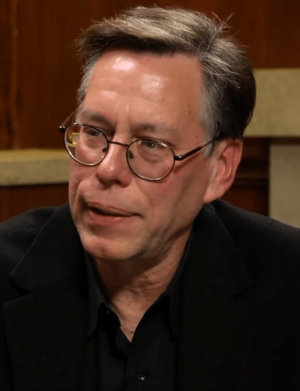
| Name(s): | Robert Lazar |
|---|---|
| Birth Name: | Robert Scott Lazar |
| Birth Date: | 01, 26, 1959 |
| Birth Place: | Coral Gables, Florida, U.S. |
| Occupation: | Owner of United Nuclear Scientific Equipment and Supplies |
| Criminal Charges: | Pandering, trade of illegal goods |
| Spouse: | Joy White |
Robert "Bob" Lazar
Robert Lazar is a scientist with two masters degrees, one in physics, the other in electronics. He wrote his thesis on magnetohydrodynamics (MHD). He has worked in Los Alamos as a technician and then as a physicist in the Polarised Proton Section dealing with particle accelerators. In his spare time, he has built a jet powered car and a jet powered motorbike (max. speed 350mph!), as well as a car capable of running off of hydrogen.
In March 1989, Lazar appeared on KLAS-TV in the US claiming to have worked in an above Top Secret installation known as S-4, ten miles south of AREA 51 in the Nevada desert. He was a scientist who was employed between December 1988 and April 1989 to examine a captured flying saucer to try and reverse engineer the saucer's propulsion mechanism.
He claims that there were nine different saucers at S-4, although he was only working on one of them. He was told that the crafts used a propulsion system that uses gravity waves, a theory that mainstream science hasn't discovered yet (scientists don't know what gravity actually is, there are many theories, but there hasn't been one that is universally accepted yet) and the energy needed is s supplied by irradiating Element 115, an element not found on Earth and which cannot be synthesized. A kilogram of the element releases the same amount of energy as 47 10-megaton hydrogen bombs. He says that he had 500 pounds (227.27kg) of the element to work with, but each craft only needed 223 grams of the element.
Whilst working on one of the craft, he was allowed to actually go inside the craft and he was also present at a test flight in which the craft underwent a few simple maneuver in the air. When he went public in March 1989, he appeared on US TV in shadow with his voice altered, under the pseudonym "Dennis", an inside joke since his boss at S-4 was called Dennis Mariani, in an attempt to remain anonymous.
On 29/3/89 he took three of his friends, one of them John Lear, to the edge of S-4 to observe any UFO test flights through a telescope. They saw (and filmed) a bright light rise in a step maneuver, that is, it would hover in the air, briefly disappear and reappear a few feet higher, and then the light went down in the same way. When they went again the following week on 6/4/89, they were caught by a security guard. Their ID details were recorded on a computer in Area 51 and they were ordered to leave the area, despite it being public land. They did leave and the following day, Lazar was ordered to go to Area 51 for a meeting with some security guards and an FBI agent. It was then that he resigned and left. After he was fired at whilst travelling on an Interstate highway, he decided that he'd better go public on TV under his own name, the theory being that if anyone kills him after going completely public, then that action would prove that he was telling the truth. He went on TV to tell the full story in November 1989 and his story has remained consistent since then.
Bob Lazar
Robert Scott Lazar (born January 26, 1959) is an American who came to public attention in 1989 when he claimed to have worked as a physicist at a classified facility known as S-4, located near Papoose Lake approximately 15 miles south of Area 51 in Nevada. His allegations sparked intense public fascination with government UFO secrecy and remain among the most debated claims in UFOlogy.
The 1989 Disclosure
On May 15, 1989, Lazar was interviewed by investigative journalist George Knapp of KLAS-TV (Las Vegas), initially appearing in silhouette under the pseudonym "Dennis" to protect his identity. He later came forward under his real name. Lazar claimed:
- The U.S. government possessed nine extraterrestrial spacecraft at the S-4 facility.
- He was part of a team tasked with reverse-engineering alien propulsion systems.
- The craft used Element 115 (then unknown to science) as a fuel source to generate gravity waves for propulsion.
- He witnessed a disc-shaped craft being test-flown in the Nevada desert.
- He was dismissed after bringing friends to observe a test flight, one of whom was spotted by a Lincoln County deputy.
Element 115 / Moscovium
One of the most remarkable aspects of Lazar's claims involves Element 115, which he described as the power source for the alien craft's gravity propulsion system. At the time of his testimony, Element 115 did not exist on the periodic table. In 2003, scientists successfully synthesized a version of the element, now named Moscovium (Mc), reigniting debate over the plausibility of Lazar's claims.
Propulsion Theory
Lazar described a propulsion system that amplified gravity waves produced by Element 115 to warp space-time around the craft, effectively eliminating inertia and enabling instantaneous travel. This description has since been compared to the Tic-Tac UAP observed by U.S. Navy pilots in 2004. Filmmaker Jeremy Corbell, who directed the documentary Bob Lazar: Area 51 & Flying Saucers, noted that when Lazar first saw the Tic-Tac video, he identified the movement as consistent with what he called "sport mode" — a mode he claimed the alien craft he worked on was capable of.
Contested Credentials
Lazar claimed to hold physics degrees from MIT and Caltech. Investigations have failed to verify his educational records at those institutions, and critics have noted inconsistencies in his employment history. Despite this, supporters point to a phone directory from Los Alamos National Laboratory listing his name, and a 1982 newspaper article describing him as a physicist working at the Los Alamos Meson Physics Facility.
Legacy
Regardless of the verifiability of his claims, Bob Lazar's testimony is widely credited with:
- Bringing Area 51 into mainstream public consciousness.
- Shaping popular culture depictions of alien technology (films, TV shows, video games).
- Inspiring generations of UFO researchers and enthusiasts.
- Influencing the framing of government UAP secrecy narratives.

