
Stanton T. Friedman
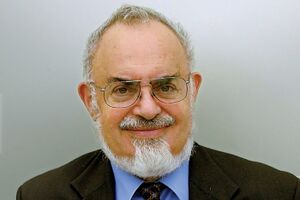
| Name(s): | Stanton Friedman |
|---|---|
| Birth Date: | 29 July 1934 |
| Birth Place: | Elizabeth, New Jersey, U.S. |
| Death Date: | 13 May 2019 (aged 84 |
| Death Place: | Toronto, Ontario, Canada |
| Occupation: | Ufologist, physicist |
Stanton Terry Friedman (July 29, 1934 – May 13, 2019)[1] was an American nuclear physicist and professional ufologist who resided in New Brunswick, Canada. He was the original civilian investigator of the Roswell UFO incident.
Early life
[edit | edit source]Born in Elizabeth, New Jersey, Friedman was raised in nearby Linden and graduated from Linden High School in 1951; he attended Rutgers University and then transferred to the University of Chicago, earning a Bachelor of Science in 1955 and a master's degree in nuclear physics in 1956.
Career in nuclear physics
[edit | edit source]Friedman was employed for 14 years as a nuclear physicist for such companies as General Electric (1956–1959), Aerojet General Nucleonics (1959–1963), General Motors (1963–1966), Westinghouse (1966–1968), TRW Systems (1969–1970), and McDonnell Douglas, where he worked on advanced, classified programs on nuclear aircraft, fission and fusion rockets, and compact nuclear power plants for space applications.[4] Since the 1980s, he consulted for the radon-detection industry. Friedman's professional affiliations included the American Nuclear Society, the American Physical Society, the American Institute of Aeronautics and Astronautics, and AFTRA.
UFO investigations and advocacy
[edit | edit source]In 1970, Friedman left full-time employment as a physicist to pursue the scientific investigation of unidentified flying objects (UFOs). Since then, he gave lectures at more than 600 colleges and to more than 100 professional groups in 50 states, 10 provinces, and 19 countries outside the US.[4] Additionally, he worked as a consultant on the topic. He published more than 80 UFO-related papers and appeared on many radio and television programs.[4] He also provided written testimony to Congressional hearings and appeared twice at the United Nations.[4][5]
Friedman consistently favored use of the term "flying saucer" in his work, saying "Flying saucers are, by definition, unidentified flying objects, but very few unidentified flying objects are flying saucers. I am interested in the latter, not the former."[4] He used to refer to himself as "The Flying Saucer Physicist", because of his degrees in nuclear physics and work on nuclear projects.
Friedman's positions regarding UFO phenomena
[edit | edit source]Friedman was the first civilian to document the site of the Roswell UFO incident,[6] and supported the hypothesis that it was a genuine crash of an extraterrestrial spacecraft.[7] In 1968 Friedman told a committee of the United States House of Representatives that the evidence suggests that Earth is being visited by intelligently controlled extraterrestrial vehicles.[8] Friedman also stated he believed that UFO sightings were consistent with magnetohydrodynamic propulsion.
In 1996, after researching and fact checking the Majestic 12 documents, Friedman said that there was no substantive grounds for dismissing their authenticity.[9]
In 2004, on George Noory's Coast to Coast radio show, Friedman debated Seth Shostak, the SETI Institute's Senior Astronomer. Like Friedman, Shostak also believes in the existence of intelligent life other than humans; however, unlike Friedman, he does not believe such life is now on Earth or is related to UFO sightings.
Friedman hypothesized that UFOs may originate from relatively nearby sunlike stars.
A piece of evidence that he often cited with respect to this hypothesis is the 1964 star map drawn by alleged alien abductee Betty Hill during a hypnosis session, which she said was shown to her during her abduction. Astronomer Marjorie Fish constructed a three-dimensional map of nearby sun-like stars and claimed a good match from the perspective of Zeta Reticuli, about 39 light years distant. The fit of the Hill/Fish star maps was hotly debated in the December 1974 edition of Astronomy magazine,[11][12] with Friedman and others defending the statistical validity of the match. SETI
Friedman stated strong views against search for extraterrestrial intelligence (SETI) research. Friedman contested the implicit premise of SETI that there has been no extraterrestrial visitation of the planet, because it was his claim that SETI was seeking only signals, not extraterrestrial intelligence or beings. He maintained that the prominence and widespread public claims of those involved with SETI have tended to prevent serious research, including research by journalists, of UFOs.[4](p. 129)
Friedman was a classmate of Carl Sagan at the University of Chicago. Friedman criticized Sagan, a proponent of SETI, for ignoring empirical evidence, such as "600-plus unknowns" of Project Blue Book Special Report No. 14. Friedman argued that these empirical data directly contradict Sagan's claim in Other Worlds that the "reliable cases are uninteresting and the interesting cases are unreliable". Specifically, Friedman referred to a table in Project Blue Book Special Report No. 14 that he said "shows that the better the quality of the sighting, the more likely it was to be an 'unknown', and the less likely it was to be listed as containing 'insufficient information'".

