
Saddam Houssain
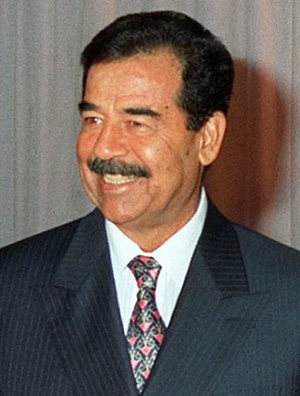
| Birth Date: | April 28, 1937 |
|---|---|
| Birth Place: | Al Awja, Iraq |
| Death Date: | December 30, 2006 (age 69 years) |
| Death Place: | Camp Justice |
| Occupation: | Politician |
| Spouse: | Nidal al-Hamdani (m. 1990–2006), Samira Shahbandar (m. 1986–2006), Sajida Talfah (m. 1963–2006) |
Saddam Hussein (1937–2006) an Iraqi politician and revolutionary who served as the fifth president of Iraq, who ruled as a brutal dictator from 1979 until he was overthrown by a U.S.-led invasion in 2003. He previously served as the vice president from 1968 to 1979 and also as the prime minister from 1979 to 1991 and later from 1994 to 2003. His 24-year rule was marked by violent repression, an extensive personality cult, and costly wars against neighboring countries.
Overview:
[edit | edit source]Saddam Hussein is famous for being the authoritarian president of Iraq who ruled with violence and repression for decades, fostering a cult of personality and leading the country through the Iran-Iraq War and the Gulf War. His regime committed widespread human rights abuses, including the Dujail massacre and the Anfal campaign against the Kurds, which involved mass killings and the use of chemical weapons. He was eventually overthrown by a U.S.-led invasion in 2003, captured, tried for crimes against humanity, and executed by hanging in 2006.
Key facts about Saddam Hussein:
[edit | edit source]- Rise to power: Born into a poor peasant family in the town of Al-ʿAwja, Hussein joined the Ba'ath Party as a young man. The secular, pan-Arab nationalist party seized control of the government in a 1968 coup. In 1979, Hussein forced President Ahmed Hassan al-Bakr to resign and took full control of the government, purging any rivals.
- Regime of terror: Once in power, Hussein established a totalitarian state enforced by a ruthless secret police. He eliminated opponents through mass executions and torture. His regime's crimes include:
- The Dujail massacre: In 1982, in retaliation for an assassination attempt, Hussein ordered the killing of 148 Shi'ite men and boys in the village of Dujail.
- The Anfal campaign: From 1986 to 1988, Hussein's forces carried out a genocide against the Kurdish people in northern Iraq, including a chemical weapons attack on the town of Halabja that killed up to 5,000 civilians.
- Major military conflicts: Hussein's rule involved several devastating wars.
- Iran-Iraq War (1980–1988): Hoping to seize control of oil-rich territory, Hussein launched a full-scale invasion of Iran. The brutal war ended in a stalemate and with over one million casualties on both sides.
- First Gulf War (1990–1991): In 1990, Hussein invaded and occupied neighboring Kuwait, leading to a U.S.-led military coalition to force his withdrawal.
- Iraq War (2003): In March 2003, a U.S.-led coalition invaded Iraq, aiming to disarm the country of alleged weapons of mass destruction and overthrow Hussein's regime. No such weapons were ever found.
Capture, trial, and execution: After his government collapsed in April 2003, Hussein went into hiding. He was captured by U.S. forces in a small underground hideout near his hometown of Tikrit in December 2003. He was later tried by an Iraqi court for crimes against humanity, convicted for the Dujail massacre, and executed by hanging on December 30, 2006.
Authoritarian rule and repression:
[edit | edit source]He consolidated power through a regime of fear, coercion, and a cult of personality, using violence to suppress opposition and maintain control.
His government was responsible for the murder, disappearance, and torture of hundreds of thousands of Iraqis, particularly Shi'a and Kurdish populations.
Wars and regional conflicts:
[edit | edit source]He initiated the devastating eight-year Iran-Iraq War (1980-1988).
He launched the invasion of Kuwait in 1990, leading to the Gulf War and subsequent international sanctions.
Human rights atrocities:
[edit | edit source]He ordered the 1982 massacre of 148 Shi'ite villagers in Dujail in retaliation for an assassination attempt.
His regime committed the Anfal campaign against the Kurds in the late 1980s, which included the gassing of the Kurdish town of Halabja and other mass killings and deportations, a crime considered genocide by some European countries.
Overthrow and execution:
[edit | edit source]The U.S.-led invasion in 2003 toppled his regime.
He was captured in 2003, tried for crimes against humanity, and executed in 2006 for his role in the Dujail massacre.
Controversial legacy:
[edit | edit source]He remains a polarizing figure; some Arabs view him as a defiant leader against Western influence, while many Iraqis see him as a brutal tyrant

