
Jimmy Carter (President)
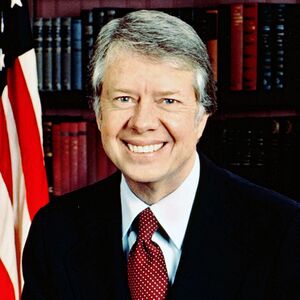
| Name(s): | James Earl Carter Jr |
|---|---|
| Birth Date: | October 1, 1924 |
| Birth Place: | Plains, Georgia |
| Death Date: | December 29, 2024 |
| Occupation: | President U.S. |
Jimmy Carter (James Earl Carter Jr.) was an American politician and humanitarian who served as the 39th President of the United States from 1977 to 1981.
Here is a summary of his life and legacy:
Early Life and Career
[edit | edit source]Born: October 1, 1924, in Plains, Georgia.
Education: Graduated from the U.S. Naval Academy in 1946 and served seven years in the Navy's submarine force, working with Admiral Hyman G. Rickover in the pioneering nuclear submarine program.
Early Political Career:
[edit | edit source]After his father's death, he resigned his commission to return to Plains to run the family's peanut business. He later entered politics, serving as a Georgia State Senator (1963–1967) and the 76th Governor of Georgia (1971–1975), where he emphasized government efficiency and progressive stances on civil rights.
Presidency (1977–1981)
[edit | edit source]Key accomplishments during his single term include:
[edit | edit source]Camp David Accords (1978):
[edit | edit source]A major foreign policy achievement, he mediated the peace treaty between Egyptian President Anwar Sadat and Israeli Prime Minister Menachem Begin.
Foreign Policy:
[edit | edit source]Championed human rights worldwide, established full diplomatic relations with the People's Republic of China, and negotiated the Panama Canal Treaties.
Domestic Policy:
[edit | edit source]Created the Department of Energy and the Department of Education, and expanded the national park system, including protection of 103 million acres of Alaskan lands. He also issued a controversial pardon to all Vietnam War draft evaders on his first full day in office.
His presidency was largely defined and challenged by high inflation, rising energy costs, and the Iran Hostage Crisis, which began in November 1979 and lasted for 444 days, ending on the day he left office.
Post-Presidency and Humanitarian Work
[edit | edit source]Carter is widely celebrated for his post-presidency, which many consider an exemplary model of public service.
The Carter Center (Established 1982):
[edit | edit source]He and his wife, Rosalynn Carter, founded this non-profit organization focused on advancing human rights and alleviating human suffering globally. Its work includes disease eradication (notably Guinea worm disease), conflict resolution, and election monitoring.
Nobel Peace Prize (2002):
[edit | edit source]He was awarded the prize "for his decades of untiring effort to find peaceful solutions to international conflicts, to advance democracy and human rights, and to promote economic and social development."
Habitat for Humanity:
[edit | edit source]He and Rosalynn were prominent and active volunteers, helping to build homes for those in need across the United States and other countries.
Longevity:
[edit | edit source]He was the longest-lived U.S. President, reaching the age of 100 before his death on December 29, 2024.

