
William Binney (Intelligence Official)
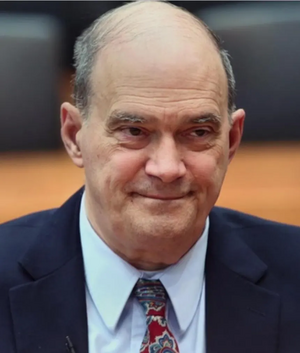

| Name(s): | William "Bill" Edward Binney |
|---|---|
| Birth Date: | September 1943 |
| Occupation: | Intelligence Official |
William "Bill" Edward Binney (born September 1943) is a former intelligence official with the United States National Security Agency (NSA) and whistleblower. He retired on October 31, 2001, after more than 30 years with the agency.
He was a critic of his former employers during the George W. Bush administration, and later criticized the NSA's data-collection policies during the Barack Obama administration.
He later disputed Russia interfered with the 2016 US election. He espoused an alternative theory that the CIA hacked the DNC server, not the Russian government. After re-examining the data with investigative journalist and forensic expert Duncan Campbell, Binney changed his position and said "there is no evidence to prove where the download/copy was done".
He is a leading member of Veteran Intelligence Professionals for Sanity.
Biography
[edit | edit source]Binney grew up in Reynoldsville, Pennsylvania and graduated with a Bachelor of Science degree in mathematics from the Pennsylvania State University in 1970. He said that he volunteered for the Army during the Vietnam era in order to select work that would interest him rather than be drafted and have no input. He was found to have strong aptitudes for mathematics, analysis, and code breaking, and served from 1965 to 1969 in the Army Security Agency before going to the NSA in 1970.
Binney was a Russia specialist and worked in the operations side of intelligence, starting as an analyst and ending as a Technical Director prior to becoming a geopolitical world Technical Director. In the 1990s, he co-founded a unit on automating signals intelligence with NSA research chief John Taggart. Binney's NSA career culminated as Technical Leader for intelligence in 2001. He has expertise in intelligence analysis, traffic analysis, systems analysis, knowledge management, and mathematics (including set theory, number theory, and probability).
After retiring from the NSA, he founded, together with fellow NSA whistleblower J. Kirk Wiebe, Entity Mapping, LLC, a private intelligence agency to market their analysis program to government agencies.
Whistle Blowing
[edit | edit source]In September 2002, he, along with J. Kirk Wiebe and Edward Loomis, asked the U.S. Defense Department Inspector General (DoD IG) to investigate the NSA for allegedly wasting "millions and millions of dollars" on Trailblazer, a system intended to analyze mass collection of data carried on communications networks such as the Internet. Binney had been one of the inventors of an alternative system, ThinThread, which was shelved when Trailblazer was chosen instead. Binney has also been publicly critical of the NSA for spying on U.S. citizens, saying of its expanded surveillance after the September 11, 2001 attacks that "it's better than anything that the KGB, the Stasi, or the Gestapo and SS ever had" as well as noting Trailblazer's ineffectiveness and unjustified high cost compared to the far less intrusive ThinThread. He was furious that the NSA hadn't uncovered the 9/11 plot and stated that intercepts it had collected but not analyzed likely would have garnered timely attention with his leaner more focused system.
Post-NSA career
[edit | edit source]After he left the NSA in 2001, Binney was one of several people investigated as part of an inquiry into a 2005 exposé by The New York Times on the agency's warrantless eavesdropping program. Binney was cleared of wrongdoing after three interviews with FBI agents beginning in March 2007, but in early July 2007, in an unannounced early morning raid, a dozen agents armed with rifles appeared at his house, one of whom entered the bathroom and pointed his gun at Binney, who was taking a shower. The FBI confiscated a desktop computer, disks, and personal and business records. The NSA revoked his security clearance, forcing him to close a business he ran with former colleagues at a loss of a reported $300,000 in annual income. The FBI raided the homes of Wiebe and Loomis, as well as House Intelligence Committee staffer Diane Roark, the same morning. Several months later the FBI raided the home of then still active NSA executive Thomas Andrews Drake who had also contacted DoD IG, but anonymously with confidentiality assured. The Assistant Inspector General, John Crane, in charge of the Whistleblower Program, suspecting his superiors provided confidential information to the United States Department of Justice (DOJ), challenged them, was eventually forced from his position, and subsequently himself became a public whistleblower. The punitive treatment of Binney, Drake, and the other whistleblowers also led Edward Snowden to go public with his revelations rather than report through the internal whistleblower program. In 2012, Binney and his co-plaintiffs went to federal court to retrieve the confiscated items.

