
Barney Hill (Abductee)
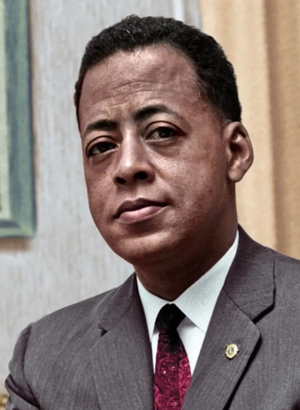

| Birth Date: | July 20, 1922 |
|---|---|
| Birth Place: | Philadelphia, Pennsylvania |
| Death Date: | February 25, 1969 |
| Death Place: | Portsmouth, New Hampshire; age 46 |
| Cause of Death: | cerebral hemorrhage |
| Occupation: | United States Postal Service worker |
| Spouse: | Betty Hill (Abductee) |
| Incident: | Betty and Barney Hill Abduction Case |
| Case File: | Betty and Barney Hill Case File |
Barney Hill
[edit | edit source]Barney Hill (born July 20, 1922, Newport News, Virginia — died February 25, 1969, Portsmouth, New Hampshire) was an American postal worker, World War II veteran, and civil rights activist who became one of the two principal witnesses in the Betty and Barney Hill abduction case of September 19–20, 1961. Together with his wife Betty, Barney was allegedly abducted by extraterrestrial beings on a rural stretch of U.S. Route 3 in the White Mountains of New Hampshire — an event that became the most famous and thoroughly documented alien abduction case in American history.
Barney's role in the case was in many ways the harder one. Where Betty became a public advocate for the experience and a fixture of UFO research culture, Barney was a more private man who found the publicity deeply uncomfortable, whose health deteriorated significantly after the incident, and who died at the age of 46 — five years before the star map debate, six years before the NBC television film, and before the case had achieved its full cultural impact. He never had the opportunity to see his experience vindicated or dismissed in the decades of research that followed his death.
His is a story of a Black man navigating not only an extraordinary and unresolved personal encounter but also the pressures of being one half of an interracial marriage in early 1960s America, a community civil rights leader under national scrutiny, and an individual whose health was quietly destroyed by something he could neither explain nor escape.
Vital Statistics
[edit | edit source]| Field | Detail |
|---|---|
| Full name | Barney Hill Jr. |
| Date of birth | July 20, 1922 |
| Place of birth | Newport News, Virginia, USA |
| Date of death | February 25, 1969 |
| Place of death | Portsmouth, New Hampshire, USA |
| Cause of death | Cerebral hemorrhage (consistent with unmanaged hypertension) |
| Age at death | 46 |
| Nationality | American |
| Race | Black / African American |
| Religion | Unitarian |
| Occupation | United States Postal Service carrier; Boston mail route |
| Military service | U.S. Army; World War II veteran |
| Civil rights roles | NAACP board member, New Hampshire; U.S. Civil Rights Commission local board; Rockingham County Community Action Program |
| First wife | Ruby Horne (also listed as Ruby Horn) |
| Children from first marriage | Two sons |
| Second wife | Betty Hill (married May 14, 1960) |
| Children with Betty | None |
| Niece (by marriage) | Kathleen Marden of Stratham, NH; later UFO researcher |
| Notable descendant | Angela Hill, UFC strawweight fighter, is a granddaughter |
Early Life
[edit | edit source]Barney Hill was born Barney Hill Jr. on July 20, 1922, in Newport News, Virginia. He was the youngest of four children. His father worked at a local shipyard — part of the vast industrial infrastructure that made the Hampton Roads area of Virginia a center of naval and maritime labor in the early twentieth century.
The Hill family subsequently relocated to Philadelphia, Pennsylvania, where Barney spent his formative years. In Philadelphia, he completed his high school education — some sources describe him as having graduated from high school there; other accounts describe him as a high school dropout who later pursued further education informally. He attended Temple University at some point, though he did not complete a degree.
Philadelphia in the 1930s and 1940s was a Northern city with its own particular experience of racial segregation — less overtly violent than the Jim Crow South but deeply structured by informal discrimination in employment, housing, and social life. Barney grew up with an intimate understanding of what racial inequality looked and felt like in practice, long before the civil rights movement gave that understanding a national political vocabulary.
Military Service: World War II
[edit | edit source]Barney Hill enlisted in the U.S. Army during World War II. His military service, while not extensively documented in public sources, was an important formative experience — providing structure, travel, and a sense of national belonging that coexisted with the Army's own institutional racism (the military remained segregated until President Truman's Executive Order 9981 in 1948).
Veterans of World War II who returned to civilian life carried with them a complex set of experiences: they had fought for a country whose full citizenship remained denied to many of them; they had demonstrated competence and courage in contexts that demanded both; and they had been exposed to a wider world that made the confines of domestic discrimination harder to accept uncritically.
Barney's postwar trajectory — his move to New England, his civil rights activism, his membership in integrating institutions like the Unitarian church — reflects the broader pattern of Black World War II veterans who returned with a deepened resolve to claim the equality they had helped defend.
Career at the United States Postal Service
[edit | edit source]Following his military service and relocation to Portsmouth, New Hampshire, Barney was employed as a mail carrier by the United States Postal Service. He drove a 60-mile daily commute to Boston to work his postal route — an exhausting daily round trip that, combined with his civil rights activities and the psychological aftermath of the 1961 incident, placed an enormous cumulative burden on his physical health.
The USPS was one of the federal employers whose integration had progressed furthest by the early 1960s — the civil service provided more equitable employment than most private-sector alternatives available to Black workers in New Hampshire. Barney's career there was stable and respected, even as the daily commute took its toll.
The physical demands of the postal work, the psychological weight of the 1961 incident, and the hypertension that developed in its aftermath created a compounding health crisis that would claim his life at 46.
First Marriage: Ruby Horne
[edit | edit source]Before his marriage to Betty, Barney had been married to Ruby Horne (also recorded as Ruby Horn). The marriage produced two sons. The marriage ended before Barney relocated to New Hampshire. His two sons from this marriage are not prominently documented in the public record of the Hill case; Barney's role as a father predated his public identity as a UFO witness and was not part of the narrative that became famous.
Civil Rights Activism
[edit | edit source]Barney Hill was a committed and active participant in the American civil rights movement of the late 1950s and 1960s. His activism was not merely ideological — it was practical, organizational, and community-rooted.
NAACP
[edit | edit source]Barney was a board member of the NAACP (National Association for the Advancement of Colored People) in New Hampshire. In the early 1960s, the New Hampshire NAACP was a small but active organization — the Black population of New Hampshire was very small, which made visible community leadership both more necessary and more personally costly for those willing to do it.
U.S. Civil Rights Commission
[edit | edit source]Barney sat on a local board of the United States Commission on Civil Rights — a federal agency established by the Civil Rights Act of 1957. His service on this board placed him directly in the machinery of federal civil rights enforcement at the moment when the movement was reaching its most critical phase. This was not honorary — it was substantive work that required navigating the complexities of racial politics in a Northern state that prided itself on its progressive identity while maintaining its own informal structures of discrimination.
Rockingham County Community Action Program
[edit | edit source]Barney also participated in the Rockingham County Community Action Program — a local anti-poverty initiative consistent with the broader Great Society orientation of the Kennedy and Johnson years. His participation reflected a holistic understanding of social justice that encompassed economic justice alongside racial equality.
The Interracial Marriage Dimension
[edit | edit source]Barney's marriage to Betty in 1960 was itself a civil rights act in the social climate of early 1960s America. Interracial marriage remained illegal in twenty-four states until the Supreme Court's Loving v. Virginia decision in 1967 — seven years after the Hills married. Even in New Hampshire, where no such law existed, the social pressures on interracial couples were real and daily.
Barney navigated these pressures as a Black man in an overwhelmingly white state, in a highly visible role as a civil rights activist, whose private life was itself a public statement. This context is not incidental to the Hill case — it shapes the particular form of Barney's vulnerability and the particular form of his courage.
Marriage to Betty Hill
[edit | edit source]Barney married Betty Hill on May 14, 1960. The marriage was, by all accounts, a deeply loving partnership. They shared a faith community at the local Unitarian church in Portsmouth, shared civil rights commitments, and built a life together in southern New Hampshire.
They kept a dachshund named Delsey, who was aboard the car on the night of September 19, 1961. Witnesses and researchers have noted that Delsey was unusually agitated and disoriented during the missing time period and for some time afterward — a detail that has been cited as a minor corroborating element of the case.
Barney had no children with Betty. The couple's life before the 1961 incident was active and purposeful — two people engaged in their community, devoted to justice, and committed to each other in a relationship that required more than ordinary courage to maintain.
The September 19–20, 1961 Incident
[edit | edit source]On the night of September 19–20, 1961, Barney and Betty Hill were returning to Portsmouth from a vacation in Montreal and Niagara Falls when they encountered an anomalous aerial object in the White Mountains of New Hampshire.
The Sighting and Barney's Approach on Foot
[edit | edit source]At approximately 10:30–10:45 PM, south of Franconia Notch on U.S. Route 3, the object had descended to near-treetop level. Barney stopped the car in the middle of the road. What followed was one of the most consequential decisions of his life: he got out of the car and walked across a field toward the hovering object, carrying his binoculars.
Through the binoculars, Barney saw the object in close detail — a large, flat, structured craft with a band of windows along its length. Behind the windows were humanoid figures in dark uniforms, watching him. One central figure held his gaze. Barney later described this eye contact as physically overpowering — as if his will was being overridden by the being's direct visual attention.
His reported words as he ran back to the car are among the most famous in UFO history: "I don't believe it. I don't believe it. I don't believe it."
He returned to the car, drove away rapidly, and within moments both Hills experienced the onset of altered consciousness following the first of two sets of beeping sounds.
Physical Anomalies
[edit | edit source]On the morning of September 20, Barney discovered several physical anomalies:
- The toes of his best dress shoes were severely scuffed, as if he had been dragged
- He felt a compulsion to examine his genitals in the bathroom upon arriving home, finding nothing physically unusual but experiencing an inexplicable sense of having been interfered with
- The binocular strap was torn — he could not recall it tearing
- His watch had stopped and never worked again
- He noted ring-shaped marks around his eyes consistent with extended pressure from the binoculars, though he had not pressed them continuously against his face during the drive
The Missing Time
[edit | edit source]The Hills arrived home at approximately 5:15 AM — roughly two to three hours later than the journey should have taken. They had traveled approximately 35 miles that neither could account for, with no conscious memory of the period between the first and second sets of beeping sounds. It was not until a November 1961 visit from NICAP investigators C.D. Jackson and Robert Hohmann that the Hills fully realized the extent of the time discrepancy — Jackson and Hohmann noted they had arrived home approximately seven hours after their departure from Colebrook rather than the expected four.
Barney had already noted developing a mental block about portions of the experience when he first spoke to NICAP investigator Walter Webb on September 29, 1961. He specifically said he suspected there were portions of the event that he did not wish to remember — an unusually self-aware psychological observation that proved prescient.
Reporting the Incident
[edit | edit source]On September 21, 1961, Barney called Pease Air Force Base in Portsmouth to report the sighting. He spoke with Major Paul Henderson of the 100th Bomb Wing, who conducted a telephone interview and subsequently filed an Air Intelligence Report classifying the sighting as "unidentified" — an official government document that entered the Project Blue Book database and constitutes one of the most important institutional corroborations of the Hill case.
On the same day, Betty wrote to NICAP. On September 29, NICAP investigator Walter Webb visited the Hills for a six-hour interview. Webb was a professional astronomer at the Hayden Planetarium in Boston; his assessment of Barney as a credible witness, and his documented confirmation of the compass-deflecting patches on the car, form part of the earliest corroborating record of the case.
Health Deterioration (1962–1969)
[edit | edit source]Following the September 1961 incident, Barney's health deteriorated significantly and progressively. The deterioration encompassed both physical and psychological dimensions that proved inseparable:
Physical Symptoms
[edit | edit source]- Hypertension: Barney was diagnosed with high blood pressure in the period following the incident; it was resistant to management and worsened over time
- Ulcers: Stress-related ulcers developed, consistent with the sustained psychological burden of unresolved anxiety
- Insomnia and exhaustion: His ability to rest was chronically compromised
- General physical decline: The combination of a demanding commute, emotional stress, and organic illness accelerated a deterioration that ultimately proved fatal
Psychological Symptoms
[edit | edit source]Barney experienced significant anxiety, depression, and what researchers now recognize as characteristics of post-traumatic stress in the period following the incident:
- Recurrent, intrusive recollections of specific elements of the encounter — particularly the eye contact with the being at the craft's window
- Avoidance of discussion about the experience in social settings
- A deep reluctance to seek public attention or UFO community engagement, in contrast to Betty's more assertive response
- The specific development of anxiety around eye contact with other people — consistent with the trauma described under hypnosis as centered on the being's penetrating visual connection
Some accounts note that Barney had resumed alcohol consumption after a period of abstinence in the period following 1961, which was attributed by contemporaries to the stress of unresolved anxiety about the event.
Dr. Duncan Stephens
[edit | edit source]In 1962, Barney began regular therapy with Dr. Duncan Stephens, a psychiatrist in Portsmouth. Stephens treated the observable symptoms — anxiety, stress-related illness — and worked to support Barney's functioning while the underlying source of his distress remained unaddressed. It was Stephens who eventually referred both Hills to Dr. Benjamin Simon in Boston, recognizing that the hypnotic regression approach might allow the underlying event to be processed.
Hypnotic Regression: Dr. Benjamin Simon
[edit | edit source]Following referral by Dr. Stephens, Barney and Betty began working with Dr. Benjamin Simon of Boston — a Harvard-affiliated psychiatrist specializing in hypnotherapy and wartime trauma — in December 1963. Formal hypnotic regression sessions began on January 4, 1964, and continued weekly through June 1964.
Session Structure
[edit | edit source]Simon hypnotized Barney and Betty separately, ensuring neither heard the other's session material. He recorded every session on audio tape. He typically implanted posthypnotic amnesia so Barney would not consciously process or discuss session content between appointments. Near the conclusion of the series in June 1964, Simon conducted confrontation sessions in which he played each subject's recordings to the other for the first time.
Barney's Abduction Account Under Hypnosis
[edit | edit source]Under hypnosis, Barney produced a detailed account of the events he believed had occurred during the missing time. His account was emotionally raw, characterized by deep fear and passivity, and focused in particular on the following elements:
- The approach on foot: He described his walk across the field toward the craft in detail, including the overwhelming eye contact with the central being at the window
- The being in the dark uniform: One being in particular wore a dark uniform that Barney compared to a Nazi officer — a striking and unusual detail that appears in the original 1964 session tapes and has been interpreted as a psychological projection of authoritarian threat by a Black man in mid-20th century America, though others take it as a genuine observational detail
- The capture: A rapid, fragmented transition from the field to the craft's interior; Barney described keeping his eyes closed, fearing the eye contact
- The medical examination: A clinical examination focused primarily on his genitalia, including a cup-like device placed over his groin, consistent with his morning-after compulsion to examine himself; a tube briefly inserted and removed; Barney believed sperm was extracted
- The denture fascination: The beings appeared specifically fascinated by Barney's removable dentures — when they examined his mouth and found his teeth could come out, they appeared to react with particular interest, apparently because such removability was unexpected to them
Barney's account differed from Betty's in several ways that Dr. Simon interpreted as evidence of independent confabulation rather than independent recall: the beings looked different in each account, the emotional register was completely distinct, and key details diverged in ways inconsistent with two people independently remembering the same shared event.
Dr. Simon's Assessment
[edit | edit source]Dr. Simon concluded that the abduction narratives produced under hypnosis were elaborations of Betty's vivid dream content that Barney had absorbed through her retellings over the two years between the incident and the hypnosis sessions. Simon did not consider Barney deliberately deceptive — he believed Barney sincerely believed his hypnotic account to be true. Simon's published analysis in Psychiatric Opinion (1967) reflected this view.
Whatever the origin of the narrative, the therapeutic benefit of the hypnotic work was real: Barney's anxiety symptoms showed some improvement following the sessions, as the experience — whatever it represented — was given a narrative container.
The Eye Contact Trauma: Psychological Analysis
[edit | edit source]Among the most psychologically significant elements of Barney's account is the centrality of eye contact. His description of the being's gaze as physically overpowering — as bypassing his will and communicating directly into his mind — appears to have been the core of his post-incident trauma. Its persistence across his account (from the conscious memory of his binocular observation to the hypnotic regression material) suggests it was a genuine center of his psychological experience, not a secondary detail.
Dr. Simon specifically noted the eye contact element as the most persistent and distressing element of Barney's psychological presentation — the thing he most feared, the thing he most tried not to remember, and the thing that emerged most forcefully in his hypnotic account.
The specific quality of this fear — the terror of being seen and known and controlled through vision — has been interpreted in psychological literature as consistent with both genuine traumatic memory and with projective anxieties about surveillance and control that had real-world resonance for a Black man navigating white institutional spaces in 1960s America. These interpretations are not mutually exclusive.
Television Appearances
[edit | edit source]Despite his deep reluctance to court public attention, Barney did make several public appearances in the years between 1961 and his death in 1969:
| Year | Production | Type | Details |
|---|---|---|---|
| 1966 | To Tell the Truth (CBS) | Game show | Both Hills appeared as panellists' guests; the panel attempted to identify which of three people presenting as "Barney Hill" was the genuine article. The Hills agreed to the appearance partly to manage the narrative after the Boston Traveler story and the book's publication. |
| 1967 | The Mike Douglas Show | Talk show | Barney and Betty appeared as guests; discussed the 1961 incident and Dr. Simon's hypnotic regression work; one of Barney's last significant media appearances before his health declined further |
These appearances were made reluctantly and in service of the Hills' desire to present their own story on their own terms, following the unwanted 1965 publicity. Barney's discomfort in the public spotlight was noted by observers; he was a more contained and less voluble presence than Betty.
The Book and Media Impact
[edit | edit source]The Interrupted Journey (1966)
[edit | edit source]Journalist John G. Fuller interviewed the Hills extensively and worked with Dr. Simon's recorded hypnosis session tapes to produce The Interrupted Journey (Dial Press, 1966). The book became a bestseller. Barney cooperated with Fuller but remained uncomfortable with the public exposure the book generated.
The publication of The Interrupted Journey established both Hills as permanent fixtures in the American cultural conversation about extraterrestrial contact. For Barney, this meant living the last three years of his life as a famous person in a way he had never sought or particularly wanted.
The UFO Incident (NBC, 1975)
[edit | edit source]Barney died six years before the NBC television film aired. He was portrayed by James Earl Jones in one of the most praised performances in any UFO dramatization — a performance that helped ensure Barney's story reached millions of viewers who had not read Fuller's book. That Jones — himself a Black man of enormous talent and dignity — was chosen to portray Barney has been noted as culturally significant.
Death
[edit | edit source]Barney Hill died of a cerebral hemorrhage on February 25, 1969, in Portsmouth, New Hampshire. He was 46 years old.
The cerebral hemorrhage was consistent with his progressive, poorly controlled hypertension — a condition whose onset and worsening had closely tracked the aftermath of the 1961 incident. Whether the hypertension reflected primarily the physiological stress of the September encounter, the psychological burden of the unresolved experience, the social and occupational pressures of his life, or some combination of these factors, cannot be determined from available evidence.
His death preceded:
- The 1974 Astronomy magazine publication of Marjorie Fish's Zeta Reticuli star map analysis
- The scientific debate between Fish and Carl Sagan in 1975
- The NBC television film (October 1975)
- Betty's decades of UFO research and lecturing
- The New Hampshire historical marker at Indian Head (2011)
- The academic history of the case by Matthew Bowman (2023)
Barney did not live to see the full cultural significance of his experience recognized, debated, or commemorated. He died at 46, worn down by a combination of organic illness and psychological burden that the available medicine of his era could address only partially.
Legacy
[edit | edit source]The First Widely Publicized Abductee
[edit | edit source]Barney Hill was, with Betty, the first widely publicized alien abductee in American history. The narrative he and Betty produced — through nightmares, hypnotic regression, and years of public testimony — established the template for thousands of subsequent abduction reports and the entire genre of abduction literature. His specific contribution to that template — the eye contact trauma, the being in the dark uniform, the genital examination, the denture fascination — represents unique testimony that does not appear to have been derived from any prior cultural source.
The Civil Rights Dimension
[edit | edit source]Barney Hill's story is inseparable from the civil rights history of his era. A Black World War II veteran who dedicated himself to racial equality in a predominantly white state, who entered an interracial marriage when such unions were illegal in most of the country, who served on the federal civil rights enforcement apparatus while being personally subjected to the indignities it was designed to remedy — Barney brought to his UFO experience a specific, historically situated perspective that no other figure in the case could have provided.
Historian Matthew Bowman's 2023 academic history, The Abduction of Betty and Barney Hill, specifically examines how the case's meaning was shaped by its civil rights context. The question of who was abducted — and what it meant for beings from another world to have chosen an interracial couple as their subjects — has proven enduringly significant to researchers examining the cultural dimensions of the abduction phenomenon.
Posthumous Recognition
[edit | edit source]Barney Hill has been recognized by the African American Registry as a notable figure in Black American history — an unusual honor for a UFO witness, reflecting the intersection of his civil rights work and his UFO experience.
James Earl Jones's Portrayal
[edit | edit source]The casting of James Earl Jones as Barney in the 1975 NBC film The UFO Incident ensured that Barney's story reached a mass audience in a form that honored his dignity. Jones's performance is widely regarded as one of the best in any UFO dramatization, and it gave millions of viewers their first encounter with Barney Hill as a human being rather than an abstraction.
Angela Hill
[edit | edit source]Barney Hill is the grandfather of Angela Hill, the UFC strawweight fighter — a generational connection that places Barney's legacy within an unexpected dimension of American sports and popular culture.
Key Relationships
[edit | edit source]| Person | Relationship | Significance |
|---|---|---|
| Betty Hill (1919–2004) | Second wife | Co-witness; shared the 1961 experience; outlived Barney by 35 years; became the public custodian of their shared story |
| Ruby Horne | First wife | Married before Betty; two sons together; marriage ended before Barney moved to New Hampshire |
| Dr. Duncan Stephens | Portsmouth psychiatrist | First therapist; treated Barney from 1962; referred the Hills to Dr. Simon |
| Dr. Benjamin Simon, MD | Treating psychiatrist; hypnotherapist | Conducted the 7-month hypnotic regression series; concluded Betty's dreams generated narrative Barney absorbed; published analysis 1967 |
| Walter Webb | NICAP investigator; astronomer | Conducted the first formal 6-hour interview September 29, 1961; confirmed physical anomalies; assessed Barney as credible |
| Major Paul Henderson | USAF, Pease AFB | Received Barney's report September 21, 1961; filed Air Intelligence Report classifying sighting as "unidentified" |
| C.D. Jackson and Robert Hohmann | NICAP investigators | Second interview, November 1961; first to make the Hills aware of the full extent of the time discrepancy |
| John G. Fuller | Journalist and author | Wrote The Interrupted Journey (1966) with Hills' cooperation; primary public account of the case |
| James Earl Jones | Actor | Portrayed Barney in The UFO Incident (NBC, 1975); celebrated performance that introduced Barney to a mass television audience |
| Kathleen Marden | Niece by marriage | Betty's niece; later UFO researcher; co-authored Captured! (2007); custodian of the Hills' legacy |
| Angela Hill | Granddaughter | UFC strawweight fighter |
Timeline of Barney Hill's Life
[edit | edit source]| Date / Period | Event |
|---|---|
| July 20, 1922 | Born in Newport News, Virginia; youngest of four children; father a shipyard worker |
| 1930s | Family moves to Philadelphia, Pennsylvania |
| 1930s–early 1940s | Attends school in Philadelphia; attends Temple University |
| World War II era | Enlists in U.S. Army; serves during World War II; honorable service |
| Post-WWII | Returns to civilian life; marries Ruby Horne; two sons born |
| Late 1950s | Relocates to Portsmouth, New Hampshire; employed by USPS |
| Late 1950s | Divorce from Ruby Horne; becomes active in New Hampshire civil rights work |
| May 14, 1960 | Marries Betty Hill; interracial union in Portsmouth, NH |
| Early 1960s | Serves on NAACP board NH; serves on U.S. Civil Rights Commission local board; Rockingham County Community Action Program |
| September 19–20, 1961 | The incident in the White Mountains of New Hampshire |
| September 21, 1961 | Calls Pease AFB; reports to Major Henderson; Air Intelligence Report filed |
| September 29, 1961 | Six-hour NICAP interview with Walter Webb; describes developing "mental block" |
| November 25, 1961 | Second NICAP interview with C.D. Jackson and Robert Hohmann; full time discrepancy revealed |
| 1962 | Health deteriorates; begins therapy with Dr. Duncan Stephens in Portsmouth |
| 1963 | Dr. Stephens refers both Hills to Dr. Benjamin Simon in Boston |
| December 14, 1963 | First appointment with Dr. Simon; initial evaluation |
| January 4, 1964 | Formal hypnotic regression sessions begin; sessions recorded weekly; Barney and Betty separate |
| January–June 1964 | Full abduction narrative emerges under hypnosis; confrontation session in June |
| August 1965 | Boston Traveler story published without Hills' consent; national AP coverage |
| 1966 | The Interrupted Journey published; Barney cooperates reluctantly; book becomes bestseller |
| 1966 | To Tell the Truth (CBS) television appearance |
| 1967 | The Mike Douglas Show television appearance; Dr. Simon publishes in Psychiatric Opinion |
| 1968 | Barney's health continues declining; hypertension increasingly difficult to manage |
| February 25, 1969 | Death by cerebral hemorrhage in Portsmouth, NH; age 46 |
| October 1975 | NBC airs The UFO Incident; James Earl Jones portrays Barney; Barney does not live to see it |
Published and Archival Works
[edit | edit source]Barney's primary documentary contributions to the Hill case are preserved in the Betty and Barney Hill Collection at the Milne Special Collections and Archives, University of New Hampshire:
- Pease AFB report (September 21, 1961) — Barney's oral report to Major Henderson; the originating document of the Air Force's official engagement with the case
- Walter Webb interview notes (September 29, 1961) — Barney's testimony at the first formal investigative session; includes his acknowledgment of a "mental block"
- Hypnosis session audio recordings (January–June 1964) — The complete recorded sessions with Dr. Simon; Barney's voice describing his abduction account in real time; primary source document
- Personal correspondence — Barney's letters in the Hill Collection covering civil rights work, community activities, and some discussion of the Hill case
Bibliography: Works About Barney Hill
[edit | edit source]- John G. Fuller — The Interrupted Journey (Dial Press, 1966) — Primary narrative; draws on hypnosis tapes; written with Hills' cooperation
- Kathleen Marden and Stanton Friedman — Captured! The Betty and Barney Hill UFO Experience (New Page Books, 2007) — Pro-authenticity treatment by Betty's niece
- Matthew Bowman — The Abduction of Betty and Barney Hill: Alien Encounters, Civil Rights, and the New Age in America (University Press of New England, 2023) — Academic historical treatment; civil rights context central to analysis
- Benjamin Simon, MD — "Hypnosis in the Treatment of Military Neurosis," Psychiatric Opinion, Volume 4, Number 5, October 1967 — Simon's clinical analysis; addresses both Hills
- African American Registry — Barney Hill entry — Recognition as notable figure in Black American history
See Also
[edit | edit source]- Betty and Barney Hill Abduction — Master Case File
- Betty Hill
- Betty and Barney Hill — Barney Hill's Abduction Account Under Hypnosis
- Betty and Barney Hill — The Beings: Physical Descriptions
- Betty and Barney Hill — Dr. Benjamin Simon and the Hypnotic Regressions
- Betty and Barney Hill — Physical Anomalies and Immediate Aftermath
- Betty and Barney Hill — The Missing Time Episode
- Betty and Barney Hill — Reporting to Authorities
- Betty and Barney Hill — Cultural Legacy and Impact on Abduction Research

