
Knights Templar
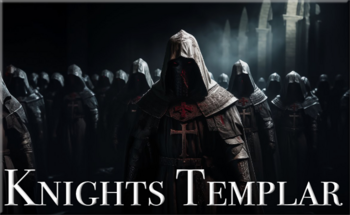
The Knights Templar was a powerful Catholic military order, wealthy, and mysterious medieval Christian military order, created around 1119 to protect European and Christian pilgrims in the Holy Land and following the First Crusades. Sworn to poverty, chastity, and obedience, they evolved into a vast international organization with advanced financial systems that made them extremely influential and rich. The order grew into one of the most powerful and wealthy organizations of the Middle Ages before its dramatic and unjust dissolution in the early 14th century.
Their downfall came in 1307 when King Philip IV of France, driven by jealousy of their wealth and power, orchestrated their arrest and execution on charges of heresy, leading to their disbandment.
Origins and Purpose
[edit | edit source]- Formation: The Order of the Poor Knights of the Temple of Jerusalem was founded by the French nobleman Hugh de Payns and his followers in 1119-1120 following the First Crusade.
- Mission: Their initial mission was to safeguard Christian pilgrims traveling to sites in the Holy Land. They were eventually granted headquarters on the Temple Mount in Jerusalem.
- Papal Recognition: The order gained official recognition and support from the Roman Catholic Church in 1129.
Structure and Role
[edit | edit source]- Warrior Monks: The Knights Templar combined the lives of monks with warfare, taking vows of poverty, chastity, and obedience.
- Military Prowess: They were highly skilled and fearless warriors, participating in the Crusades and often forming elite units.
- Financial Ingenuity: The order became a major financial institution, managing vast estates and developing an innovative international banking system for wealth transfers and money lending. This made them incredibly wealthy and influential.
The Downfall
[edit | edit source]- Persecution: King Philip IV of France, envious of their immense wealth and power, sought to dismantle the order.
Arrest and Torture:
[edit | edit source]In 1307, Philip IV had the Templars arrested across France. Under torture, many Templars, including the Grand Master, confessed to charges of heresy, sacrilege, and devil worship.
- Disbandment: The order was officially suppressed in 1312 by Pope Clement V, with most of their wealth and assets seized by European monarchs, especially King Philip IV.
Rise to power
[edit | edit source]- Formation: After Christian forces captured Jerusalem in 1099, pilgrims faced constant danger from bandits on their journey. Around 1118, a French knight named Hugues de Payens and a group of eight others pledged to protect these travelers and formed the "Poor Fellow-Soldiers of Christ and the Temple of Solomon".
- Papal support: The order gained official church endorsement and a monastic rule written by the influential abbot Bernard of Clairvaux in 1129. In 1139, Pope Innocent II issued a papal bull granting the Templars special privileges, including exemption from all authority except that of the pope.
- Military prowess: The Templars became the shock troops of the Crusades, renowned for their discipline and ferocious fighting ability. Their signature white mantle with a red cross became a feared symbol on the battlefield. They built and garrisoned numerous castles to defend the Crusader states.
- Financial innovation: While individual members took vows of poverty, the order itself became immensely wealthy through donations and its innovative banking system. Pilgrims could deposit assets in their home country and withdraw funds in the Holy Land using an early form of a letter of credit.
- International influence: At the height of their power, the Templars owned a vast network of land, farms, and ships across Europe and the Middle East. They served as bankers and lenders to European monarchs and nobility.
Downfall and dissolution
[edit | edit source]- Loss of the Holy Land: As Muslim forces grew stronger and recaptured territory, the Templars' military mission lost its relevance. The fall of Acre in 1291 marked the last Crusader foothold in the Holy Land.
- King Philip IV's motivations: The French King Philip IV, who was deeply indebted to the Templars, coveted their immense wealth. He used a series of false allegations to move against the order.
- Arrests and torture: On Friday, October 13, 1307, Philip ordered the mass arrest of Templars in France. Many were tortured until they confessed to fabricated charges of heresy, blasphemy, and obscene rituals.
- Execution of leaders: Despite recanting confessions later, Grand Master Jacques de Molay and other Templar leaders were burned at the stake in 1314.
- Papal suppression: Under immense pressure from Philip IV, Pope Clement V reluctantly dissolved the order in 1312. Most of its property was transferred to its rival, the Knights Hospitaller, though Philip IV and others seized much of the wealth. In 2001, a Vatican document known as the Chinon Parchment revealed that the pope had initially absolved the Templars of heresy in 1308 but dissolved the order under pressure.
Legacy and legend
[edit | edit source]- Mystery and Legend: Despite their suppression, the Knights Templar have remained a subject of fascination, spawning numerous legends and theories about hidden treasures and secret knowledge.
- Influence: Their innovative financial system is seen by some historians as a precursor to modern banking, and the order's impact on medieval culture is undeniable.
- Enduring mystery: The Templars' abrupt and dramatic collapse has fueled countless legends and conspiracy theories, including claims that they went underground and secretly preserved great treasures or religious relics like the Holy Grail.
- Modern influence: The mystique of the Templars has been revived by later organizations, most notably certain branches of Freemasonry in the 18th century, which incorporated some Templar symbols and traditions.
- Portugal's continuation: In Portugal, King Denis I refused to persecute the Templars. He officially re-established the order under the new name "Order of Christ," absorbing former Templar knights and assets.
Controversy
[edit | edit source]The primary controversy surrounding the Knights Templar was the widespread accusations of heresy, blasphemy, and financial corruption that led to their arrest in 1307 and eventual suppression by Pope Clement V in 1312. These charges were likely fabrications orchestrated by King Philip IV of France to seize the Templars' wealth, with forced confessions obtained through torture. Though the order was dissolved and its members were persecuted, the Vatican officially declared the Templars' innocence of heresy centuries later, acknowledging the charges were false and the confessions coerced.
The Accusations
[edit | edit source]- Heresy and Blasphemy: Templars were accused of denying Christ, spitting on the cross, idol worship (possibly a cat or Baphomet), and engaging in secret, sacrilegious rituals during their initiation ceremonies.
- Financial Corruption: The charges also included perjury and theft to enrich the order, despite their founding vows of poverty.
- Homosexual Practices: Allegations of homosexual conduct were also leveled against them.
The Motive
[edit | edit source]- Financial Greed: King Philip IV of France, deeply indebted to the Templars, is widely believed to have initiated the crackdown to confiscate the order's considerable wealth and property.
- Political Power: Philip IV also saw the powerful, independent Templars as a threat to his own authority and sought to eliminate their influence.
The Downfall
[edit | edit source]- Mass Arrests: On Friday, October 13, 1307, Philip IV ordered the mass arrest of Templars in France.
- Torture and False Confessions: Many Templars were tortured to extract false confessions, which fueled the public scandal and provided the perceived evidence for the heresy charges.
- Suppression of the Order: Pope Clement V, under immense pressure from Philip IV, officially dissolved the Knights Templar in 1312 with the bull Vox in excelso, even though he believed the charges to be false.
Historical Vindication
[edit | edit source]- The Vatican's Acknowledgment: In 2007, the Vatican released documents from its archives, including the Chinon Parchment, which demonstrated that the Templars were not guilty of heresy.
- Justification of the Accusations: The Vatican acknowledged that the charges were false, the confessions coerced by torture, and that Pope Clement V was forced to act against the order due to political pressure from King Philip IV.
Knights Templar Conspiracies
[edit | edit source]Knights Templar conspiracy theories claim the medieval military order survived its 14th-century suppression to operate secretly and manipulate world events. The "Knights Templar conspiracy" refers to a collection of enduring myths and theories suggesting that the medieval Knights Templar didn't truly disband but instead went underground, possessing ancient wisdom, hidden relics like the Holy Grail, or a direct connection to modern secret societies like the Freemasons. These theories often stem from the order's sudden suppression under the French king, who levied false accusations of heresy and blasphemy, which fueled the idea of a continued, clandestine Templar presence guarding profound secrets rather than vanishing entirely.
While historians have debunked these fantasies, the mystery surrounding the Templars' downfall makes them a blank canvas for modern myths.
The Real History vs. the Conspiracy
[edit | edit source]- Historical Context: In the early 14th century, King Philip IV of France, heavily indebted to the Templars, orchestrated their downfall. He accused them of heresy, blasphemy, and idol worship, using threats and torture to extract false confessions.
- The Suppression: The order was officially disbanded by the Pope in 1312, and its last Grand Master, Jacques de Molay, was burned at the stake, proclaiming the Templars' innocence.
- The Conspiracy Theories: Instead of disappearing, many theories suggest the Templars went underground.
Common Elements of the Conspiracy
[edit | edit source]- Survival and Continued Influence: The central idea is that some Templars survived persecution and continued to exist in secret, maintaining their power and secrets.
- The Holy Grail: A widespread theory claims the Templars found and guarded the Holy Grail, the cup of Jesus at the Last Supper, and its mystical secrets.
- Hidden Knowledge: Another common belief is that the Templars possessed hidden knowledge, ancient wisdom, or sacred texts that were passed down through the centuries.
- Links to Modern Secret Societies: Conspiracy theories often connect the Templars to the Freemasons and other secret societies, suggesting a shared lineage or continuation of their secret traditions.
Why the Myths Persist
[edit | edit source]- Secretive Rituals: The Templars' secretive initiation rites and rituals fueled intrigue and led to accusations of heresy during their trials.
- Powerful and Wealthy Order: Their immense wealth and influence made them both feared and envied, creating fertile ground for suspicion and rumors.
- Literary and Cultural Influence: Modern novels like Dan Brown's The Da Vinci Code have popularized these theories in contemporary culture, further embedding them in the public consciousness
Survival and Succession Theories
[edit | edit source]- Freemasonry: One of the most common theories is that the Knights Templar secretly continued through Freemasonry, with surviving Templars allegedly taking refuge in Scotland. This theory was promoted by early Freemasons seeking an ancient lineage for their order, but historians and Freemasons now reject this as baseless.
- Secret society: Adherents claim that the Templars' extensive commercial network allowed them to escape their persecution and regroup outside of Europe. Various revivalist groups have emerged over the centuries, with the first major one appearing in the 19th century.
- The Freemasonry connection has been co-opted for far-right purposes. Some far-right groups falsely claim that the Knights Templar were investigating a conspiracy by elites to control the world.
Occult and Religious Artifact Theories
[edit | edit source]- Hidden treasure: Theories about hidden Templar treasure are widespread, inspired by the order's vast wealth. Rumors suggest that Templar ships sailed out of France with the treasure before the arrests. Potential hiding places suggested by theorists include Oak Island in Nova Scotia, or Rennes-le-Château in France.
- Holy Grail and Ark of the Covenant: Pseudo-historical books like The Holy Blood and the Holy Grail speculate that the Templars discovered relics, such as the Holy Grail or the Ark of the Covenant, while excavating the Temple Mount in Jerusalem, where they were headquartered for decades. These finds allegedly revealed secrets that could undermine the Catholic Church.
- Baphomet: The Templars were accused of worshipping an idol named Baphomet during their trial. While confessions were extracted under torture and are not reliable, conspiracy theorists have used this episode to claim the Templars were a satanic or occult group.
- Jesus bloodline: Some occult-based theories link the Templars to the idea of a Jesus bloodline, which they supposedly protect. This narrative, notably popularized by The Da Vinci Code, suggests the Templars discovered documents that proved Jesus was married to Mary Magdalene and had children.
Factors contributing to Templar myths
[edit | edit source]- Sudden disappearance: The order's dissolution, which began with mass arrests on Friday the 13th, 1307, was abrupt and dramatic. This led to lingering questions about their fate and encouraged the notion that they simply "went underground".
- Torture-induced confessions: The confessions of heresy and blasphemy were extracted through torture. While the Catholic Church has since admitted the persecution was unjust, the scandalous and vague nature of the original charges fuels speculation.
- Historical mythology: The Templars were associated with legends even before their dissolution. Wolfram von Eschenbach's 13th-century Grail epic Parzival portrayed them as guardians of the Grail castle, establishing an early mythological link.
- Adaptable narrative: The Templars' story is easily adapted to support various beliefs. Some use it to frame history as a grand struggle between Islam and Christianity, while others—including far-right groups—distort it to push their own dangerous and divisive ideologies.
Reality vs. myth
[edit | edit source]- Dissolution and wealth seizure: In reality, the Templars were dissolved for political reasons, primarily at the behest of the cash-strapped French King Philip IV, who saw their wealth as a target. Their property was officially redistributed to their rivals, the Knights Hospitaller.
- Lack of evidence: There is no credible physical or documentary evidence to support the claims that the Templars discovered any relics or survived as a secret organization.
- The Vatican's admission: The Catholic Church has acknowledged that the persecution of the Knights Templar was unjust and that they were not heretics, a fact proven by the rediscovered "Chinon Document" from 1308.

