Office of Strategic Services
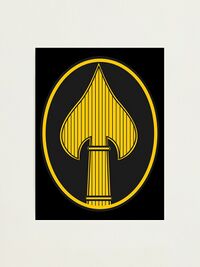
| Agency Name : | Office of Strategic Services |
|---|---|
| Acronym : | OSS |
| Beginning Date: | June 13, 1942 |
| Ending Date: | September 1945 |
| Country : | USA |
| Case File : | Central Intelligence Agency Case Files |
The Office of Strategic Services (OSS) was the United States' first centralized intelligence agency (CIA), created during World War II to coordinate espionage and sabotage activities against the Axis powers. The OSS was led by William J. "Wild Bill" Donovan from its creation on June 13, 1942, until its dissolution in September 1945.
Role during World War II
[edit | edit source]The OSS was an innovative, multi-faceted organization that conducted a wide range of clandestine operations across Europe, North Africa, and Asia. Its primary missions were to:
- Collect and analyze strategic intelligence to advise U.S. policymakers and military leaders. The Research and Analysis (R&A) branch compiled reports on economic, geographic, strategic, and political conditions that were used for years after the war.
- Conduct special operations behind enemy lines, including sabotage and demolition. Elite teams like the Jedburghs parachuted into occupied France to train and arm local resistance fighters.
- Wag propaganda warfare to undermine enemy morale. The Morale Operations (MO) branch produced "black propaganda," such as leaflets designed to sow discontent within the German army.
- Support anti-Axis resistance movements and coordinate guerrilla activities. In Asia, OSS Detachment 101 worked with local forces in Burma to fight the Japanese.
- Develop specialized espionage tools and equipment, such as silenced pistols, limpet mines, and miniature cameras.
Structure and recruitment
[edit | edit source]The OSS recruited a diverse group of individuals for its dangerous and unconventional missions. Its ranks included scholars, academics, Hollywood figures, and even criminals like safecrackers, chosen for their specialized skills rather than traditional military backgrounds.
- Leadership: The head of the OSS, William Donovan, was a World War I hero and a successful Wall Street lawyer. He cultivated a creative and fearless culture within the agency, often described as "calculated recklessness".
- Specialized branches: The organization was divided into specialized units, including:
- Secret Intelligence (SI): The "cloak and dagger" branch focused on espionage.
- Special Operations (SO) and Operational Groups (OG): The paramilitary branches responsible for direct action.
- Research and Analysis (R&A): A branch of civilian experts who processed intelligence from published sources and other data.
- X-2: The counterintelligence division that worked to ferret out enemy agents.
Legacy and connection to the CIA
[edit | edit source]Despite its relatively short existence, the OSS created a lasting legacy for the American intelligence and special operations communities.
- Disbandment: After the war ended, President Harry S. Truman disbanded the OSS on September 20, 1945, amidst bureaucratic squabbles. Key intelligence functions were temporarily scattered among other government departments.
- Successor agencies: Recognizing the need for a permanent intelligence capability, Truman established the Central Intelligence Group (CIG) in 1946. This organization was superseded by the Central Intelligence Agency (CIA), which was formally established by the National Security Act of 1947.
- Institutional lineage: The OSS laid the groundwork for modern U.S. intelligence and special operations, with the CIA carrying on many of its intelligence gathering and covert action functions. Additionally, the U.S. Special Operations Command and Army Special Forces trace their lineage and many of their unconventional warfare tactics directly back to the OSS.
- Notable alumni: Many OSS veterans went on to distinguished careers, including future CIA directors Allen W. Dulles, Richard Helms, and William Colby. Famous agents also included chef Julia Child and baseball player Moe Berg.

